The types of angels meaning in the bible is a fascinating topic for readers interested in the spiritual world described in Scripture. Angels appear throughout the Bible as heavenly beings connected with messages, protection, worship, judgment, and the fulfillment of God’s purposes. However, the Bible does not provide one simple chart listing every type of angel and its exact responsibilities.
Understanding the types of angels meaning in the bible requires examining different angelic beings and titles mentioned across biblical books. Some angels are described as messengers, while others are associated with worship, divine presence, protection, or spiritual conflict. Over time, Jewish and Christian traditions developed additional ideas about angelic hierarchies, making it important to separate direct biblical descriptions from later interpretations.
Quick Answer: What Are the Types of Angels in the Bible?
The types of angels meaning in the bible refers to different heavenly beings and angelic roles mentioned in Scripture. Major biblical categories include angels, archangels, cherubim, seraphim, and living creatures, each associated with different symbolic roles such as delivering messages, worship, protection, and divine service.
What Does Angel Mean in the Bible?
The word angel generally means messenger.
In the biblical world, angels are heavenly beings who carry out divine purposes. They may deliver important messages, provide guidance, protect people, participate in heavenly worship, or appear in visions connected with judgment.
Angels are created beings and should not be confused with God.
Their authority and power are understood as coming from God, and their primary purpose is connected with divine service.
The meaning of angels therefore goes beyond the popular image of winged human figures. Biblical descriptions are often more complex and sometimes symbolic.
Types of Angels Meaning Table
| Angelic Type | Main Biblical Association | Common Symbolism |
|---|---|---|
| Angels | Messages and divine service | Guidance and communication |
| Archangels | Leadership among angels | Spiritual authority |
| Cherubim | Sacred protection | Holiness and divine presence |
| Seraphim | Heavenly worship | Purity and devotion |
| Living Creatures | Divine throne visions | Worship and divine majesty |
The Origin and History of Angels in the Bible
Belief in heavenly beings was part of the ancient religious world.
The Bible contains references to angels from early narratives through prophetic visions and New Testament writings.
The Hebrew Bible presents angels as servants and messengers connected with God’s activity in the world.
Later Jewish thought developed greater interest in the names, ranks, and responsibilities of angels.
Christian traditions continued this interest and eventually developed detailed systems describing angelic hierarchies.
However, many popular descriptions of nine levels or ranks of angels come from later theological traditions rather than from a single biblical passage.
Origin and History Table
| Period | Development |
|---|---|
| Early biblical period | Angels appear as messengers and servants |
| Prophetic writings | More detailed heavenly visions |
| Second Temple Judaism | Increased interest in angelic beings |
| Early Christianity | Angels connected with salvation and spiritual conflict |
| Later tradition | Detailed angelic hierarchies developed |
Ordinary Angels and Their Role
The most common angelic beings in the Bible are simply called angels.
Their roles vary depending on the situation.
They may bring messages, provide guidance, announce important events, or carry out divine instructions.
Some biblical stories also connect angels with protection.
The central idea is service.
Angels are not presented as independent spiritual powers acting according to personal desires. Their purpose is connected with carrying out divine will.
This role makes ordinary angels an important part of understanding the types of angels meaning in the bible.
Archangels in the Bible
The term archangel generally means a chief or leading angel.
Michael is specifically identified as an archangel in the New Testament and is associated with spiritual conflict and protection.
Gabriel is another major angelic figure in biblical tradition, although the Bible does not directly call him an archangel.
Later religious traditions often group Michael and Gabriel among the highest-ranking angels.
The biblical evidence about angelic ranks remains limited.
For this reason, readers should distinguish between what Scripture directly states and what later traditions developed.
Cherubim: Guardians of Sacred Space
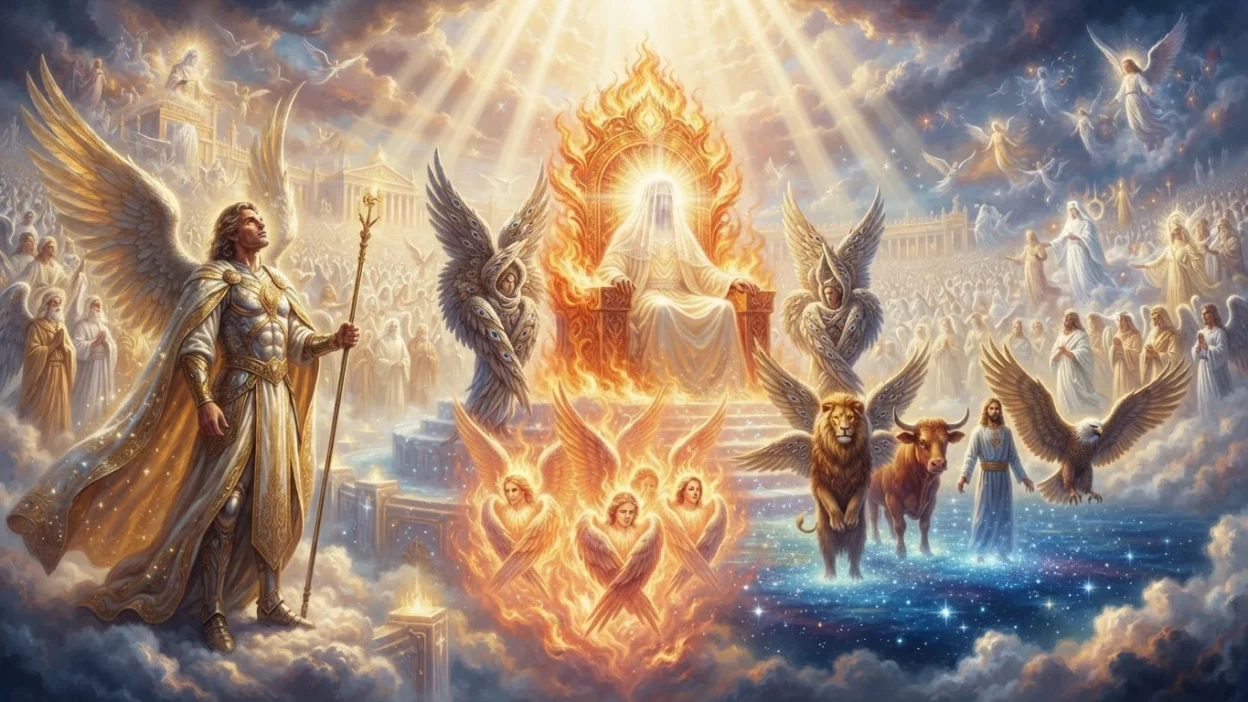
Cherubim are among the most distinctive heavenly beings described in Scripture.
They are associated with guarding sacred space and representing the divine presence.
Cherubim appear in important biblical settings connected with the Garden of Eden and the sacred worship traditions of Israel.
They are also associated with the Ark of the Covenant.
Biblical visions suggest that cherubim are not simply small winged children, despite how they are sometimes portrayed in modern art.
Their imagery is much more powerful and mysterious.
Symbolically, cherubim represent:
- Divine holiness
- Sacred protection
- God’s presence
- The boundary between ordinary and sacred space
Seraphim and Their Spiritual Meaning
Seraphim appear in the prophetic vision of Isaiah.
They are closely connected with worship and the holiness of God.
The name seraphim is often associated with burning or fiery beings.
Their imagery emphasizes purity, spiritual intensity, and complete devotion to God.
The seraphim symbolize the overwhelming holiness and majesty of the divine presence.
Their role in heavenly worship also represents the idea that all creation ultimately exists under divine authority.
For many readers, seraphim are among the most spiritually symbolic categories within the types of angels meaning in the bible.
The Living Creatures in Biblical Visions
The Bible also describes mysterious living creatures in prophetic and apocalyptic visions.
These beings appear in visions connected with the divine throne and heavenly worship.
Their descriptions can be highly symbolic and contain imagery that is difficult to compare with ordinary human or animal forms.
The living creatures are often associated with:
- Divine majesty
- Heavenly worship
- Creation
- Spiritual authority
- The throne of God
Some traditions attempt to connect these beings with other angelic categories, but the Bible does not always provide simple definitions.
Their mysterious appearance reminds readers that biblical visions often use symbolic imagery.
The Spiritual Meaning of Different Types of Angels
The spiritual meaning of the types of angels meaning in the bible goes beyond identifying different heavenly beings.
Each category can symbolize an important spiritual idea.
Angels Symbolize Guidance
Their role as messengers represents communication and divine direction.
Archangels Symbolize Courage
Their leadership can symbolize strength and faithfulness during spiritual conflict.
Cherubim Symbolize Holiness
Their connection with sacred spaces represents respect for the divine presence.
Seraphim Symbolize Purity
Their fiery imagery represents spiritual cleansing and complete devotion.
Living Creatures Symbolize Worship
Their presence around the divine throne represents reverence and recognition of divine majesty.
Together, these images create a rich spiritual picture of service, worship, protection, and divine authority.
Symbolic Meaning of Angels in the Bible
Angels can also be understood symbolically.
They often represent the connection between the heavenly and earthly worlds.
Their appearance can symbolize guidance during uncertainty or the presence of divine purpose in human history.
Different angelic images can represent:
- Light as spiritual understanding
- Wings as divine service and heavenly movement
- Fire as purity and transformation
- Protection as spiritual security
- Messages as guidance and revelation
These symbolic interpretations help explain why angels remain important in religious thought and culture.
Types of Angels Compared
| Type | Main Role | Biblical Association | Symbolic Meaning |
|---|---|---|---|
| Angels | Messengers and servants | Divine communication | Guidance |
| Archangel | Leading angelic figure | Spiritual conflict | Courage |
| Cherubim | Guardians | Sacred presence | Holiness |
| Seraphim | Heavenly worship | Divine holiness | Purity |
| Living Creatures | Throne worship | Heavenly visions | Majesty |
This comparison provides a simple overview of the major categories commonly discussed in relation to the types of angels meaning in the bible.
Why Do People Search for Types of Angels Meaning in the Bible?
People search for this topic because angels are among the most mysterious figures in Scripture.
Readers often want to know:
- How many types of angels are mentioned in the Bible?
- What is the difference between cherubim and seraphim?
- Are archangels higher than other angels?
- What do angels symbolize spiritually?
- Do angels protect people?
- What do biblical angels actually look like?
Modern films, books, and social media have also increased public interest in angelic beings.
However, popular images of angels are often very different from the descriptions found in biblical visions.
Common Misconceptions About Biblical Angels
One major misconception is that all angels look like humans with white robes and feathered wings.
Biblical descriptions are far more diverse.
Another misconception is that cherubim are always small children with wings.
The biblical cherubim are powerful heavenly beings associated with sacred protection.
People also sometimes assume that the Bible provides a complete and detailed hierarchy of every angelic rank.
The famous system of nine orders of angels comes largely from later Christian theological traditions.
It is also incorrect to treat angels as equal to God.
In the Bible, angels are created servants who operate under divine authority.
Angels in Jewish and Christian Tradition
Angels are important in both Jewish and Christian religious traditions.
Jewish writings often describe angels as messengers and servants connected with God’s work.
Christian traditions continue these ideas while also connecting angels with major events in the life of Jesus and the future hope described in Revelation.
Different religious communities may interpret angelic beings differently.
Some emphasize literal spiritual beings, while others focus more strongly on symbolic meaning.
Despite these differences, angels remain powerful symbols of divine service and heavenly reality.
Cultural and Modern Usage of Angel Types
Today, angels appear throughout popular culture.
They are found in movies, television, books, artwork, jewelry, and online discussions.
Modern culture often presents angels as personal guardians or beautiful winged humans.
These images may be inspired by religious traditions, but they do not always match biblical descriptions.
Interest in the types of angels meaning in the bible has increased because people want to separate biblical information from popular myths.
This makes careful study especially important.
How to Understand Angels in the Bible
The best way to study angels is to examine each biblical passage in its context.
Readers should avoid assuming that later traditions automatically represent direct biblical teaching.
A helpful approach includes:
- Reading the full biblical passage
- Considering the literary context
- Distinguishing symbolic visions from historical narratives
- Comparing related passages
- Separating Scripture from later traditions
This approach allows readers to appreciate the richness of biblical angelic imagery without adding unsupported details.
The Lasting Importance of Biblical Angels
The types of angels meaning in the bible remains important because angels represent major spiritual themes.
They remind readers of divine service, worship, guidance, holiness, and the struggle between good and evil.
Different angelic beings contribute different symbols to the biblical story.
Cherubim emphasize sacred protection.
Seraphim emphasize purity and worship.
Archangels symbolize leadership and courage.
Ordinary angels represent divine messages and service.
Together, these heavenly beings create a powerful picture of a spiritual reality centered on divine authority.
Final Thought
The types of angels meaning in the bible reveals that biblical angels are far more diverse and mysterious than many popular images suggest. Scripture describes heavenly beings connected with messages, protection, worship, sacred presence, and spiritual conflict. Angels serve as messengers, cherubim represent sacred guardianship, seraphim symbolize purity and worship, and archangelic figures are associated with spiritual leadership.
The Bible does not provide a complete modern-style hierarchy, so readers should distinguish direct biblical teaching from later traditions. The deeper spiritual meaning of angels points toward guidance, devotion, courage, holiness, and divine authority. Their lasting importance comes from the powerful symbols they provide for understanding the relationship between the heavenly world and human faith.
FAQs
1. How many types of angels are mentioned in the Bible?
Major categories commonly discussed include angels, archangels, cherubim, seraphim, and living creatures.
2. What is the difference between cherubim and seraphim?
Cherubim are mainly associated with sacred protection and divine presence, while seraphim are associated with heavenly worship and purity.
3. Is Michael an archangel?
Yes. Michael is specifically identified as an archangel in the New Testament.
4. Are all biblical angels described with wings?
No. The Bible contains different descriptions of heavenly beings, and not every angel is described in the same way.
5. What do angels symbolize spiritually?
Angels can symbolize guidance, protection, divine service, holiness, worship, and spiritual courage.
6. Are the nine orders of angels listed in the Bible?
No. The detailed nine-order hierarchy developed mainly through later Christian theological tradition.
7. Why are angels important in the Bible?
Angels are important because they appear as heavenly servants involved in messages, worship, protection, judgment, and divine purposes.