The descendants of cain meaning in the bible is a topic that attracts readers who want to understand the family line of Cain and its importance in the Book of Genesis. Cain, the first son of Adam and Eve mentioned in Scripture, is remembered primarily for killing his brother Abel. However, Genesis also provides information about Cain’s descendants and their contributions to the early development of human society.
Understanding the descendants of cain meaning in the bible requires looking beyond Cain’s individual actions. His family line includes people connected with early cities, livestock, music, and metalworking. The story raises important questions about human civilization, sin, responsibility, family history, and the relationship between human achievement and moral character.
Quick Answer: What Do the Descendants of Cain Mean in the Bible?
The descendants of cain meaning in the bible refers to the family line that came from Cain after he left his original home. Genesis connects Cain’s descendants with the development of early human culture, including city-building, livestock care, music, and metalworking. Spiritually, the story can symbolize the contrast between human progress and the need for moral responsibility.
Who Was Cain in the Bible?
Cain was the first son of Adam and Eve mentioned in Genesis.
He worked as a farmer, while his brother Abel cared for livestock.
The relationship between the two brothers became one of the earliest examples of conflict and violence in the biblical story.
Cain later killed Abel, an event that had serious consequences for his relationship with God and his family.
Afterward, Cain became associated with wandering and separation.
However, his story did not end with punishment.
Genesis explains that Cain continued his life and established a family line.
This background is essential for understanding the descendants of cain meaning in the bible.
Descendants of Cain Meaning Table
| Aspect | Meaning |
|---|---|
| Cain | Son of Adam and Eve |
| Main family line | Descendants listed in Genesis 4 |
| Major contribution | Early development of human society |
| Important themes | Civilization, responsibility, violence, progress |
| Spiritual symbolism | Human achievement requires moral accountability |
The Family Line of Cain
Genesis provides a genealogy beginning with Cain.
The family line is traditionally listed through several generations.
Cain is connected with Enoch, who is associated with the building of a city.
The genealogy continues through Irad, Mehujael, Methushael, and Lamech.
Lamech is an important figure because his family is connected with major developments in early human culture.
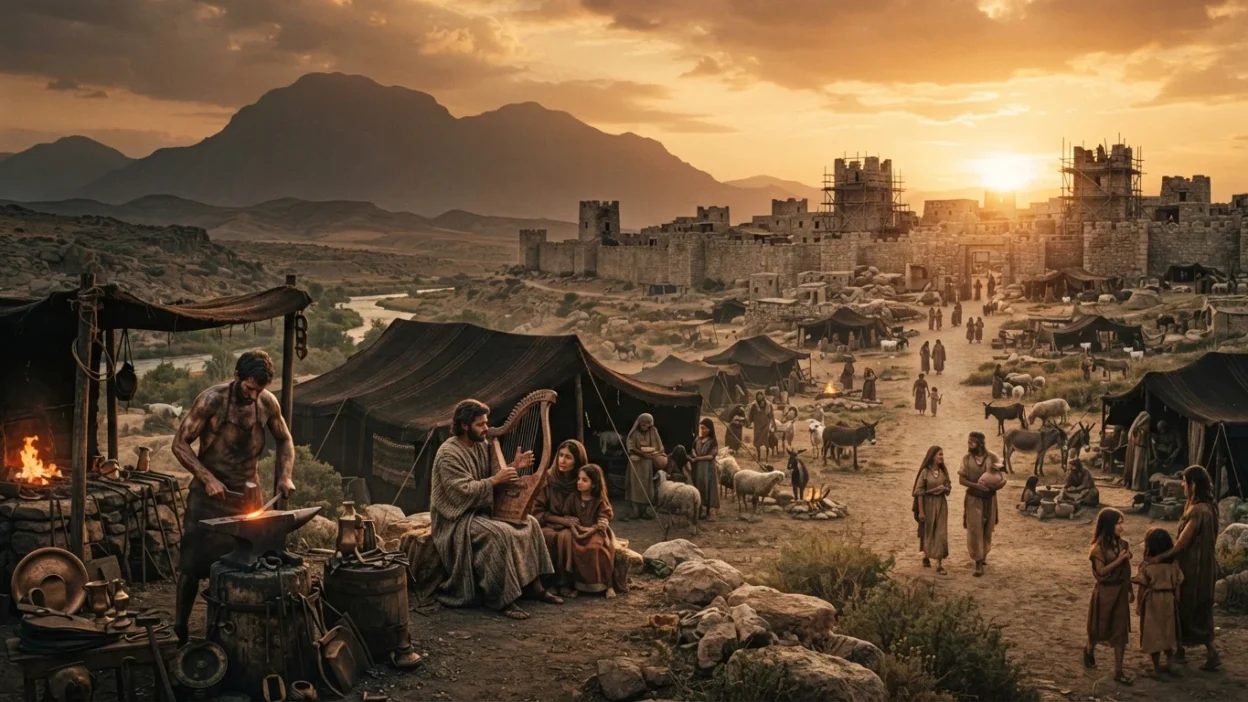
His children are associated with:
- Livestock and tent dwelling
- Music and instruments
- Metalworking and tools
This genealogy shows that the descendants of Cain were connected with important aspects of civilization.
Cain’s Descendants and the First City
One of the earliest developments connected with Cain is city-building.
Genesis describes Cain as building a city and associating it with his son Enoch.
The city represents an important transition in human society.
Instead of living only as scattered families, people began forming organized communities.
Symbolically, the city can represent human creativity, organization, and the desire for security.
However, the wider biblical story also reminds readers that human civilization does not automatically produce moral goodness.
This tension is central to the descendants of cain meaning in the bible.
Origin and History Table
| Descendant | Traditional Association |
|---|---|
| Cain | Beginning of the family line |
| Enoch | Associated with a city |
| Irad | Part of Cain’s genealogy |
| Mehujael | Part of the family line |
| Methushael | Part of the family line |
| Lamech | Connected with later cultural developments |
Lamech and the Development of Civilization
Lamech is one of the most significant descendants in Cain’s genealogy.
His family is connected with several major developments.
One of his children is associated with those who lived in tents and cared for livestock.
Another is connected with music and musical instruments.
Another is associated with metalworking and the creation of tools.
These details are important because they present Cain’s family line as part of the growth of human civilization.
The story shows the development of practical skills, artistic expression, and technology.
However, Lamech is also associated with violence, creating a contrast between human progress and moral behavior.
The Descendants of Cain and Early Human Culture
The descendants of cain meaning in the bible is strongly connected with the development of culture.
The genealogy includes themes related to:
Cities
Organized communities and human settlement.
Livestock
The development of animal care and nomadic lifestyles.
Music
Artistic creativity and cultural expression.
Metalworking
The creation of tools and technological progress.
These achievements demonstrate human creativity and intelligence.
At the same time, the story does not suggest that technological or cultural progress automatically makes people morally better.
This remains an important lesson for modern readers.
The Spiritual Meaning of the Descendants of Cain
The spiritual meaning of the descendants of cain meaning in the bible can be understood through the contrast between achievement and character.
Cain’s family line is associated with important cultural developments.
People build cities, develop music, care for animals, and create tools.
Yet the genealogy also includes themes of violence and human wrongdoing.
Symbolically, this teaches that human progress and spiritual growth are not always the same thing.
A society can become more advanced while still struggling with pride, conflict, injustice, and violence.
The spiritual lesson encourages readers to connect knowledge and creativity with moral responsibility.
Symbolic Meaning of Cain’s Family Line
Cain’s descendants can symbolize several broader ideas.
Human Creativity
The development of cities, music, and technology represents human imagination and skill.
Civilization
The genealogy shows the growth of organized human society.
Moral Responsibility
The story reminds readers that progress requires ethical guidance.
The Consequences of Choices
Cain’s original actions affect how later readers understand his family story.
The Complexity of Human Nature
Human beings can create beautiful and useful things while still struggling with destructive behavior.
These symbolic themes make the story relevant beyond its ancient setting.
Descendants of Cain Compared With the Line of Seth
The Bible later presents another important family line through Seth, another son of Adam and Eve.
The two genealogies are often compared because they represent different themes within Genesis.
| Descendants of Cain | Descendants of Seth |
|---|---|
| Listed in Genesis 4 | Listed primarily in Genesis 5 |
| Connected with early cultural development | Connected with later generations before the Flood |
| Includes Lamech associated with violence | Includes another Lamech in a different genealogy |
| Includes an Enoch connected with Cain’s family | Includes another Enoch associated with walking with God |
| Often linked symbolically with human civilization | Often linked with continuity of the godly family line in traditional interpretation |
It is important not to confuse people with similar names in the two genealogies.
The Enoch connected with Cain’s family is not the same person as the Enoch in Seth’s family line.
Likewise, the genealogies include different individuals named Lamech.
Why Do People Search for Descendants of Cain Meaning in the Bible?
Many people search for the descendants of cain meaning in the bible because Cain’s family line receives less attention than other biblical genealogies.
Readers often want to know:
- Who were Cain’s descendants?
- Did Cain’s family survive the Flood?
- What did Cain’s descendants contribute to society?
- Why are music and metalworking connected with Cain’s family?
- Are Cain’s descendants considered cursed?
- How are Cain’s descendants different from Seth’s descendants?
These questions show why the genealogy remains interesting to modern Bible readers.
Common Misconceptions About Cain’s Descendants
One major misconception is that every descendant of Cain was personally cursed because of Cain’s actions.
The Bible does not present a simple statement that all of Cain’s descendants inherited his personal guilt.
Another misconception is that Cain’s descendants continued indefinitely after the Flood.
According to the Genesis flood narrative, humanity outside Noah’s family did not survive the Flood. This means Cain’s specific genealogical line would not continue after that event.
Some people also incorrectly connect Cain’s descendants with later racial groups or ethnic communities.
These claims are not supported by the biblical genealogy and should be rejected.
The story is about an ancient family line, not a basis for assigning spiritual or moral value to modern groups of people.
Cain’s Descendants and the Flood
The descendants of Cain are listed in the early chapters of Genesis before the Flood narrative.
The Bible later presents Noah and his family as the survivors of the Flood.
Because Cain’s genealogy is separate from Noah’s family line, the descendants of Cain listed in Genesis would not have continued through the Flood according to the biblical narrative.
This is important for understanding the historical structure of Genesis.
Cain’s descendants are therefore significant mainly as part of the early history of humanity before the Flood.
Cultural and Modern Interest in Cain’s Descendants
Modern interest in Cain’s descendants comes from biblical studies, genealogy, religious discussions, and popular culture.
Books, films, and online content sometimes create fictional stories about Cain’s descendants.
Some of these stories present them as secret groups or mysterious bloodlines.
These ideas often go far beyond the biblical text.
The actual Genesis account provides a relatively short genealogy.
The continued popularity of the topic often comes from people trying to understand the origins of cities, music, technology, and early human society.
Human Progress and Moral Responsibility
One of the strongest lessons connected with the descendants of cain meaning in the bible is the relationship between progress and morality.
Cain’s descendants are associated with remarkable human achievements.
They build communities.
They develop music.
They create tools.
They develop practical skills.
Yet the story also contains warnings about violence and human wrongdoing.
This contrast remains relevant today.
Modern societies have developed extraordinary technology and knowledge, but progress alone does not solve problems involving hatred, injustice, or destructive choices.
The biblical symbolism encourages the idea that human advancement should be guided by wisdom and moral responsibility.
The Lasting Biblical Importance of Cain’s Descendants
The descendants of cain meaning in the bible remains important because the genealogy provides one of the Bible’s earliest pictures of developing human civilization.
It connects an ancient family line with cities, culture, music, livestock, and technology.
The story also provides an important spiritual warning.
Human creativity is valuable, but achievement without moral responsibility can create serious consequences.
Cain’s family line demonstrates the complexity of human history.
People can produce beautiful art and useful inventions while still struggling with violence and selfishness.
This combination of creativity and moral struggle makes the story meaningful for modern readers.
Final Thought
The descendants of cain meaning in the bible reveals an important picture of early human civilization. Cain’s family line is connected with cities, livestock, music, and metalworking, showing the development of human creativity and culture. At the same time, the genealogy contains reminders of violence and moral failure. This contrast gives the story a powerful spiritual meaning: human progress does not automatically produce wisdom or goodness.
Technology, art, and civilization can improve human life, but they also require moral responsibility. The story of Cain’s descendants encourages readers to value creativity while recognizing the importance of character, justice, and responsible choices. Its ancient message remains relevant in a modern world shaped by constant cultural and technological development.
FAQs
1. Who were the descendants of Cain?
Cain’s descendants listed in Genesis include Enoch, Irad, Mehujael, Methushael, and Lamech, along with later members of Lamech’s family.
2. What were Cain’s descendants known for?
They are associated with early cities, livestock care, music, and metalworking.
3. Did Cain’s descendants survive the Flood?
According to the Genesis flood narrative, only Noah’s family survived, so Cain’s genealogical line did not continue after the Flood.
4. What is the spiritual meaning of Cain’s descendants?
Their story can symbolize the contrast between human progress and the continuing need for moral responsibility.
5. Are Cain’s descendants cursed in the Bible?
The Bible does not state that every descendant of Cain inherited Cain’s personal guilt or curse.
6. What is the difference between Cain’s and Seth’s family lines?
Cain’s genealogy is found in Genesis 4 and is associated with early cultural development, while Seth’s genealogy is presented separately in Genesis 5.
7. Why are Cain’s descendants important?
They provide one of the earliest biblical accounts of the development of cities, culture, music, technology, and human society.

Levi Ezra is a spiritual writer and author at BibLoft.com, exploring symbolism, dreams, and hidden meanings in life, offering insightful reflections to guide spiritual understanding and inner awareness.