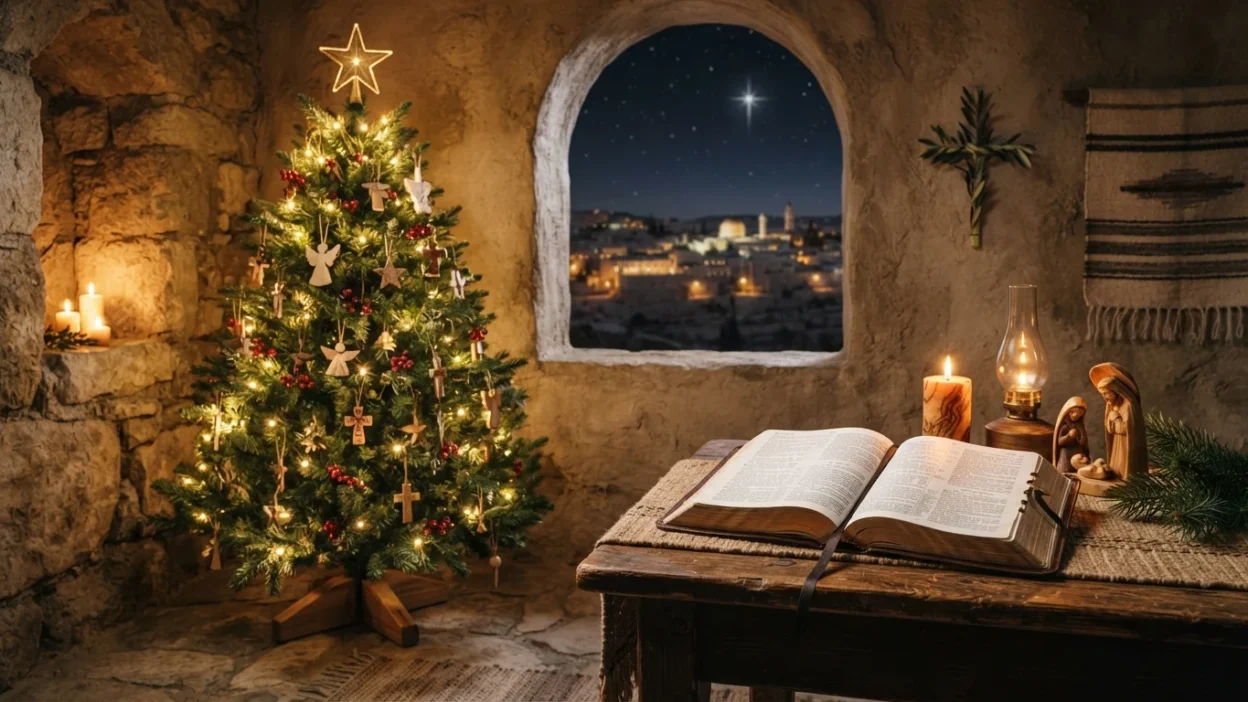
The Christmas tree meaning in the Bible is a question many Christians ask when they want to understand whether this popular holiday tradition has a direct biblical connection. The Bible does not specifically mention Christmas trees or command believers to use them during the celebration of Christ’s birth. However, evergreen trees, branches, lights, and other natural symbols can be discussed in relation to broader biblical themes such as life, hope, light, and God’s creation.
Understanding the Christmas tree meaning in the Bible also requires separating biblical teaching from later Christmas traditions. The modern Christmas tree developed centuries after the biblical books were written, particularly through European Christian customs. While some people associate the tree with pagan practices, others see it as a Christian symbol of everlasting life and celebration. Examining its history and symbolism can help believers understand the tradition without confusing cultural customs with direct biblical commands.
Quick Answer: What Does the Christmas Tree Mean in the Bible?
The Bible does not directly mention Christmas trees or give them a specific spiritual meaning.
The modern Christmas tree is a later Christian cultural tradition, not a biblical command.
Many Christians symbolically associate evergreen trees with everlasting life, hope, renewal, and celebration.
Its meaning ultimately depends on how it is used and understood.
Does the Bible Mention a Christmas Tree?
The simple answer is no. There is no verse that describes a Christmas tree as Christians know it today.
Christmas itself developed as a Christian celebration centuries after the biblical period. Therefore, references to Christmas trees cannot be expected in Scripture.
Some discussions connect Christmas trees with Jeremiah 10:1–5, where people are warned about making and decorating idols from wood. However, this passage is describing idolatry, not a modern Christmas tree. The context involves cutting down a tree, shaping it, and decorating it as an object of worship.
| Question | Biblical Answer |
|---|---|
| Does the Bible mention Christmas trees? | No |
| Does Scripture command Christmas trees? | No |
| Are evergreen trees mentioned in Scripture? | Yes, various trees and plants are mentioned |
| Is Christmas a biblical command? | No |
| Can Christians use Christmas trees? | Christian traditions differ |
| Is a Christmas tree automatically an idol? | No |
The important issue is whether an object replaces God or becomes an object of worship.
Origin and History of the Christmas Tree
The modern Christmas tree has a long and complex history.
Evergreen plants have been used in various cultures as symbols of life during winter because they remain green when many other plants lose their leaves. However, the specific tradition of decorating an indoor evergreen tree for Christmas developed in Europe.
Germany is commonly associated with the development of the modern Christmas tree tradition. By the 16th century, Christians in German-speaking regions were decorating trees as part of Christmas celebrations. The custom eventually spread throughout Europe and later became popular in North America.
| Historical Feature | Description |
|---|---|
| Ancient evergreen customs | Evergreens often represented life during winter |
| European tradition | Evergreens became connected with Christmas customs |
| German influence | Helped develop the decorated Christmas tree |
| 19th century | Christmas trees became increasingly popular |
| Modern tradition | Trees are decorated with lights, ornaments, and gifts |
This history shows that the Christmas tree is primarily a cultural and religious tradition, rather than a practice prescribed by the Bible.
Biblical and Religious Connection
Although the Bible does not mention Christmas trees, Scripture contains many references to trees.
Trees frequently appear as powerful images in biblical writing. In Genesis, the Tree of Life appears in the Garden of Eden. Psalm 1 compares a righteous person to a tree planted by streams of water. Jesus also used agricultural and plant imagery when teaching spiritual truths.
These passages do not establish the Christmas tree as a biblical symbol. However, they help explain why Christians may naturally associate trees with spiritual ideas.
The Bible frequently uses creation to communicate lessons about God’s character, life, growth, fruitfulness, and blessing.
Therefore, Christians can draw symbolic lessons from a Christmas tree without claiming that Scripture directly assigns those meanings to it.
Spiritual Meaning of the Christmas Tree
The spiritual meaning Christians attach to a Christmas tree often centers on life, hope, light, and celebration.
1. Everlasting Life
Because evergreen trees remain green throughout winter, they can serve as a visual reminder of life that continues despite difficult seasons.
For Christians, this can point symbolically toward eternal life through Christ.
2. Hope
Winter can represent darkness, coldness, and waiting. An evergreen tree remains vibrant during that season, making it a natural symbol of hope and endurance.
3. Light
Christmas trees are often covered with lights. Christians may use those lights as a reminder of Jesus’ description as the light of the world.
John 8:12 records Jesus saying that those who follow Him will have the light of life.
4. Celebration
A decorated tree can represent joy and celebration surrounding the birth of Jesus.
5. Renewal
The evergreen’s continuing color can symbolize renewal and God’s sustaining power.
| SymbolPossible Christian Meaning | |
|---|---|
| Evergreen branches | Life and endurance |
| Lights | Christ as the light |
| Star | Christ’s birth and heavenly guidance |
| Ornaments | Celebration and gratitude |
| Gifts beneath the tree | Giving and generosity |
| Green color | Life and renewal |
These are symbolic interpretations, not meanings directly stated in Scripture.
What Does an Evergreen Tree Symbolize?
Evergreen trees have naturally become associated with life because they remain green throughout seasons when many other plants become dormant.
For Christians, this can provide a useful picture of spiritual endurance.
The Bible often describes God’s people using plant and tree imagery. Psalm 1:3 describes the righteous person as being like a tree planted beside streams of water, producing fruit in its season.
This does not mean Psalm 1 is talking about a Christmas tree. Instead, it demonstrates how trees can communicate spiritual truths throughout Scripture.
An evergreen Christmas tree can therefore remind a Christian of God’s sustaining grace and the hope of life beyond temporary circumstances.
Christmas Tree Lights and Their Spiritual Meaning
Lights are one of the most recognizable parts of modern Christmas decorations.
The Bible uses light as an important spiritual symbol. Jesus is described as the light of the world, and His followers are called to reflect that light through their lives.
When Christians place lights on a Christmas tree, they may use them as a reminder that Christ brings light into spiritual darkness.
The lights themselves are not holy objects. Their value comes from the meaning a person gives them.
A Christian family might look at the tree lights and remember:
- Jesus is the light of the world.
- God offers hope in darkness.
- Believers are called to live as lights.
- Christ brings spiritual life and truth.
This makes the decoration an opportunity for reflection rather than an object of worship.
Christmas Tree and the Cross of Christ
Some Christian traditions connect the Christmas tree with the broader story of salvation.
The Christmas season celebrates Christ’s birth, while the cross represents His death and resurrection. Together, these events form a central part of the Christian gospel.
The tree itself should not be confused with the cross. However, a Christmas tree can be used as part of a larger family celebration that points attention toward Jesus.
This is especially meaningful when families focus less on decoration and more on worship, generosity, gratitude, and remembering Christ.
Is Jeremiah 10 Talking About a Christmas Tree?
Jeremiah 10 is frequently cited in arguments about Christmas trees.
The passage describes people cutting wood, shaping it, decorating it with silver and gold, and treating it as an object that cannot speak or move.
Some readers interpret this as a warning against Christmas trees.
However, the surrounding context clearly focuses on idols and false gods. The problem is not simply cutting down a tree or decorating wood. The problem is creating an object of worship and treating it as a deity.
This distinction is essential.
A modern Christmas tree placed in a home as seasonal decoration is not automatically equivalent to an idol. However, Christians should still examine their hearts and priorities whenever cultural traditions become overly important.
Is the Christmas Tree Pagan?
This is one of the most debated questions surrounding the tradition.
Evergreen plants had symbolic uses in pre-Christian cultures, but the modern Christmas tree developed through later European customs. Therefore, saying simply that “Christmas trees are pagan” is an oversimplification.
Likewise, saying that the Christmas tree is directly commanded by the Bible would also be incorrect.
| Claim | Better Explanation |
|---|---|
| “The Bible commands Christmas trees.” | False |
| “The Bible directly condemns Christmas trees.” | Not specifically |
| “Jeremiah 10 clearly describes Christmas trees.” | The context concerns idols |
| “Evergreens existed in pre-Christian customs.” | Yes |
| “Every Christmas tree is pagan.” | Too broad |
| “Christians may attach symbolic meaning to a tree.” | Yes |
Christians have different convictions about Christmas traditions, so individuals should consider Scripture, conscience, and the purpose behind their practices.
Christmas Tree Meaning in Christian Families
For many Christian families, the Christmas tree becomes a visual reminder of the Christmas season.
Families may decorate it together, read Scripture, sing carols, pray, and exchange gifts. In this setting, the tree is not necessarily the focus of worship.
The tree can become a backdrop for conversations about:
- Jesus’ birth
- God’s love
- Generosity
- Family relationships
- Gratitude
- Eternal life
- Hope
The spiritual value comes from how the tradition is practiced.
A simple decoration can become an opportunity to teach children that Christmas is ultimately about Christ rather than material possessions.
Why Do People Search for Christmas Tree Meaning in the Bible?
People search for Christmas tree meaning in the Bible for several reasons.
Some want to know whether decorating a Christmas tree is biblically acceptable. Others have heard claims that the tree is pagan or that Jeremiah 10 forbids the practice.
Parents may also want a Christian explanation they can share with their children.
Another reason is spiritual curiosity. People often want to turn Christmas traditions into opportunities for biblical reflection.
The best approach is to distinguish between what the Bible explicitly teaches and what Christians symbolically associate with later traditions.
Common Misconceptions About Christmas Trees
Misconception 1: Christmas trees are mentioned in the Bible
They are not. The modern Christmas tree developed after the biblical period.
Misconception 2: Jeremiah 10 directly bans Christmas trees
Jeremiah 10 addresses idolatry. It does not specifically discuss the modern Christmas tree.
Misconception 3: Christmas trees have one official Christian meaning
There is no single biblical definition. Different Christians attach different symbolic meanings to the tradition.
Misconception 4: A decorated tree is automatically an idol
An idol involves worship and misplaced devotion. Decoration alone does not automatically make something an idol.
Misconception 5: Christians must use a Christmas tree
They do not. Christmas trees are a tradition, not a biblical command.
Is It Wrong for Christians to Have a Christmas Tree?
Christians have different opinions about Christmas customs.
Some families choose to have a tree and use it as part of their celebration. Others avoid Christmas trees because of personal convictions or concerns about cultural traditions.
Romans 14 provides an important principle concerning disagreements over practices and special days. Christians should be careful not to judge one another unnecessarily over matters where Scripture does not give a direct command.
The key questions are:
Does the tradition replace worship of God?
Does it violate personal conscience?
Does it distract from Christ?
Can it be practiced with gratitude and moderation?
These questions are more important than the tree itself.
Christmas Tree vs. Biblical Tree Symbolism
| Christmas Tree | Biblical Tree Imagery |
|---|---|
| Modern cultural tradition | Directly found in Scripture |
| Often symbolizes celebration | Often symbolizes life, growth, and righteousness |
| Decorated with lights | Light has spiritual symbolism |
| Used during Christmas | Used throughout biblical narratives |
| Not commanded by Scripture | Many tree images are part of biblical teaching |
This comparison helps keep biblical teaching and modern tradition in their proper categories.
How Christians Can Use the Christmas Tree Meaningfully
A Christian family can use the Christmas tree as a teaching opportunity.
Instead of making the tree the center of Christmas, parents can use its decorations to point toward biblical truths.
For example, lights can remind children about Christ as the light of the world. A star can remind them of the birth of Jesus. Gifts can encourage conversations about generosity and God’s greatest gift.
The tree can therefore become a visual teaching tool rather than an object of worship.
Final Thought
The Christmas tree meaning in the Bible is not based on a direct biblical command because Scripture never mentions the modern Christmas tree. Its history belongs primarily to later European Christmas traditions. Nevertheless, Christians can choose to give the tree meaningful symbolic value. Evergreen branches can remind believers of life and endurance, lights can point toward Christ as the light of the world, and gifts can encourage generosity and gratitude.
The most important issue is not whether a family owns a Christmas tree but what place that tradition holds in its heart. A tree should never replace worship of God or become an idol. When used thoughtfully, it can simply become a seasonal reminder of hope, joy, life, and the celebration of Jesus Christ.
FAQs
1. Does the Bible mention Christmas trees?
No. The Bible does not specifically mention Christmas trees or command Christians to use them.
2. What does a Christmas tree symbolize for Christians?
Many Christians use it symbolically to represent life, hope, renewal, light, and celebration.
3. Is Jeremiah 10 about Christmas trees?
Jeremiah 10 addresses the making and worship of idols. It does not specifically describe the modern Christmas tree.
4. Is having a Christmas tree a sin?
The Bible does not specifically identify having a Christmas tree as sinful. Christians may have different personal convictions about the tradition.
5. Is the Christmas tree pagan?
Evergreens had uses in pre-Christian cultures, but the modern Christmas tree developed through European Christmas traditions. Calling every Christmas tree pagan is an oversimplification.
6. Can a Christmas tree have biblical meaning?
Yes, as a symbolic reminder, although those meanings should not be presented as direct biblical definitions.
7. What is the most important meaning of Christmas?
For Christians, Christmas primarily celebrates the birth of Jesus Christ and the Christian message of God’s salvation through Him.

Levi Ezra is a spiritual writer and author at BibLoft.com, exploring symbolism, dreams, and hidden meanings in life, offering insightful reflections to guide spiritual understanding and inner awareness.