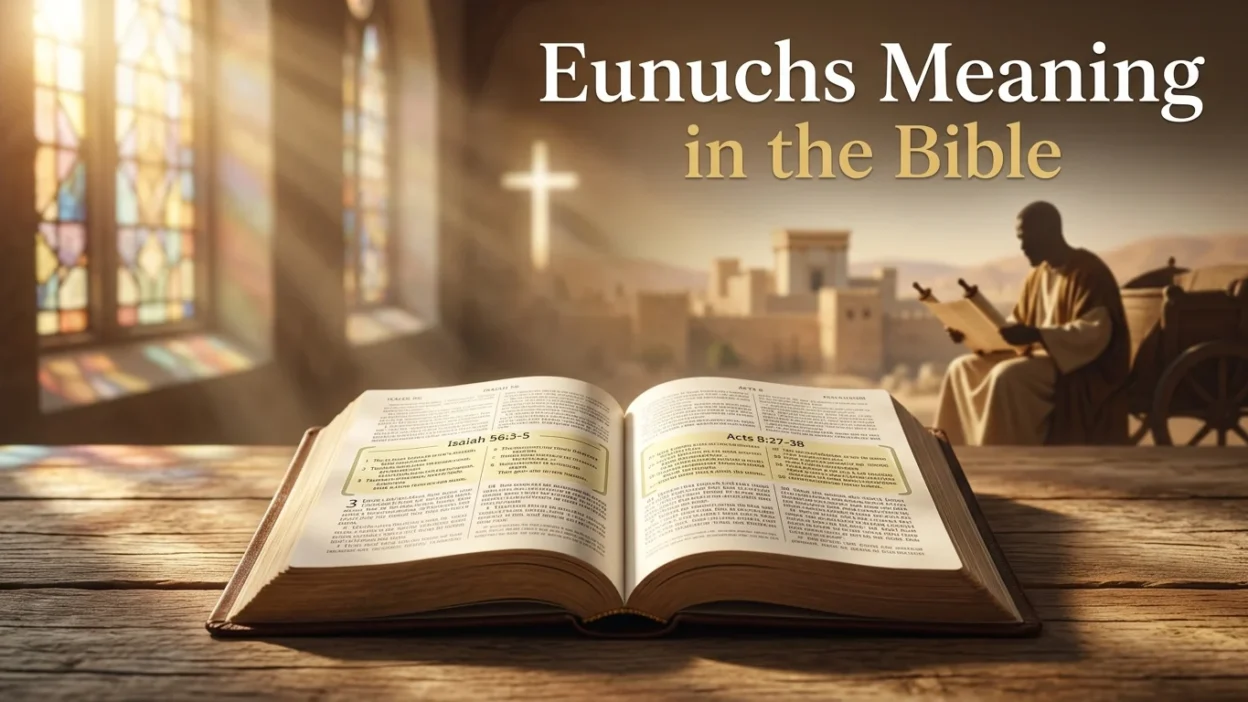
The eunuchs meaning in the Bible is a topic that often raises questions among Bible readers, students, and Christians seeking a deeper understanding of Scripture.
Eunuchs appear several times in both the Old and New Testaments, serving in royal courts, protecting kings, and even becoming examples of faith and devotion to God.
Understanding the eunuchs meaning in the Bible helps explain important biblical teachings about God’s kingdom, acceptance, and spiritual commitment.
Although the role of eunuchs may seem unusual in today’s culture, the Bible presents them in meaningful ways that reveal God’s grace and His invitation to all people.
This article explores the eunuchs meaning in the Bible, their historical background, spiritual symbolism, biblical references, and why they remain significant for believers today.
Quick Answer
The eunuchs meaning in the Bible refers to men who were either physically castrated or chose a life of celibacy for specific purposes. In Scripture, eunuchs often served royal courts, while spiritually they symbolize dedication, faithfulness, and the truth that God’s kingdom welcomes everyone who follows Him.
What Does Eunuchs Mean in the Bible?
In biblical times, a eunuch generally referred to a man who had been castrated, often so he could safely serve in royal households without posing a threat to the king’s family. However, the term could also describe trusted government officials, even when physical castration was uncertain.
The Bible uses the word in both literal and symbolic ways. Some eunuchs served kings and queens, while others became examples of faithful followers of God.
Table: Meaning of Eunuchs in the Bible
| Aspect | Meaning |
|---|---|
| Biblical Term | Eunuch |
| Basic Definition | A man who was castrated or a royal official |
| Main Role | Royal servant, palace official, trusted advisor |
| Spiritual Symbolism | Dedication, surrender, faithfulness to God |
| Key Bible References | Isaiah 56, Matthew 19, Acts 8 |
Origin and History of Eunuchs
The practice of appointing eunuchs began centuries before biblical times. Ancient civilizations such as Egypt, Assyria, Babylon, Persia, and later the Roman Empire used eunuchs in royal administrations.
Because they could not establish family dynasties, rulers often trusted eunuchs with positions involving wealth, government, and protection of the royal household.
Israel itself generally did not encourage the practice. However, as foreign empires ruled over God’s people, Jewish history increasingly intersected with cultures where eunuchs held important positions.
Table: Historical Background
| Topic | Details |
|---|---|
| Origin | Ancient Near Eastern kingdoms |
| Common Employers | Kings and emperors |
| Primary Duties | Palace management, administration, security |
| Biblical Time Period | Old and New Testament eras |
| Historical Importance | Trusted royal officials and servants |
Biblical Connection of Eunuchs
The eunuchs meaning in the Bible becomes clearer by examining important passages where they appear.
1. Isaiah’s Promise
One of the most encouraging passages appears in Isaiah 56:3–5.
God promises faithful eunuchs that they will receive “a name better than sons and daughters” if they remain faithful to His covenant. This remarkable promise demonstrates that God values obedience over physical condition.
2. Jesus’ Teaching
In Matthew 19:12, Jesus explains that there are three kinds of eunuchs:
- Those born that way
- Those made eunuchs by others
- Those who choose to live like eunuchs for the sake of God’s kingdom
Jesus uses the final category symbolically to describe voluntary celibacy devoted entirely to serving God.
3. The Ethiopian Eunuch
Acts 8 records one of the most inspiring stories involving a eunuch.
The Ethiopian eunuch was a high-ranking government official who traveled to Jerusalem to worship God. While reading Isaiah, he met Philip, who explained the gospel of Jesus Christ.
The eunuch believed immediately and requested baptism, becoming one of the earliest Gentile believers recorded in the New Testament.
Important Bible Characters Connected with Eunuchs
Several notable figures help explain the eunuchs meaning in the Bible.
The Ethiopian Eunuch
- Treasurer of the Queen of Ethiopia
- Sincere seeker of God
- Baptized by Philip
- Example of immediate faith
Ebed-Melech
Ebed-Melech was an Ethiopian eunuch serving King Zedekiah. He courageously rescued the prophet Jeremiah from a cistern, demonstrating compassion and faith.
God later rewarded his trust and bravery.
Royal Eunuchs in Persia
The Book of Esther mentions several royal eunuchs serving King Xerxes. They acted as trusted palace officials responsible for carrying out royal commands.
Spiritual Meaning of Eunuchs in the Bible
The spiritual significance extends far beyond physical identity.
The eunuchs meaning in the Bible points to complete devotion to God, spiritual surrender, and faithful service regardless of social status.
Spiritually, eunuchs symbolize:
- Total commitment to God
- Faithfulness despite personal sacrifice
- Obedience over outward appearance
- Inclusion in God’s kingdom
- A transformed heart devoted to Christ
Their stories remind believers that God welcomes anyone who sincerely seeks Him.
Table: Spiritual Symbolism
| Symbol | Spiritual Meaning |
|---|---|
| Faithfulness | Remaining loyal to God |
| Sacrifice | Putting God’s kingdom first |
| Inclusion | God’s love extends to everyone |
| Obedience | Following God’s commands wholeheartedly |
| New Identity | Spiritual acceptance through faith |
Why Did Jesus Mention Eunuchs?
Jesus’ teaching in Matthew 19 surprises many readers because He shifts attention away from physical conditions toward spiritual commitment.
When Jesus speaks about those who become eunuchs “for the kingdom of heaven,” He refers to individuals who willingly remain unmarried so they can dedicate themselves fully to God’s work.
His teaching emphasizes:
- Personal calling
- Kingdom priorities
- Self-sacrifice
- Complete devotion to God
Rather than commanding celibacy for everyone, Jesus recognizes it as a special calling for certain believers.
Cultural and Modern Understanding of Eunuchs
Today, the eunuchs meaning in the Bible is studied primarily from historical, theological, and spiritual perspectives. Modern readers no longer view eunuchs through the lens of royal service but instead focus on what their stories reveal about God’s grace and His acceptance of all who seek Him.
Many Bible scholars point out that eunuchs demonstrate how God removes barriers that society often creates. In biblical times, they were sometimes excluded from certain religious privileges, yet Scripture progressively reveals God’s desire to welcome faithful believers regardless of their background.
Christians today often see eunuchs as examples of humility, dedication, and wholehearted service to God.
Why People Search for “Eunuchs Meaning in the Bible”
The topic attracts attention because it appears in several important Bible passages that can seem confusing without historical context.
People commonly search this keyword because they want to know:
- What a eunuch was in biblical times.
- Why Jesus talked about eunuchs.
- Whether eunuchs could worship God.
- The story of the Ethiopian eunuch.
- The spiritual symbolism behind the term.
- Whether the Bible honors or condemns eunuchs.
Understanding the historical and biblical context answers these questions and helps readers interpret Scripture accurately.
Common Misconceptions About Eunuchs
There are several misunderstandings surrounding the eunuchs meaning in the Bible.
Misconception 1: Every Eunuch Was Castrated
Truth: In some biblical passages, the word “eunuch” refers to a trusted royal official. While many eunuchs were physically castrated, the term could also describe a high-ranking court servant.
Misconception 2: God Rejected Eunuchs
Truth: Isaiah 56 clearly shows God’s promise to faithful eunuchs. They were welcomed into God’s covenant when they honored Him.
Misconception 3: Jesus Commanded Everyone to Become Eunuchs
Truth: Jesus did not command celibacy for all believers. In Matthew 19, He described voluntary celibacy as a special calling for some people devoted to God’s kingdom.
Misconception 4: Eunuchs Were Unimportant
Truth: Many eunuchs held positions of great authority, influence, and trust within powerful kingdoms. The Ethiopian eunuch, for example, played a significant role in the spread of the gospel.
Comparison Table: Physical vs. Spiritual Meaning
| Aspect | Physical Meaning | Spiritual Meaning |
|---|---|---|
| Identity | Royal servant or castrated man | Fully devoted follower of God |
| Purpose | Serve kings and kingdoms | Serve God’s kingdom |
| Position | Palace official | Faithful believer |
| Main Focus | Earthly responsibilities | Spiritual commitment |
| Biblical Lesson | Historical role | God’s grace and acceptance |
Lessons Christians Can Learn
The eunuchs meaning in the Bible teaches valuable lessons that still apply today.
Believers can learn to:
- Trust God’s acceptance rather than human opinions.
- Remain faithful even when facing rejection.
- Place God’s kingdom above personal ambitions.
- Serve with humility and integrity.
- Recognize that God values the heart more than outward circumstances.
The Ethiopian eunuch especially demonstrates how sincere faith leads to immediate obedience and joyful discipleship.
Why the Eunuchs Meaning in the Bible Still Matters Today
Although the cultural role of eunuchs belongs to the ancient world, the biblical message remains highly relevant.
Their stories remind Christians that no person is beyond God’s invitation. Social position, physical condition, nationality, or background cannot prevent someone from receiving God’s grace through faith.
The eunuchs meaning in the Bible also encourages believers to pursue wholehearted devotion, placing God above worldly recognition and trusting His promises.
Final Thought
The eunuchs meaning in the Bible reveals far more than an ancient cultural practice.
Throughout Scripture, eunuchs become powerful examples of God’s compassion, inclusion, and transforming grace.
From Isaiah’s promise of an everlasting name to the joyful conversion of the Ethiopian eunuch in Acts, the Bible demonstrates that God welcomes everyone who sincerely seeks Him.
Jesus further expanded this understanding by teaching that true commitment to God’s kingdom comes from the heart. Whether studying biblical history or seeking spiritual insight, the stories of eunuchs remind believers that faith, obedience, and devotion are what truly matter in God’s eyes.
Their example continues to encourage Christians to serve God faithfully with humility, courage, and unwavering trust.
FAQs
Are eunuchs mentioned in both the Old and New Testaments?
Yes. Eunuchs appear in Isaiah, Jeremiah, Esther, Daniel, Matthew, and Acts, among other passages.
Who was the Ethiopian eunuch?
He was a high-ranking official serving the queen of Ethiopia who believed in Jesus after Philip explained the gospel and was immediately baptized (Acts 8).
What did Jesus mean by “eunuchs for the kingdom of heaven”?
Jesus referred to people who voluntarily remain unmarried so they can devote themselves fully to God’s service.
Does the Bible honor eunuchs?
Yes. Scripture presents several eunuchs as faithful servants and shows that God welcomes those who trust and obey Him.
What is the spiritual meaning of eunuchs in the Bible?
They symbolize dedication, surrender, faithful service, and the truth that God’s kingdom is open to everyone who believes.
Why is the Ethiopian eunuch important?
His conversion demonstrates that the gospel is for all nations and that sincere faith leads to salvation and inclusion in God’s family.
Can Christians learn from the lives of biblical eunuchs?
Absolutely. Their lives teach humility, obedience, trust in God, and wholehearted commitment to His kingdom.