The precious stones meaning in the Bible reveals a rich world of beauty, value, symbolism, and spiritual truth. Throughout Scripture, gemstones appear in sacred clothing, royal treasures, visions of heaven, and descriptions of God’s glory. Their brilliance and rarity made them natural symbols of things that were considered valuable, pure, enduring, and worthy of honor. From the breastpiece worn by Israel’s high priest to the foundations of the New Jerusalem, precious stones carry both historical and symbolic importance.
Understanding the precious stones meaning in the Bible requires looking at each passage in its proper context. A gemstone may sometimes be described simply as a valuable material, while in other passages it becomes part of a larger spiritual picture. The Bible does not always assign one fixed meaning to every stone. However, precious stones can collectively point to themes such as God’s glory, beauty, holiness, identity, redemption, permanence, and the incomparable value of spiritual truth.
Quick Answer: What Do Precious Stones Mean in the Bible?
The precious stones meaning in the Bible is often connected with beauty, value, holiness, God’s glory, identity, and eternal hope. Gemstones were used in the high priest’s breastpiece, associated with wealth and royalty, and later used symbolically in biblical visions of the heavenly city. Their exact symbolism depends on the passage and context.
What Are Precious Stones in the Bible?
Precious stones are naturally occurring minerals valued for their beauty, rarity, durability, or brilliance.
In biblical times, gemstones were used in jewelry, royal decorations, religious objects, and trade.
Scripture mentions several stones, although identifying every ancient stone with a modern gemstone can be difficult.
Names for stones have changed across languages and historical periods.
Some biblical descriptions may refer to stones that do not correspond exactly to modern classifications.
| Biblical Use | Purpose or Association |
|---|---|
| High priest’s breastpiece | Representation of Israel’s tribes |
| Jewelry | Beauty and value |
| Royal treasures | Wealth and honor |
| Sacred imagery | Glory and holiness |
| New Jerusalem | Eternal beauty and splendor |
The meaning of a specific stone should therefore be interpreted carefully rather than assuming every stone has one universal spiritual definition.
Origin and History of Precious Stones in Biblical Times
Gemstones were highly valued in the ancient world.
People used them for personal decoration, trade, royal collections, seals, and ceremonial objects.
Many stones were transported through major trade routes connecting regions of Africa, Asia, and the Middle East.
Their rarity made them symbols of wealth and status.
However, precious stones were not important only because of their financial value.
In the Bible, beautiful materials were also used in places connected with worship and sacred service.
Gold, silver, fine fabrics, and precious stones all contributed to descriptions of beauty and honor.
This historical background helps explain why Scripture used gemstones to communicate ideas of splendor and value.
Precious Stones in the High Priest’s Breastpiece
One of the most important examples of the precious stones meaning in the Bible appears in Exodus 28.
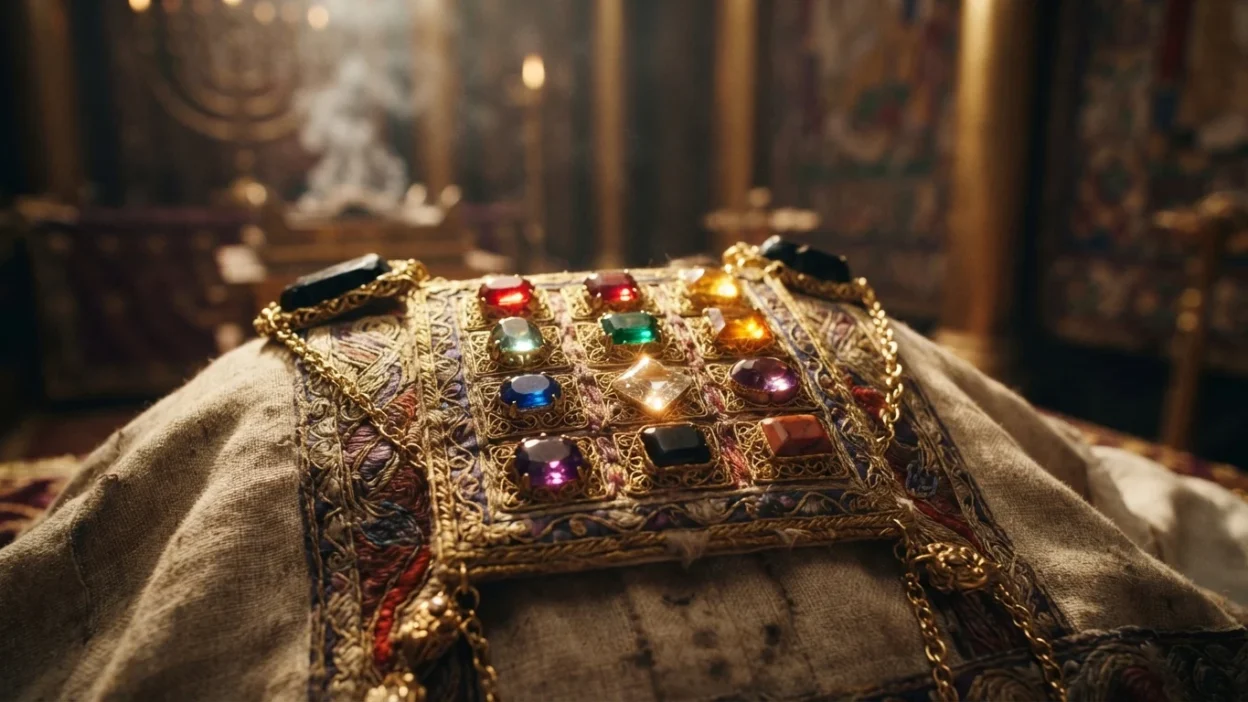
The high priest wore a special breastpiece containing twelve stones arranged in rows.
Each stone was associated with one of the twelve tribes of Israel.
The stones served as a visible reminder that the tribes were represented before God.
This connection gives the breastpiece a powerful theme of identity and remembrance.
The emphasis was not simply on the beauty of the stones.
The breastpiece had a sacred function connected with the priestly role.
| Biblical Feature | Significance |
|---|---|
| Twelve stones | Twelve tribes of Israel |
| Individual stones | Representation and identity |
| Breastpiece | Worn by the high priest |
| Names engraved | Memorial before God |
| Sacred setting | Worship and priestly service |
The exact identification of all twelve stones remains debated because ancient terminology does not always match modern gem names.
The Twelve Stones and the Tribes of Israel
Exodus describes the stones as being arranged in four rows.
Each stone carried the name of one of Israel’s tribes.
This created a powerful connection between physical beauty and collective identity.
The high priest symbolically carried the names of the tribes before God.
For readers studying the precious stones meaning in the Bible, this is an important point.
The stones were not simply magical objects.
Their role was connected with representation, remembrance, worship, and covenant identity.
Different Bible translations may use slightly different names for the stones because translating ancient gemstone terms can be challenging.
Therefore, readers should be cautious about making overly certain claims about the exact modern identity of every stone.
Spiritual Meaning of Precious Stones in the Bible
The spiritual meaning of precious stones can be understood through several major themes.
1. Value
Gemstones were rare and valuable.
They can symbolize the importance of spiritual truth and what is precious in God’s sight.
2. Beauty
Their brilliance reflects the biblical use of beauty in descriptions of sacred places and heavenly visions.
3. Identity
The stones in the high priest’s breastpiece represented the tribes of Israel.
4. Holiness
Precious materials were sometimes used in sacred settings to communicate honor and reverence.
5. Permanence
The durability of stones can symbolize lasting truth, faith, and eternal hope.
| Spiritual Theme | Symbolic Association |
|---|---|
| Value | What is precious and meaningful |
| Beauty | Glory and splendor |
| Identity | God’s people remembered |
| Holiness | Sacred purpose |
| Permanence | Enduring hope |
These interpretations should be treated as broad biblical themes rather than assuming that every individual gemstone has a secret spiritual code.
Precious Stones and God’s Glory
The Bible sometimes uses brilliant materials and gemstone imagery in visions associated with divine glory.
The book of Revelation, for example, contains vivid descriptions of heavenly beauty and radiance.
Precious stones help communicate something difficult to express in ordinary language.
Human readers understand brightness, beauty, rarity, and splendor.
These qualities become visual images that point beyond ordinary earthly experience.
The precious stones meaning in the Bible can therefore include the idea that God’s glory is beyond ordinary human wealth.
The stones are symbols within the description, helping readers imagine magnificence and beauty.
Precious Stones in the New Jerusalem
Revelation describes the New Jerusalem using imagery of gold, pearls, and precious stones.
The city’s foundations are described with various precious materials.
This imagery emphasizes beauty, security, permanence, and divine glory.
The New Jerusalem is not presented as an ordinary earthly city.
Its magnificent description communicates the greatness of God’s eternal kingdom.
The stones used in the vision represent a setting of extraordinary value and beauty.
For Christians, this imagery is often connected with eternal hope.
It reminds believers that God’s promises extend beyond temporary earthly possessions.
Precious Stones Compared With Gold and Pearls
The Bible uses several valuable materials symbolically.
Each can emphasize a slightly different idea depending on the passage.
| Material | Common Biblical Association |
|---|---|
| Precious stones | Beauty, value, glory, identity |
| Gold | Value, purity, royalty, sacred beauty |
| Silver | Value and redemption in certain contexts |
| Pearls | Great worth and beauty |
| Fine garments | Honor and celebration |
These materials should not be assigned rigid meanings in every passage.
Context remains the most important guide.
Are Individual Precious Stones Given Specific Meanings?
Many modern articles assign detailed spiritual meanings to individual stones.
For example, one gemstone may be connected with healing, wisdom, protection, or prosperity.
However, readers should be careful.
The Bible does not provide a complete dictionary assigning one fixed spiritual meaning to every precious stone.
Some symbolic connections come from later traditions rather than directly from Scripture.
The safest approach is to study how a particular stone is used in its biblical passage.
The precious stones meaning in the Bible is often clearer when the focus remains on the larger themes of the text rather than speculative symbolism.
Common Misconceptions About Precious Stones
Misconception 1: Every biblical gemstone has one secret meaning
The Bible does not provide a universal code for interpreting gemstones.
Misconception 2: Modern crystal meanings are the same as biblical meanings
Modern spiritual practices should not automatically be projected onto Scripture.
Misconception 3: The exact identity of every biblical stone is certain
Ancient gemstone names can be difficult to match precisely with modern classifications.
Misconception 4: Precious stones were used as magical objects
Their biblical use was often connected with beauty, value, identity, worship, and symbolic imagery rather than magic.
Misconception 5: Wealth itself guarantees spiritual blessing
The Bible consistently teaches that material wealth is not the ultimate measure of faithfulness or spiritual value.
Why Do People Search for Precious Stones Meaning in the Bible?
People search precious stones meaning in the Bible because gemstones appear in several fascinating passages.
The high priest’s breastpiece raises questions about the twelve stones and their connection to Israel’s tribes.
Revelation also inspires curiosity through its descriptions of the New Jerusalem.
Others want to know whether gemstones have spiritual meanings or whether modern crystal symbolism has biblical roots.
Studying the biblical context helps provide a balanced answer.
Precious stones can carry symbolism, but their meaning should come from Scripture rather than modern assumptions.
Cultural and Modern Usage of Biblical Gemstones
Today, biblical gemstones are often represented in jewelry, Christian artwork, books, and religious education.
Some people wear jewelry inspired by the twelve tribes of Israel or the stones described in Revelation.
Gemstones may also appear in church decorations and artistic representations of biblical visions.
Modern interest in birthstones and crystals has also increased curiosity about biblical gemstones.
However, biblical interpretation should distinguish between historical Scripture and modern spiritual systems that assign additional powers to stones.
The Bible’s primary emphasis is on God, faith, worship, identity, and hope rather than treating gemstones as sources of supernatural power.
Precious Stones as Symbols of God’s People
The breastpiece of the high priest offers a meaningful picture of representation.
Each tribe was symbolically associated with a stone.
Together, the stones formed one sacred arrangement.
This can provide a broader spiritual reflection on unity and individual identity.
Each stone was distinct, yet each belonged to the larger breastpiece.
Likewise, communities can contain individuals with different roles while remaining connected by a shared purpose.
This is a symbolic application rather than a direct statement about modern communities.
Still, the image demonstrates how biblical objects can communicate both individuality and unity.
Lessons From Precious Stones for Modern Readers
The imagery of gemstones can provide several practical spiritual lessons.
Recognize true value. What is valuable in God’s sight may differ from what society considers valuable.
Remember identity. The twelve stones remind readers of the importance of belonging and representation.
Seek lasting treasures. Earthly possessions are temporary, while spiritual values can have lasting significance.
Appreciate beauty. Biblical descriptions show that beauty can have a meaningful place in worship and sacred expression.
Avoid superstition. Gemstones are part of God’s creation and should not replace trust in God.
These lessons help make ancient biblical imagery relevant without forcing unsupported interpretations.
How Do Precious Stones Point to Eternal Hope?
The precious stones meaning in the Bible reaches an especially powerful expression in Revelation’s vision of the New Jerusalem.
The imagery describes a future marked by beauty, security, and the presence of God.
Precious stones communicate permanence because of their strength and durability.
They also communicate value because of their rarity and beauty.
Together, these qualities create a picture of a future that is far greater than temporary earthly wealth.
For believers, the symbolism encourages hope.
The ultimate treasure is not the gemstone itself.
The greater message is the glory of God and the promise of life in His presence.
Final Thought
The precious stones meaning in the Bible reveals far more than an interest in ancient jewelry or wealth. Throughout Scripture, gemstones are connected with beauty, value, identity, holiness, and the glory of God. The twelve stones in the high priest’s breastpiece represented the tribes of Israel, while the brilliant imagery of Revelation points toward eternal hope and the splendor of God’s presence.
At the same time, readers should avoid assigning secret or magical meanings to every stone. The Bible does not provide a universal gemstone code. Instead, each passage should be understood within its historical and literary context. Ultimately, precious stones remind believers that physical beauty and earthly value can point toward deeper truths, while the greatest treasure remains a relationship with God and the hope found in His promises.
FAQs
1. What do precious stones symbolize in the Bible?
They can symbolize value, beauty, holiness, identity, God’s glory, and eternal hope, depending on the biblical context.
2. What were the twelve precious stones in the Bible?
Exodus describes twelve stones in the high priest’s breastpiece, each associated with one of the twelve tribes of Israel.
3. Do all biblical gemstones have specific spiritual meanings?
No. The Bible does not provide a fixed spiritual meaning for every individual gemstone.
4. Are biblical precious stones the same as modern crystals?
Not necessarily. Ancient stone names do not always correspond exactly to modern gemstone classifications.
5. What do precious stones represent in Revelation?
They contribute to the imagery of beauty, glory, permanence, and the splendor of the New Jerusalem.
6. Did people in the Bible use gemstones for magic?
Biblical references generally connect gemstones with beauty, wealth, worship, identity, and symbolic imagery rather than magical powers.
7. What is the main spiritual lesson of precious stones?
They can remind believers to recognize true spiritual value, appreciate God’s glory, and place eternal hope above temporary material treasures.

Levi Ezra is a spiritual writer and author at BibLoft.com, exploring symbolism, dreams, and hidden meanings in life, offering insightful reflections to guide spiritual understanding and inner awareness.