
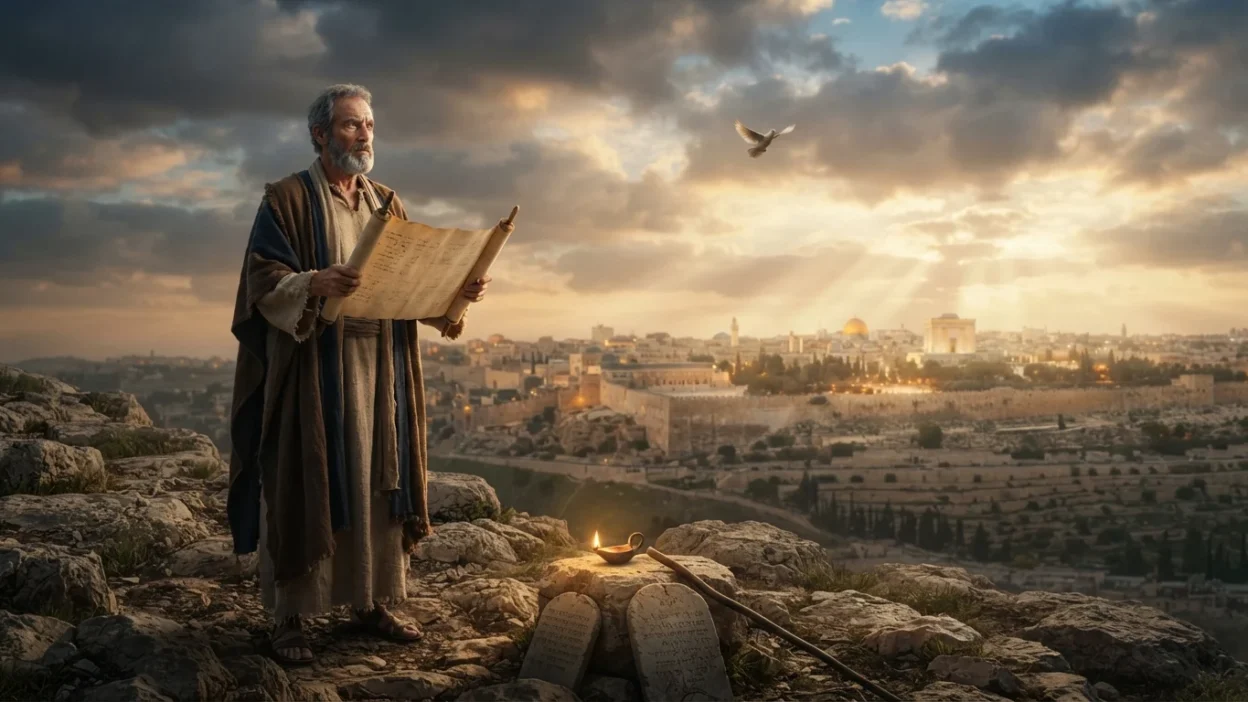
The Bible prophecy meaning is often misunderstood because many people immediately think of predictions about the future or the end of the world. While biblical prophecy can include messages about future events, its purpose is much broader. Prophecy in Scripture involves communicating a message connected with God’s will, calling people to faithfulness, exposing injustice, offering warning, and providing hope.
Understanding the Bible prophecy meaning requires looking at the role of prophets throughout the Old and New Testaments. Biblical prophets spoke in specific historical situations, often addressing kings, nations, and ordinary people. Their messages could concern present behavior, coming consequences, future hope, or God’s promises. Exploring the Bible prophecy meaning helps readers understand prophecy as a major part of the biblical story rather than simply a collection of mysterious predictions.
Quick Answer: What Does Bible Prophecy Mean?
The Bible prophecy meaning refers to a message presented in Scripture as coming from God and communicated through a prophet or prophetic voice. Biblical prophecy may include warnings, teaching, calls to repentance, descriptions of future events, judgment, hope, and promises of restoration.
What Is Bible Prophecy?
In the Bible, prophecy is broader than predicting the future.
A prophet was a person who communicated a message believed to come from God.
Sometimes that message involved future events.
At other times, it addressed present problems.
Prophets spoke against injustice, idolatry, corruption, and unfaithfulness.
They also encouraged people, offered hope, and called communities to return to God.
The Bible prophecy meaning therefore includes both forth-telling and foretelling.
Forth-telling refers to speaking God’s message about a present situation.
Foretelling refers to communicating something connected with future events.
| Aspect | Meaning |
|---|---|
| Prophecy | A message communicated through a prophetic voice |
| Prophet | A person who delivers a divine message |
| Forth-telling | Speaking about present spiritual or moral issues |
| Foretelling | Communicating future events or outcomes |
| Main purpose | Warning, guidance, correction, hope, and restoration |
The Origin and History of Biblical Prophecy
Prophecy has deep roots in the biblical story.
In the Old Testament, prophetic figures appear throughout Israel’s history.
Some, such as Moses, Samuel, Elijah, and Elisha, played important roles in guiding God’s people.
Later, prophets such as Isaiah, Jeremiah, Ezekiel, and the Twelve Minor Prophets delivered messages during periods of political crisis, spiritual decline, exile, and restoration.
These prophets did not usually speak in isolation from history.
Their messages responded to real events and conditions.
They addressed issues such as injustice, false worship, violence, oppression, and political danger.
The Bible prophecy meaning becomes clearer when readers understand this historical context.
What Was the Role of a Prophet in the Bible?
A biblical prophet served as a messenger.
Prophets could challenge leaders, warn nations, comfort suffering people, and call communities to repentance.
Their role was often difficult.
A prophet might deliver a message that people did not want to hear.
For this reason, biblical prophets were not simply predictors.
They were also teachers, reformers, and witnesses.
Their messages frequently emphasized the importance of justice, faithfulness, mercy, and obedience.
| Role of a Prophet | Biblical Purpose |
|---|---|
| Messenger | Communicate God’s message |
| Watchman | Warn people of danger or consequences |
| Teacher | Call people toward truth |
| Critic | Challenge injustice and corruption |
| Comforter | Offer hope during suffering |
| Witness | Point people toward faithfulness |
Major Prophets and Minor Prophets
The Old Testament is commonly divided into Major Prophets and Minor Prophets.
These labels do not mean that some prophets were more important than others.
They mainly refer to the length of the biblical books.
The Major Prophets include Isaiah, Jeremiah, Ezekiel, and Daniel in many Christian arrangements.
The Minor Prophets are a collection of twelve shorter prophetic books, including Hosea, Joel, Amos, Obadiah, Jonah, Micah, and Malachi.
Together, these writings cover a wide range of historical periods and themes.
They demonstrate that biblical prophecy addressed both immediate circumstances and future hope.
Prophecy and the Future
One reason people search Bible prophecy meaning is to understand predictions about the future.
Future-oriented prophecy is certainly present in Scripture.
Some prophetic messages warn about coming judgment.
Others describe restoration, peace, a future king, or the renewal of God’s people.
However, biblical prophecy should not be reduced to a secret timetable.
Many prophecies were spoken to specific historical audiences.
Understanding the original context is essential before applying a passage to modern events.
Different Jewish and Christian traditions also interpret prophetic passages in different ways.
Careful study considers literary genre, historical setting, language, and the larger biblical context.
The Spiritual Meaning of Bible Prophecy
The spiritual Bible prophecy meaning centers on God’s communication, human responsibility, and hope.
Warning
Prophecy can warn people about the consequences of injustice and unfaithfulness.
Repentance
Many prophetic messages invite people to change direction.
Hope
Prophets also offer promises of restoration after suffering.
Faithfulness
Prophecy reminds believers that faith involves actions, justice, and commitment.
God’s Sovereignty
Prophetic messages often emphasize that history and nations are not beyond God’s authority.
| Spiritual Theme | Symbolic Meaning |
|---|---|
| Warning | A call to awareness and change |
| Judgment | Accountability for actions |
| Repentance | Returning to God |
| Hope | Confidence beyond present suffering |
| Restoration | Renewal after loss |
| Light | Truth and divine guidance |
These themes show that prophecy is intended to influence how people live, not simply satisfy curiosity about future events.
Messianic Prophecy in the Bible
Some biblical passages are understood within Christianity as pointing toward the Messiah.
Christians interpret certain texts from Isaiah, Micah, Psalms, and other Old Testament writings in relation to Jesus.
Jewish interpretations of these passages may differ because Judaism and Christianity understand the identity and role of the Messiah differently.
This makes context especially important.
The study of messianic prophecy involves theology, history, and interpretation.
Rather than assuming every reader understands these passages in the same way, it is helpful to recognize the major interpretive traditions surrounding them.
Prophecy in the New Testament
The New Testament continues the theme of prophecy.
John the Baptist is presented as a prophetic figure preparing the way for Jesus.
Jesus speaks about the kingdom of God, judgment, and future events.
The New Testament also contains prophetic material in books such as Revelation.
Prophecy appears within the early Christian community as well.
The Apostle Paul discusses prophecy as a spiritual gift connected with strengthening and encouraging believers.
The Bible prophecy meaning in the New Testament therefore includes teaching, encouragement, warning, and hope.
The Book of Revelation and Biblical Prophecy
Revelation is one of the most well-known prophetic books in the Bible.
It contains vivid imagery, symbols, visions, warnings, and promises.
Because its language is highly symbolic, readers interpret it in different ways.
Some approaches understand much of its imagery in relation to events of the first-century Roman world.
Others focus on future fulfillment.
Still others see recurring spiritual patterns that apply throughout history.
These differences demonstrate why prophecy should be studied carefully.
Symbolic language should not automatically be treated as a literal prediction of a specific modern event.
Prophecy vs. Prediction: What Is the Difference?
Although prophecy can include prediction, the two terms are not identical.
| Prophecy | Prediction |
|---|---|
| May communicate a divine message | Usually forecasts an event |
| Can address present behavior | Usually focuses on the future |
| Includes warning and teaching | Focuses mainly on what may happen |
| May offer hope and restoration | May not have spiritual purpose |
| Found within religious contexts | Can appear in many contexts |
This comparison helps explain why the Bible prophecy meaning is broader than simply knowing what will happen next.
Common Misconceptions About Bible Prophecy
Misconception 1: All prophecy predicts the distant future
Many prophetic messages addressed immediate situations and called people to change.
Misconception 2: Every prophecy has only one possible interpretation
Some passages are interpreted differently across religious traditions and scholarly approaches.
Misconception 3: Prophecy is mainly about fear
Biblical prophecy contains warnings, but it also contains hope, comfort, restoration, and encouragement.
Misconception 4: Every modern event fulfills a prophecy
People should be cautious about automatically connecting current events with biblical predictions.
Misconception 5: Prophets only spoke about spiritual rituals
Biblical prophets also addressed justice, poverty, corruption, violence, and the treatment of vulnerable people.
Why Do People Search for Bible Prophecy Meaning?
People search Bible prophecy meaning for different reasons.
Some are curious about end-times teachings.
Others want to understand what prophets actually did.
Many readers encounter prophetic passages and find their language difficult.
The symbolic imagery of books such as Daniel and Revelation can also create questions.
Studying prophecy helps readers understand the relationship between history, faith, warning, hope, and interpretation.
It also encourages a more balanced view of prophets as messengers who spoke to both their own generation and, in some traditions, to future hope.
Cultural and Modern Interest in Bible Prophecy
Bible prophecy continues to influence books, films, sermons, online discussions, and popular culture.
End-times themes are especially common.
Some people connect prophecy with modern politics, wars, technology, or natural disasters.
Others focus on prophecy as a message about justice and spiritual renewal.
Modern interest can sometimes lead to speculation.
A careful approach recognizes the difference between responsible interpretation and unsupported prediction.
The historical context of Scripture remains an important starting point.
How to Study Biblical Prophecy Wisely
Studying prophecy begins with context.
Ask who originally received the message.
Consider what historical events were happening.
Notice the type of literature being used.
Some passages use poetry, visions, symbols, or direct speeches.
Compare the passage with other parts of Scripture.
It is also helpful to recognize that faithful interpreters may disagree.
The goal should not simply be to discover a hidden code.
Instead, readers can ask what the prophetic message reveals about God, justice, faithfulness, hope, and human responsibility.
The Deeper Symbolism of Biblical Prophecy
The Bible prophecy meaning often points to the idea that God’s truth speaks into both the present and the future.
A prophetic warning can symbolize the need for self-examination.
A call to repentance can symbolize a new beginning.
Promises of restoration can represent hope after loss.
Visions of peace can encourage faith during uncertainty.
These themes give prophecy lasting spiritual importance.
Even when a passage has a specific historical setting, its larger themes can continue to challenge and encourage readers.
Final Thought
The Bible prophecy meaning is much broader than predicting the future. Throughout Scripture, prophecy communicates messages of warning, correction, justice, hope, repentance, and restoration. Biblical prophets spoke to real people facing real political, social, and spiritual challenges. Some messages looked toward future events, while others demanded immediate change. The prophetic tradition also reminds readers that faith is connected with justice, mercy, and responsibility.
From Isaiah and Jeremiah to John the Baptist and Revelation, prophecy remains an important part of the biblical story. Understanding it requires careful attention to history, literary style, and religious interpretation. Ultimately, biblical prophecy invites readers not only to ask what may happen, but also to consider how truth, hope, and faithfulness should shape life today.
FAQs
1. What does Bible prophecy mean?
Bible prophecy refers to messages in Scripture communicated through prophetic figures, often involving warning, teaching, correction, future events, hope, or restoration.
2. Is prophecy only about predicting the future?
No. Biblical prophecy also addresses present problems, calls people to repentance, challenges injustice, and offers hope.
3. Who were the main prophets in the Bible?
Important prophets include Moses, Samuel, Elijah, Elisha, Isaiah, Jeremiah, Ezekiel, Daniel, and the Twelve Minor Prophets.
4. What is messianic prophecy?
Messianic prophecy refers to biblical passages interpreted as concerning a future Messiah. Jewish and Christian traditions may interpret these passages differently.
5. Is the Book of Revelation a prophecy?
Yes. Revelation is a prophetic and apocalyptic book containing symbolic visions, warnings, and promises of hope.
6. How should biblical prophecy be interpreted?
Prophecy should be studied by considering its historical context, literary style, original audience, language, and place within the larger biblical story.
7. Does every modern event fulfill biblical prophecy?
No. Modern events should not automatically be connected to biblical prophecy without careful interpretation and strong contextual reasons.