
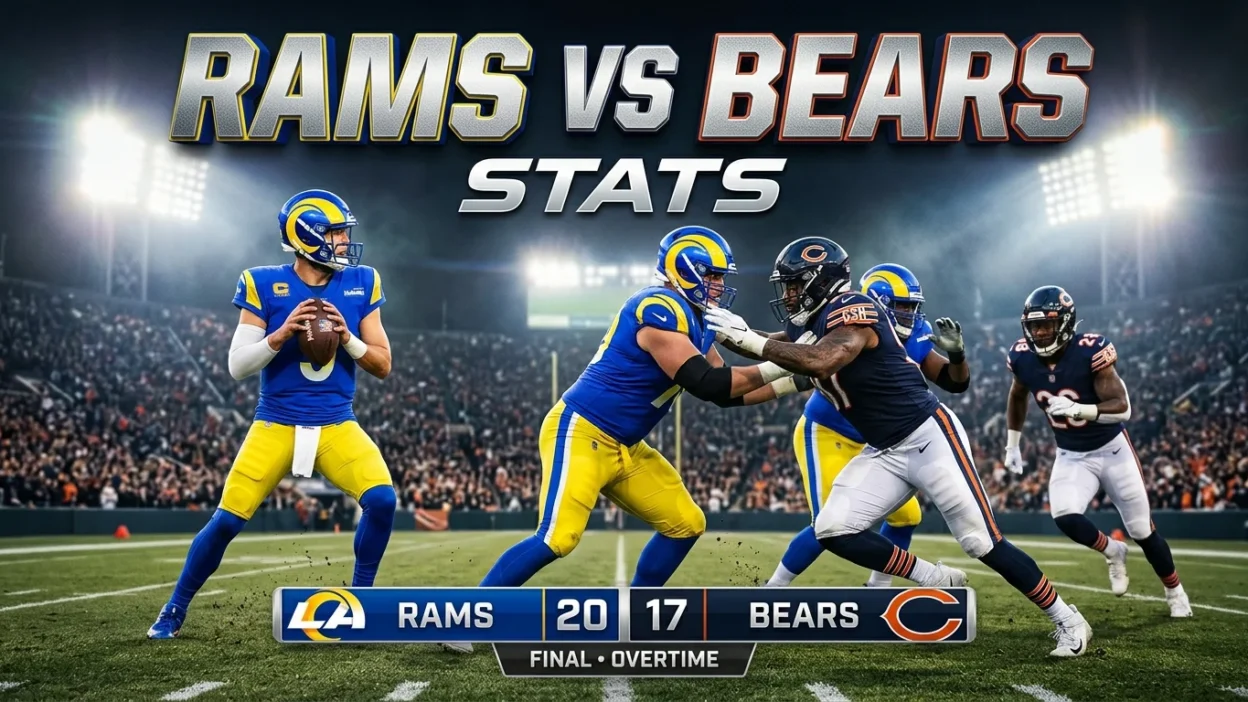
The Los Angeles Rams vs Chicago Bears stats from their January 18, 2026, NFL playoff matchup reveal how a close game was decided by turnovers, rushing touchdowns, and overtime execution. The Rams defeated the Bears 20–17 in overtime at Soldier Field to advance to the NFC Championship Game. Kyren Williams scored two rushing touchdowns for Los Angeles, while Harrison Mevis kicked the game-winning 42-yard field goal.
Chicago produced more total yards than Los Angeles, but quarterback Caleb Williams threw three interceptions. Rams quarterback Matthew Stafford passed for 258 yards without throwing a touchdown or an interception. The Bears gained 417 total yards compared with the Rams’ 340, yet their turnovers proved costly. These statistics show why total yardage does not always determine the winner in football. In a closely contested playoff game, protecting the ball, finishing drives, and making crucial defensive plays can matter more than gaining extra yards.
Quick Answer: Los Angeles Rams vs Chicago Bears Stats
The Los Angeles Rams defeated the Chicago Bears 20–17 in overtime on January 18, 2026, in the NFC Divisional Playoff. Kyren Williams rushed for two touchdowns, Matthew Stafford passed for 258 yards, and Caleb Williams threw for 257 yards with two touchdowns and three interceptions. The Rams won despite Chicago gaining more total yards.
Why Do People Search for Los Angeles Rams vs Chicago Bears Stats?
Fans search for Rams vs Bears statistics to understand how the game unfolded, which players performed best, and why one team won. The box score provides information about passing, rushing, receiving, turnovers, and scoring.
The January 18 playoff game was especially interesting because Chicago gained more yards and held the ball longer, but Los Angeles made better use of key opportunities.
The most important numbers include:
- Final score: Rams 20, Bears 17
- Total yards: Rams 340, Bears 417
- Passing yards: Matthew Stafford 258, Caleb Williams 257
- Rushing touchdowns: Kyren Williams scored two for Los Angeles
- Turnovers: Chicago threw three interceptions
- Winning play: Harrison Mevis converted a 42-yard field goal in overtime
These figures explain the main contrast between the teams: Chicago moved the ball effectively, while the Rams benefited from defensive takeaways and successful scoring drives.
Los Angeles Rams Stats: What Do They Show?
The Rams’ statistics highlight a balanced approach built around rushing touchdowns, controlled passing, and defensive playmaking.
Matthew Stafford completed 20 of 42 passes for 258 yards. Although he did not throw a touchdown, he avoided interceptions. Kyren Williams carried the ball 21 times for 87 yards and scored twice.
Los Angeles recorded 340 total yards, including 111 rushing yards. The team also avoided turnovers, an important advantage in a playoff game decided by three points.
Rams Passing Stats
| Player | Completions/Attempts | Passing Yards | TDs | INTs |
|---|---|---|---|---|
| Matthew Stafford | 20/42 | 258 | 0 | 0 |
Stafford’s passing performance helped Los Angeles move the ball, but the Rams relied on their running game to finish drives. His ability to protect possession was valuable because Chicago’s defense could not capitalize on an interception.
Rams Rushing Stats
| Player | Carries | Rushing Yards | TDs |
|---|---|---|---|
| Kyren Williams | 21 | 87 | 2 |
| Blake Corum | 6 | 19 | 0 |
| Puka Nacua | 2 | 6 | 0 |
| Jordan Whittington | 1 | 0 | 0 |
| Matthew Stafford | 1 | -1 | 0 |
Kyren Williams was Los Angeles’ leading rusher and most important scoring threat. His four-yard touchdown in the first quarter gave the Rams an early lead, and his five-yard touchdown in the fourth quarter helped put the team ahead again.
Rams Receiving Stats
| Player | Receptions | Receiving Yards | TDs |
|---|---|---|---|
| Puka Nacua | 5 | 56 | 0 |
| Colby Parkinson | 3 | 56 | 0 |
| Jordan Whittington | 2 | 35 | 0 |
| Davante Adams | 2 | 24 | 0 |
| Kyren Williams | 4 | 30 | 0 |
| Tyler Higbee | 1 | 27 | 0 |
Puka Nacua and Colby Parkinson each gained 56 receiving yards. Their contributions helped the Rams move the ball through the air, even though no Los Angeles player caught a touchdown pass.
Chicago Bears Stats: What Do They Reveal?
The Bears’ statistics show that their offense gained considerable yardage but struggled with turnovers. Caleb Williams passed for 257 yards and two touchdowns, while D’Andre Swift led the rushing attack with 76 yards.
Chicago accumulated 417 total yards and recorded 23 first downs. However, three interceptions interrupted promising drives and gave Los Angeles additional opportunities.
Bears Passing Stats
| Player | Completions/Attempts | Passing Yards | TDs | INTs |
|---|---|---|---|---|
| Caleb Williams | 23/42 | 257 | 2 | 3 |
Caleb Williams threw touchdown passes to D.J. Moore and Cole Kmet. Moore’s three-yard touchdown helped Chicago take the lead in the second quarter, while Kmet’s 14-yard score late in the fourth quarter tied the game and forced overtime.
Despite those important plays, the interceptions were costly. Cobie Durant recorded two interceptions for Los Angeles, and Kamren Curl added another.
Bears Rushing Stats
| Player | Carries | Rushing Yards | TDs |
|---|---|---|---|
| D’Andre Swift | 19 | 76 | 0 |
| Caleb Williams | 5 | 40 | 0 |
| Kyle Monangai | 13 | 36 | 0 |
| D.J. Moore | 1 | 8 | 0 |
| Luther Burden III | 1 | 0 | 0 |
Swift led the Bears with 76 rushing yards, while Caleb Williams added 40 yards on the ground. Chicago’s running game was productive, but the team did not score a rushing touchdown.
Bears Receiving Stats
| Player | Receptions | Receiving Yards | TDs |
|---|---|---|---|
| Colston Loveland | 4 | 56 | 0 |
| D.J. Moore | 5 | 52 | 1 |
| Rome Odunze | 2 | 44 | 0 |
| Kyle Monangai | 4 | 36 | 0 |
| Cole Kmet | 3 | 31 | 1 |
| Luther Burden III | 3 | 24 | 0 |
Colston Loveland led Chicago in receiving yards with 56. Moore and Kmet scored the Bears’ two touchdowns through the air, while Odunze added 44 yards on two catches.
Rams vs Bears Stats Comparison Table
The team comparison reveals why Los Angeles won even though Chicago gained more yards.
| Statistic | Los Angeles Rams | Chicago Bears |
|---|---|---|
| Final score | 20 | 17 |
| Total yards | 340 | 417 |
| Net passing yards | 229 | 257 |
| Rushing yards | 111 | 160 |
| First downs | 22 | 23 |
| Total plays | 77 | 81 |
| Turnovers lost | 0 | 3 |
| Time of possession | 32:26 | 39:15 |
| Third-down conversions | 5/16 | 9/19 |
| Penalties | 1 for 5 yards | 3 for 24 yards |
Chicago held advantages in total yards, rushing yards, first downs, and possession time. However, the Bears’ three interceptions were a major disadvantage. Los Angeles protected the ball and scored two rushing touchdowns before winning the game with a field goal in overtime.
When Should You Focus on Player Stats or Team Stats?
Both types of statistics help explain a football game, but they answer different questions.
Focus on Player Stats When:
- You want to identify the leading passer, rusher, or receiver.
- You are comparing quarterback performances.
- You want to know who scored touchdowns.
- You are evaluating individual defensive contributions.
For example, Kyren Williams’ two rushing touchdowns explain how the Rams converted drives into points.
Focus on Team Stats When:
- You want to compare overall offensive production.
- You want to understand possession and third-down performance.
- You are examining turnovers and penalties.
- You want to understand why a team lost despite gaining more yards.
For example, Chicago’s 417 total yards show that the Bears moved the ball effectively. Their three interceptions explain why that yardage did not produce a victory.
10 Examples of How to Read Rams vs Bears Statistics
- Final score: The Rams won 20–17, meaning they scored three more points than Chicago.
- Passing yards: Stafford passed for 258 yards, one more than Caleb Williams’ 257.
- Passing touchdowns: Caleb Williams threw two touchdowns, while Stafford threw none.
- Interceptions: Chicago threw three interceptions, while the Rams threw none.
- Rushing production: The Bears gained 160 rushing yards compared with 111 for Los Angeles.
- Leading Rams rusher: Kyren Williams gained 87 yards and scored twice.
- Leading Bears rusher: D’Andre Swift recorded 76 rushing yards.
- Receiving leader: Puka Nacua and Colby Parkinson each recorded 56 receiving yards for Los Angeles.
- Possession: Chicago held the ball for 39 minutes and 15 seconds, more than the Rams.
- Overtime result: Harrison Mevis’ 42-yard field goal secured the Rams’ victory.
These examples demonstrate why the box score should be read as a complete picture rather than judged by one statistic.
Common Mistakes When Reading Rams vs Bears Stats
Mistake 1: Assuming more total yards means a win.
Chicago gained 417 yards but lost. Yardage measures offensive production, not the final result.
Mistake 2: Comparing passing yards without considering turnovers.
Caleb Williams and Stafford finished with nearly identical passing totals, but Caleb threw three interceptions. Those turnovers changed the game.
Mistake 3: Ignoring rushing touchdowns.
Kyren Williams’ two touchdowns accounted for a significant portion of the Rams’ scoring. Touchdowns matter more directly to the final score than yards alone.
Mistake 4: Treating time of possession as the deciding factor.
Chicago controlled the ball longer, but the Rams made better use of critical possessions.
Mistake 5: Forgetting special teams.
Harrison Mevis’ overtime field goal decided the game. Kicking statistics and special-teams plays are essential when analyzing a close NFL matchup.
Memory Trick: How to Remember the Key Stats
Use this simple reminder:
- Yards tell you how far a team moved the ball.
- Touchdowns tell you how effectively it finished drives.
- Turnovers show how often it gave away possession.
- The final score determines the winner.
For this game, remember three numbers: 20–17, 417, and 3. The Rams won 20–17, Chicago gained 417 yards, and the Bears threw three interceptions.
Those numbers summarize the game’s central story: Chicago gained more yards, but the Rams protected the ball and made decisive plays.
American vs British English: Football Terminology
The Rams vs Bears matchup was an American football game, so its statistics use NFL terminology.
In American English, a touchdown is worth six points before any extra-point attempt. A field goal is worth three points. A rushing yard is gained by advancing the ball on a running play, while a passing yard measures yardage gained through completed passes.
In British English, the word football usually refers to association football, known as soccer in the United States. American football is generally identified by its full name to avoid confusion.
These language differences do not change the statistics, but they can help international readers understand an NFL box score.
Similar Terms in NFL Player Statistics
- Passing yards: Yards gained through completed forward passes.
- Rushing yards: Yards gained by running with the ball.
- Receiving yards: Yards gained by a player catching a pass and advancing the ball.
- Touchdown: A scoring play worth six points.
- Interception: A defensive player catches a pass intended for the offense.
- Sack: A defensive player tackles the quarterback behind the line of scrimmage during a passing play.
- First down: A new set of downs awarded when the offense meets the required yardage or earns one through a penalty.
- Time of possession: The amount of time a team controls the ball.
- Overtime: Extra playing time used to determine the winner when a game is tied after regulation.
Understanding these terms makes it easier to compare player performances and interpret the final box score.
Final Verdict: Rams vs Bears Stats
The Rams vs Bears playoff game demonstrated that turnovers can outweigh a team’s advantage in total yardage. Chicago gained 417 yards, recorded 23 first downs, and held the ball for more than 39 minutes. Yet three interceptions disrupted the Bears’ offense and helped Los Angeles stay in control of the most important moments.
Kyren Williams scored two rushing touchdowns for the Rams, while Cobie Durant made two crucial interceptions. Caleb Williams produced two touchdown passes, including a late score that forced overtime, but the Bears could not finish the game with a win. Harrison Mevis ultimately converted the decisive field goal.
FAQs
Who won the Los Angeles Rams vs Chicago Bears game?
The Los Angeles Rams defeated the Chicago Bears 20–17 in overtime on January 18, 2026, in the NFC Divisional Playoff.
How many passing yards did Matthew Stafford record?
Matthew Stafford passed for 258 yards, completing 20 of 42 attempts with no touchdowns or interceptions.
How many passing yards did Caleb Williams record?
Caleb Williams passed for 257 yards, completing 23 of 42 attempts. He threw two touchdown passes and three interceptions.
Who scored the Rams’ touchdowns?
Kyren Williams scored both Rams touchdowns on rushing plays, with runs of four yards and five yards.
Which Bears players scored touchdowns?
D.J. Moore caught a three-yard touchdown pass, and Cole Kmet caught a 14-yard touchdown pass.
Which team gained more total yards?
The Chicago Bears gained 417 total yards, while the Los Angeles Rams gained 340.
How did the Rams win in overtime?
The Rams drove into field-goal range, and Harrison Mevis converted a 42-yard field goal to secure the 20–17 victory.
Remember This
The Los Angeles Rams vs Chicago Bears stats are best understood by looking at scoring, turnovers, and individual performances together.
- The Rams won 20–17 in overtime.
- Kyren Williams scored two rushing touchdowns.
- Matthew Stafford passed for 258 yards without an interception.
- Caleb Williams passed for 257 yards and two touchdowns but threw three interceptions.
- Chicago gained more total yards, but Los Angeles made the decisive plays.
The most important lesson is that offensive yardage alone does not guarantee victory. Teams must protect the football and convert their opportunities into points.
Conclusion
The Los Angeles Rams vs Chicago Bears matchup on January 18, 2026, was a closely contested playoff game that highlighted the importance of turnovers and finishing drives. Chicago produced more total yards and controlled possession for longer, but three interceptions made it harder for the Bears to turn their offensive production into points. Kyren Williams’ two rushing touchdowns gave Los Angeles a reliable scoring advantage, while Cobie Durant’s interceptions helped disrupt Chicago’s passing attack.
The game ended 20–17 after Harrison Mevis kicked a 42-yard field goal in overtime. For fans reviewing the Rams vs Bears stats, the key takeaway is that total yardage tells only part of the story. Passing efficiency, rushing touchdowns, defensive takeaways, and special-teams execution all influence the outcome of an NFL game.