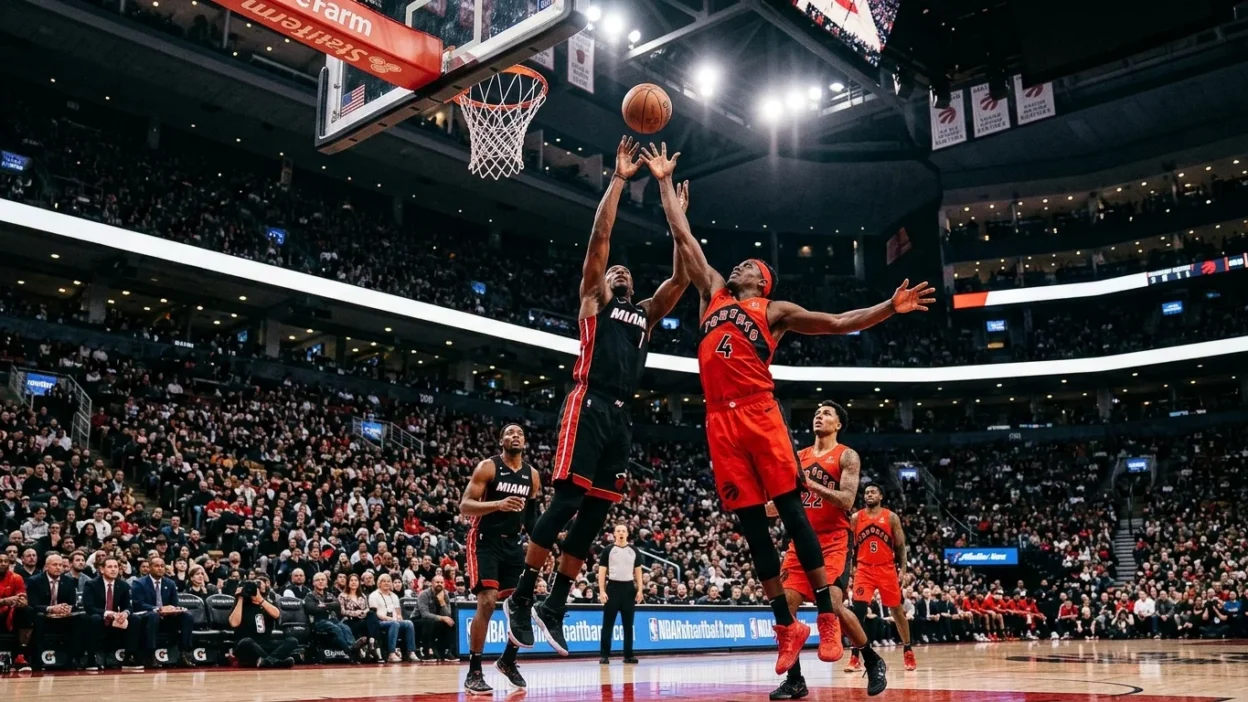
The Miami Heat vs Toronto Raptors match player stats from October 3, 2026, show how Miami secured a convincing 129–105 victory over Toronto in a preseason matchup. Miami built a strong first-quarter lead and maintained its advantage throughout the game. Tim Hardaway led the Heat with 14 points, while Pelle Larsson added 13 points. For Toronto, RJ Barrett and Tyreke Key each scored 15 points, making them the Raptors’ joint top scorers.
The game offered useful insights into both teams’ scoring, shooting, rebounding, and playmaking. Miami finished with a better field-goal percentage and made more free throws, helping it create a 24-point winning margin. Toronto had several productive individual performances, but the team struggled to match Miami’s early offensive pressure. The following breakdown covers the final score, quarter-by-quarter results, key player statistics, team comparison, and the main lessons from the matchup.
Quick Answer
The Miami Heat defeated the Toronto Raptors 129–105 on October 3, 2026, in a preseason game. Tim Hardaway scored 14 points for Miami, while Pelle Larsson added 13. RJ Barrett and Tyreke Key led Toronto with 15 points each. Miami dominated the first quarter, outscoring Toronto 41–23.
Match Overview
| Match Detail | Information |
|---|---|
| Teams | Miami Heat vs Toronto Raptors |
| Date | October 3, 2026 |
| Competition | NBA preseason |
| Venue | Videotron Centre, Quebec City |
| Final Score | Miami Heat 129–105 Toronto Raptors |
| Winning Team | Miami Heat |
| Winning Margin | 24 points |
| Miami’s Top Scorer | Tim Hardaway — 14 points |
| Toronto’s Top Scorers | RJ Barrett and Tyreke Key — 15 points each |
Miami’s fast start set the tone for the contest. The Heat scored 41 points in the opening quarter and entered halftime with a 76–55 lead. Toronto improved its scoring in the following periods, but the early deficit proved difficult to overcome.
Miami Heat vs Toronto Raptors Score by Quarter
| Quarter | Miami Heat | Toronto Raptors |
|---|---|---|
| First Quarter | 41 | 23 |
| Second Quarter | 35 | 32 |
| Third Quarter | 19 | 25 |
| Fourth Quarter | 34 | 25 |
| Final Score | 129 | 105 |
Miami won the first two quarters by a combined 21 points. Toronto performed better in the third quarter, outscoring Miami 25–19, but the Heat responded with 34 points in the fourth to finish comfortably ahead.
Miami Heat Player Stats
The Heat received scoring contributions from several players rather than relying on one high-volume scorer. Tim Hardaway led the team with 14 points, while Pelle Larsson and Andrew Wiggins also reached double figures.
| Miami Player | Points | Rebounds | Assists |
|---|---|---|---|
| Tim Hardaway | 14 | 0 | 0 |
| Pelle Larsson | 13 | 2 | 2 |
| Andrew Wiggins | 12 | 1 | 0 |
| Nikola Jović | 11 | 7 | 4 |
| Bez Mbeng | 11 | 3 | 3 |
| Ian Schieffelin | 11 | 3 | 1 |
| Bam Adebayo | 10 | 6 | 0 |
| Giannis Antetokounmpo | 9 | 4 | 7 |
| Myron Gardner | 7 | 4 | 2 |
| Vladislav Goldin | 6 | 1 | 0 |
Stats show points, rebounds, and assists from the October 3 game.
Miami’s Standout Performers
Tim Hardaway: Hardaway led Miami with 14 points and made all four of his field-goal attempts, including three three-pointers. His efficient shooting helped the Heat establish an early advantage.
Pelle Larsson: Larsson scored 13 points, collected two rebounds, and recorded two assists. He also made all seven of his free throws, converting his opportunities at the line.
Andrew Wiggins: Wiggins contributed 12 points and made four of his six field-goal attempts. He also connected on four three-pointers, providing valuable outside shooting.
Nikola Jović: Jović recorded 11 points, seven rebounds, four assists, and two blocks. His all-around contribution helped Miami in several areas beyond scoring.
Giannis Antetokounmpo: Antetokounmpo finished with nine points, four rebounds, and seven assists. His passing helped create scoring opportunities for teammates during his time on the court.
Toronto Raptors Player Stats
Toronto had two leading scorers, with RJ Barrett and Tyreke Key each finishing with 15 points. Chucky Hepburn and Scottie Barnes also reached double figures.
| Toronto Player | Points | Rebounds | Assists |
|---|---|---|---|
| RJ Barrett | 15 | 3 | 1 |
| Tyreke Key | 15 | 1 | 0 |
| Scottie Barnes | 11 | 2 | 2 |
| Chucky Hepburn | 11 | 5 | 2 |
| Jakob Poeltl | 9 | 1 | 1 |
| Jaden Bradley | 9 | 3 | 2 |
| Ja’Kobe Walter | 8 | 5 | 1 |
| Malachi Smith | 7 | 4 | 2 |
| Collin Murray-Boyles | 6 | 9 | 1 |
| Nimari Burnett | 6 | 3 | 3 |
| Immanuel Quickley | 5 | 2 | 3 |
| Jamal Shead | 3 | 5 | 8 |
Toronto’s Standout Performers
RJ Barrett: Barrett scored 15 points, grabbed three rebounds, and made seven of eight free throws. He was one of Toronto’s most productive offensive players.
Tyreke Key: Key also scored 15 points, shooting five of nine from the field and four of seven from three-point range. His outside shooting helped Toronto keep scoring during the game.
Chucky Hepburn: Hepburn recorded 11 points, five rebounds, two assists, and four steals. His defensive activity stood out even as Toronto struggled to close the scoring gap.
Scottie Barnes: Barnes contributed 11 points, two rebounds, and two assists. He also recorded three steals, showing activity on the defensive end.
Jamal Shead: Shead scored three points but led Toronto with eight assists. His playmaking helped teammates find scoring opportunities.
Team Stats Comparison
The team statistics explain why Miami won by 24 points. The Heat shot more accurately from the field and converted a much higher number of free throws. Toronto recorded more steals, but that defensive activity was not enough to offset Miami’s scoring efficiency.
| Team Statistic | Miami Heat | Toronto Raptors |
|---|---|---|
| Final Score | 129 | 105 |
| Field Goals Made | 42 | 37 |
| Field Goals Attempted | 86 | 94 |
| Field-Goal Percentage | 48% | 39% |
| Three-Pointers Made | 14 | 12 |
| Three-Point Percentage | 35% | 29% |
| Free Throws Made | 31 | 19 |
| Free-Throw Percentage | 86% | 63% |
| Rebounds | 55 | 43 |
| Assists | 31 | 25 |
| Steals | 9 | 17 |
| Blocks | 7 | 2 |
Team totals are based on the available game statistics.
Miami made five more field goals and 12 more free throws than Toronto. Its 55 rebounds also gave the Heat a 12-rebound advantage. Toronto’s 17 steals were a positive defensive statistic, but they did not translate into enough efficient scoring to change the outcome.
Why Did Miami Heat Win?
1. Strong First-Quarter Scoring
Miami scored 41 points in the first quarter, while Toronto managed only 23. This 18-point difference gave the Heat an early cushion and forced the Raptors to play from behind.
2. More Efficient Shooting
Miami converted 48% of its field-goal attempts, compared with Toronto’s 39%. The Heat also made 14 three-pointers, two more than the Raptors.
3. Better Free-Throw Production
Miami made 31 of 36 free throws. Toronto made 19 of 30. This 12-point difference at the free-throw line was a major part of the final margin.
4. Balanced Team Contributions
Miami had multiple players scoring between nine and 14 points. This distribution helped the team maintain offensive production across different lineups.
What Were the Main Takeaways?
The game provided several useful observations about both teams:
- Miami’s offense started quickly: The Heat’s first-quarter performance established control early.
- Toronto had individual scoring highlights: Barrett and Key both scored 15 points.
- Miami was more efficient: Better field-goal and free-throw percentages helped create the winning margin.
- Toronto showed defensive activity: The Raptors recorded 17 steals and received eight assists from Jamal Shead.
- The game was a preseason contest: The result offers a snapshot of that matchup rather than a regular-season standings result.
FAQs
1. Who won the Miami Heat vs Toronto Raptors game?
The Miami Heat defeated the Toronto Raptors 129–105 on October 3, 2026.
2. Who was Miami’s top scorer?
Tim Hardaway led Miami with 14 points. Pelle Larsson scored 13, while Andrew Wiggins added 12.
3. Who led Toronto in scoring?
RJ Barrett and Tyreke Key were Toronto’s joint leading scorers, with 15 points each.
4. How many points did Giannis Antetokounmpo score?
Antetokounmpo scored nine points and recorded four rebounds and seven assists.
5. How many assists did Jamal Shead record?
Jamal Shead recorded eight assists, the highest total for Toronto in this game.
6. Which team shot better from the field?
Miami shot 48% from the field, while Toronto shot 39%.
7. Was this a regular-season game?
No. The October 3, 2026 matchup was an NBA preseason game.
Remember This
The main figures to remember from the Miami Heat vs Toronto Raptors matchup are the 129–105 final score, Miami’s 41-point first quarter, and the 24-point winning margin. Tim Hardaway led Miami with 14 points, while RJ Barrett and Tyreke Key scored 15 each for Toronto. Miami’s shooting efficiency and free-throw advantage were key differences in the result.
Conclusion
The Miami Heat earned a convincing 129–105 win over the Toronto Raptors on October 3, 2026. A powerful first quarter gave Miami an early lead, and the team maintained its advantage with efficient shooting and strong free-throw production. Tim Hardaway led the Heat in scoring, while Pelle Larsson, Andrew Wiggins, and Nikola Jović made valuable contributions. Toronto received 15 points apiece from RJ Barrett and Tyreke Key, and Jamal Shead led the team in assists. Although the Raptors recorded more steals, Miami’s shooting accuracy and rebounding helped secure the victory. As a preseason game, the matchup offered an early look at player contributions and team performance ahead of the regular season.