
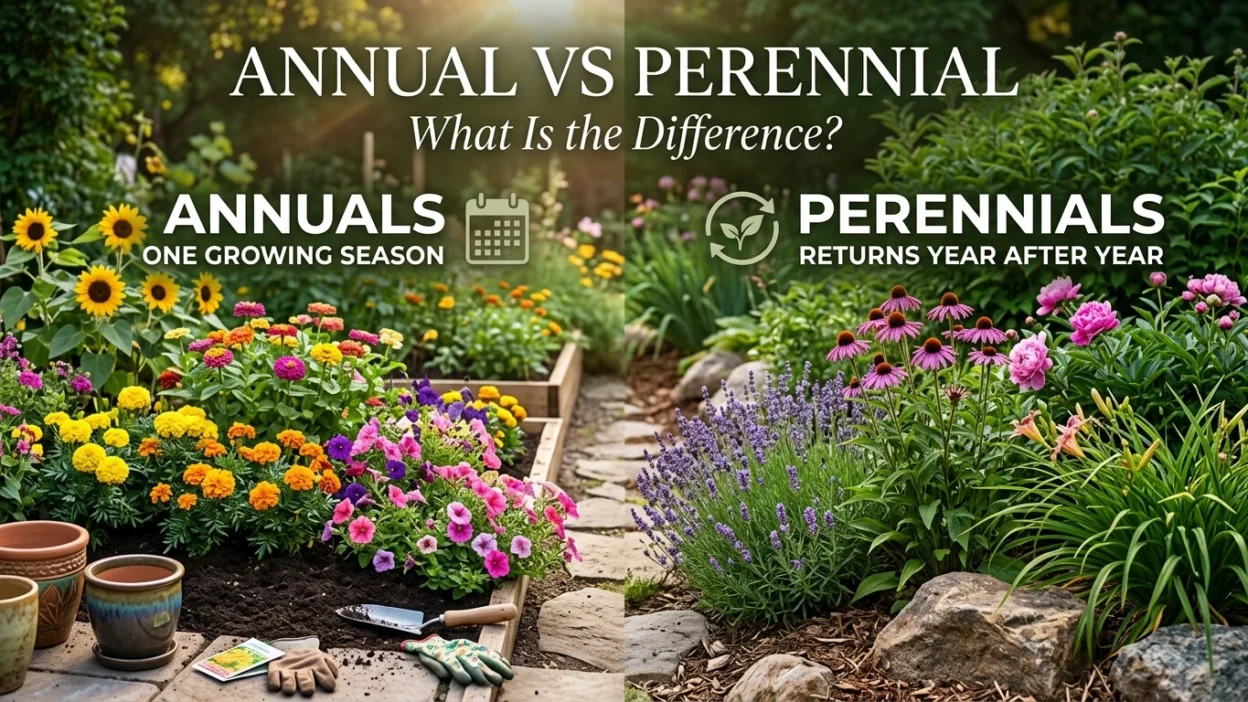
Annual vs perennial is a common comparison in gardening, landscaping, and plant care. Both terms describe how plants grow and complete their life cycles, but they have one important difference: annual plants generally complete their life cycle in one growing season, while perennial plants live for more than two years. Understanding this difference can help you choose the right plants for your garden, flower beds, or outdoor containers.
Annual flowers are popular for their bright colors and seasonal displays, while perennial plants are valued for returning year after year. Some annuals grow quickly and bloom for months, whereas many perennials need time to establish strong roots before producing their best flowers. In this guide, you will learn the meanings of annual and perennial, how to distinguish them, when to use each term, and how to avoid common gardening mistakes.
Quick Answer: Annual vs Perennial
An annual plant completes its life cycle in one growing season, producing seeds before dying. A perennial plant lives for more than two years and can grow again across multiple seasons. Annuals often provide quick, seasonal color, while perennials can offer long-term growth with suitable care and growing conditions.
Why People Confuse Annual and Perennial
People often confuse annual and perennial because both types of plants can flower, produce seeds, and grow in the same garden. Their differences are not always obvious when you look at a plant for the first time.
The main distinction is the plant’s life cycle. Annuals usually grow, flower, produce seeds, and die within one growing season. Perennials survive beyond that period, often becoming dormant during cold or unfavorable weather before growing again.
Another source of confusion is climate. A plant that is perennial in a warm region may be grown as an annual in a colder region if it cannot survive the winter outdoors.
First Word: What Does Annual Mean?
The word annual means occurring once every year or lasting for one year, depending on context. In gardening, an annual plant completes its life cycle in a single growing season.
Annuals generally grow from seed, develop leaves and stems, flower, produce seeds, and then die. Gardeners often plant them when they want fresh colors or a new design each season.
Examples of popular annual flowers include:
- Marigolds
- Petunias
- Zinnias
- Sunflowers
- Cosmos
- Impatiens
Annuals are useful for filling empty spaces in flower beds, creating seasonal displays, and adding bright colors to containers. However, many annuals need to be replanted each year unless they naturally reseed themselves.
Second Word: What Does Perennial Mean?
The word perennial describes something that continues for a long time or recurs over several years. In gardening, a perennial plant lives for more than two years.
Many perennial plants survive unfavorable seasons through their roots, bulbs, crowns, or other underground structures. Some lose their above-ground growth during winter and return when conditions improve. Others remain green throughout the year in suitable climates.
Examples of popular perennial plants include:
- Lavender
- Coneflowers
- Peonies
- Hostas
- Daylilies
- Many varieties of salvia
Perennials can be a practical choice for gardeners who want lasting planting arrangements. Once established, many require less replanting than annuals, although watering, pruning, feeding, and dividing may still be necessary.
Annual vs Perennial: Comparison Table
| Feature | Annual Plants | Perennial Plants |
|---|---|---|
| Life span | One growing season | More than two years |
| Life cycle | Usually completed in one season | Continues over multiple years |
| Replanting | Usually needed each season | Usually not needed every year |
| Flowering | Often flowers in its first season | May flower in the first year or later |
| Seasonal behavior | Dies after completing its life cycle | May regrow after dormancy |
| Initial garden effect | Often provides quick color | May take time to establish |
| Long-term cost | Seeds or plants may need replacing | Can provide value over several years |
| Examples | Marigold, zinnia, petunia | Lavender, peony, coneflower |
When to Use Annual and Perennial Plants
Choose annuals when you want immediate seasonal color, flexible garden designs, or flowers that can be changed every year. They work well in hanging baskets, window boxes, containers, and flower beds that need a fresh appearance each season.
Choose perennials when you want plants that can remain in the same location for several years. They are useful for permanent flower borders, established landscapes, and gardens where you want plants to return after their dormant period.
You can also combine both types. For example, plant perennial lavender along a garden border and add annual petunias in containers nearby. This creates a lasting structure with opportunities to change colors each year.
10 Examples of Annual and Perennial Plants
- Marigold — Annual: Commonly grown for its bright orange or yellow flowers during one growing season.
- Petunia — Annual: Popular in hanging baskets and containers for its colorful blooms.
- Zinnia — Annual: Known for vivid flowers and its popularity in summer gardens.
- Sunflower — Usually annual: Many familiar garden varieties complete their life cycle in one season.
- Cosmos — Annual: Produces delicate flowers and can reseed under suitable conditions.
- Lavender — Perennial: Can return year after year in a suitable climate with well-drained soil.
- Peony — Perennial: A long-lived garden plant known for its large, attractive flowers.
- Coneflower — Perennial: Often grown in flower borders and pollinator-friendly gardens.
- Hosta — Perennial: Valued mainly for its foliage and ability to grow again after dormancy.
- Daylily — Perennial: Grows from persistent roots and can produce flowers over many seasons.
Plant classifications can vary by species and growing conditions. Always check the variety’s requirements for your climate.
Common Mistakes When Choosing Plants
Assuming annual means the plant flowers only once: Annual refers to its life cycle, not necessarily the number of flowers it produces. An annual may bloom repeatedly throughout its growing season.
Assuming every perennial stays green in winter: Many perennials lose their above-ground growth or become dormant during cold weather.
Believing perennials require no maintenance: Perennials may need pruning, watering, fertilizing, dividing, or protection from extreme weather.
Expecting every perennial to bloom immediately: Some need time to establish roots before producing abundant flowers.
Ignoring local climate: A perennial in one region may not survive winter in another. Temperature, soil, moisture, and sunlight all affect plant survival.
Memory Trick: Annual = One Season, Perennial = Persistent
A simple way to remember the difference is to connect annual with one growing season and perennial with persistence.
- Annual: Complete life cycle within one growing season.
- Perennial: Persists for more than two years.
When shopping for plants, remember that annuals are often chosen for seasonal displays, while perennials are often chosen for longer-lasting garden structure.
American vs British English
The words annual and perennial have the same basic meanings in American and British English. However, gardening terminology can vary slightly depending on the region and climate.
| Term | American English | British English |
|---|---|---|
| Annual plant | Plant completing its life cycle in one growing season | Same basic meaning |
| Perennial plant | Plant living for more than two years | Same basic meaning |
| Garden bed | Common gardening term | Flower bed is also widely used |
| Yard | Common term for the outdoor area around a home | Garden is often used more broadly |
In both varieties of English, gardeners use annual and perennial to describe plant life cycles. Regional climate can affect how a particular plant is grown.
Similar Words: Biennial, Annual, and Perennial
A related term is biennial, which describes a plant that normally completes its life cycle over two growing seasons.
| Plant type | Typical life cycle | Example |
|---|---|---|
| Annual | One growing season | Marigold |
| Biennial | Two growing seasons | Some varieties of foxglove |
| Perennial | More than two years | Peony |
A biennial plant often grows leaves and roots during its first season, then flowers and produces seeds during its second. This is different from annuals, which usually complete their life cycle within one growing season, and perennials, which can survive for many years.
Final Verdict: Which Is Better?
Neither annual nor perennial plants are automatically better. The right choice depends on your garden goals, climate, budget, and the amount of maintenance you prefer.
Annuals are excellent for quick color and seasonal variety. Perennials are useful for building a garden that can return year after year. Combining both gives you flexibility, lasting structure, and colorful displays.
Before buying a plant, check its expected life cycle, sunlight requirements, soil preferences, and winter hardiness. Choosing plants suited to your growing conditions is more important than selecting them based on life span alone.
FAQs
1. What is the main difference between annual and perennial plants?
Annual plants usually complete their life cycle in one growing season. Perennial plants live for more than two years and can grow again across multiple seasons.
2. Do annual flowers come back every year?
Most annual plants die after completing their life cycle. Some can produce seeds that germinate naturally, creating new plants the following season.
3. Do perennial plants bloom every year?
Many established perennials flower each year under suitable conditions, but bloom timing and frequency depend on the plant species, climate, and care.
4. Are annuals easier to grow than perennials?
Some annuals are easy to grow and flower quickly, while others need regular care. Perennials may require more patience at first but can become established over time.
5. Which is cheaper, annual or perennial plants?
Annuals may cost less initially, but they often need to be purchased again each season. Perennials may cost more at first but can provide value over several years.
6. Can a perennial plant die in winter?
Yes. Some perennials cannot survive extreme cold, while others naturally become dormant and return when temperatures improve. Climate suitability is important.
7. What is the difference between annual, biennial, and perennial?
Annuals usually complete their life cycle in one growing season, biennials normally take two growing seasons, and perennials live for more than two years.
Remember This
Annual plants usually live for one growing season, while perennial plants survive for more than two years. Annuals offer seasonal flexibility, and perennials can provide lasting growth. Your climate and the plant’s specific requirements determine which option will work best.
Conclusion
Understanding annual vs perennial makes choosing garden plants easier. Annuals are a good choice when you want quick, colorful displays that can change with the seasons. Perennials are ideal when you want plants that can return over several years and help create a stable garden design.
You do not have to choose just one type. A combination of annuals and perennials can give your garden bright seasonal flowers alongside dependable, long-lasting plants. Check each plant’s growing needs and local hardiness before planting to get the best results.