
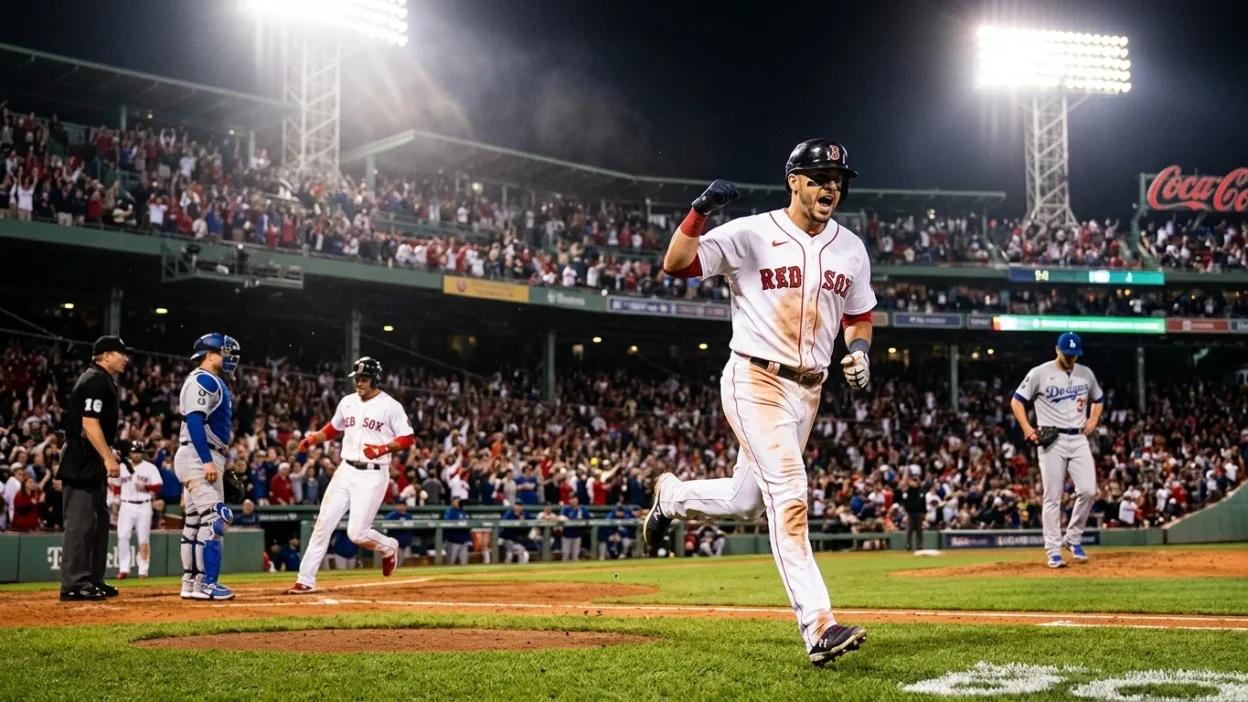
The Dodgers vs Red Sox match player stats from August 2, 2026, show how the Boston Red Sox defeated the Los Angeles Dodgers 8–4 at Dodger Stadium. Boston collected nine hits and hit four home runs, while Los Angeles also recorded nine hits but could not match Boston’s scoring power. The victory completed a three-game series sweep for the Red Sox.
Ceddanne Rafaela, Wilyer Abreu, Masataka Yoshida, and Jarren Duran each hit a home run for Boston. Yoshida finished with two hits and two runs batted in, while Rafaela and Abreu each recorded two hits and two runs. For the Dodgers, Andy Pages drove in three runs, and Max Muncy scored twice. Boston’s rookie starting pitcher Jake Bennett earned the win, while Emmet Sheehan took the loss after allowing five earned runs in 2⅔ innings. These numbers explain the biggest performances and turning points of the matchup.
Quick Answer
The Boston Red Sox defeated the Los Angeles Dodgers 8–4 on August 2, 2026. Both teams recorded nine hits, but Boston hit four home runs to create the difference. Andy Pages led the Dodgers with three RBIs, while Masataka Yoshida recorded two RBIs for Boston. Jake Bennett earned the win.
Why People Compare Dodgers vs Red Sox Player Stats
Fans compare the Dodgers and Red Sox statistics to understand which players made the biggest impact and why one team won. A final score shows the result, but the box score explains how it happened.
In this game, the teams had the same number of hits, yet Boston scored four more runs. The Red Sox hit four home runs and took advantage of a difficult third inning for Dodgers starter Emmet Sheehan. Los Angeles briefly led in the second inning but could not hold the advantage.
First Team: Boston Red Sox Player Stats
Boston finished with eight runs, nine hits, and no errors. Four different players homered, giving the Red Sox the offensive advantage they needed.
Red Sox Batting Box Score
| Player | AB | R | H | RBI | HR |
|---|---|---|---|---|---|
| Nick Sogard | 4 | 0 | 0 | 0 | 0 |
| Ceddanne Rafaela | 5 | 2 | 2 | 1 | 1 |
| Wilyer Abreu | 4 | 2 | 2 | 1 | 1 |
| Willson Contreras | 5 | 0 | 0 | 0 | 0 |
| Masataka Yoshida | 4 | 1 | 2 | 2 | 1 |
| Caleb Durbin | 3 | 1 | 1 | 1 | 0 |
| Andruw Monasterio | 4 | 1 | 1 | 0 | 0 |
| Jarren Duran | 4 | 1 | 1 | 1 | 1 |
| Carlos Narváez | 2 | 0 | 0 | 0 | 0 |
AB = at-bats, R = runs, H = hits, RBI = runs batted in, HR = home runs. Substitute appearances are not shown in this simplified table.
Boston’s Top Offensive Performers
Ceddanne Rafaela: Rafaela went 2-for-5 with two runs, one RBI, and a home run. His third-inning homer started Boston’s three-home-run outburst.
Wilyer Abreu: Abreu also recorded two hits, two runs, one RBI, and a home run. He homered immediately after Rafaela, giving Boston back-to-back home runs.
Masataka Yoshida: Yoshida finished 2-for-4 with one run and two RBIs. His home run in the third inning extended Boston’s lead and helped force Sheehan out of the game.
Jarren Duran: Duran added a solo home run in the sixth inning. His hit gave Boston another run of breathing room.
Second Team: Los Angeles Dodgers Player Stats
The Dodgers recorded nine hits and four runs, but their offense could not keep pace with Boston’s home runs. Los Angeles also committed one fielding error.
Dodgers Batting Box Score
| Player | AB | R | H | RBI | HR |
|---|---|---|---|---|---|
| Shohei Ohtani | 3 | 0 | 1 | 0 | 0 |
| Andy Pages | 5 | 0 | 2 | 3 | 0 |
| Tommy Edman | 4 | 0 | 0 | 0 | 0 |
| Freddie Freeman | 3 | 0 | 1 | 0 | 0 |
| Alex Call | 1 | 0 | 1 | 0 | 0 |
| Mookie Betts | 4 | 0 | 0 | 0 | 0 |
| Kyle Tucker | 2 | 1 | 1 | 0 | 0 |
| Teoscar Hernández | 4 | 1 | 1 | 0 | 0 |
| Max Muncy | 4 | 2 | 2 | 0 | 0 |
| Eliézer Alfonzo | 4 | 0 | 0 | 1 | 0 |
Dodgers’ Key Performers
Andy Pages: Pages was Los Angeles’s most productive run producer, recording two hits and three RBIs. His two-run single helped the Dodgers take a brief 3–2 lead in the second inning, and he drove in another run later.
Max Muncy: Muncy collected two hits and scored twice. His offensive contribution helped the Dodgers remain competitive, but he did not record an RBI.
Kyle Tucker: Tucker recorded one hit and scored a run. He helped generate offense, although he did not drive in a run.
Teoscar Hernández: Hernández added one hit and scored a run as Los Angeles attempted to keep the game close.
Dodgers vs Red Sox Match Player Stats Comparison
| Category | Red Sox | Dodgers |
|---|---|---|
| Final score | 8 | 4 |
| Total hits | 9 | 9 |
| Home runs | 4 | 0 |
| Runs batted in | 6 | 4 |
| Errors | 0 | 1 |
| Starting pitcher | Jake Bennett | Emmet Sheehan |
| Winning pitcher | Jake Bennett | — |
| Losing pitcher | — | Emmet Sheehan |
The most important difference was home-run power. Both teams recorded nine hits, but Boston hit four home runs and scored eight runs. The Dodgers relied more on singles and doubles and did not hit a home run in this game.
When Should You Look at Batting or Pitching Stats?
Batting statistics explain which players helped produce runs. Hits, home runs, runs, and RBIs reveal how effectively a lineup converted opportunities into scoring.
Pitching statistics show how well pitchers controlled the opposing hitters. Innings pitched, earned runs, walks, and strikeouts help explain whether a starter kept the game close or forced the bullpen to enter early.
For this matchup, both sets of numbers matter. Boston’s batters produced four home runs, while its pitching staff recovered after allowing the Dodgers to take a brief lead.
Red Sox vs Dodgers Pitching Stats
Boston Red Sox Pitchers
| Pitcher | IP | H | R | ER | BB | SO |
|---|---|---|---|---|---|---|
| Jake Bennett | 5.2 | 6 | 3 | 3 | 2 | 4 |
| Greg Weissert and other relievers | — | — | — | — | — | — |
Los Angeles Dodgers Pitchers
| Pitcher | IP | H | R | ER | BB | SO |
|---|---|---|---|---|---|---|
| Emmet Sheehan | 2.2 | 6 | 5 | 5 | 1 | 4 |
| Jack Dreyer | 1.1 | 0 | 0 | 0 | 1 | 2 |
| Evan Phillips | 1.0 | 0 | 0 | 0 | 0 | 0 |
| Kyle Hurt | 2.0 | 1 | 1 | 1 | 1 | 4 |
| Wyatt Mills | 2.0 | 2 | 2 | 1 | 2 | 1 |
IP = innings pitched, ER = earned runs, BB = walks, SO = strikeouts. Baseball innings use thirds: 5.2 means five innings and two outs, not 5.2 decimal innings.
Who Was the Winning Pitcher?
Jake Bennett earned the win for Boston after allowing three earned runs across 5⅔ innings. He gave up six hits, walked two batters, and struck out four.
Emmet Sheehan took the loss after allowing five earned runs in 2⅔ innings. Boston’s three-home-run third inning was the biggest factor in his short outing.
How the Game Was Decided
Boston scored twice in the first inning on RBI singles by Masataka Yoshida and Caleb Durbin. The Dodgers answered in the second inning, with Eliézer Alfonzo contributing a run and Andy Pages hitting a two-run single to put Los Angeles ahead 3–2.
The lead did not last. In the third inning, Rafaela and Abreu hit consecutive home runs, followed by another home run from Yoshida. That three-homer stretch put Boston ahead 5–3 and changed the direction of the game.
Duran added a solo home run in the sixth inning. Boston scored twice more in the eighth, while Los Angeles added one run in the seventh. The Red Sox bullpen then protected the lead through the final innings.
Common Mistakes When Reading Player Stats
- Confusing hits with runs: A player can get a hit without scoring.
- Mixing up RBI and runs: Runs count when a player crosses home plate; RBIs credit a batter for helping a teammate score.
- Ignoring innings pitched: A starter who exits early may leave more work for the bullpen.
- Treating errors as hits: An error is a defensive mistake, not an official hit.
- Assuming equal hits mean equal offense: Boston and Los Angeles each had nine hits, but Boston hit four home runs and scored more runs.
Memory Trick for Baseball Box Scores
Remember AB–R–H–RBI–HR:
- AB: At-bats
- R: Runs scored
- H: Hits
- RBI: Runs batted in
- HR: Home runs
For example, Rafaela’s line of 5 AB, 2 R, 2 H, 1 RBI, and 1 HR means he had five at-bats, scored twice, collected two hits, drove in one run, and hit one home run.
American vs British English in Baseball
Baseball is most closely associated with American English, so its terminology is widely used in MLB reporting. British English uses different terms for sports such as cricket, but baseball scorekeeping terms generally remain the same internationally.
| Baseball term | Meaning |
|---|---|
| Home run | A hit that lets the batter circle all bases and score |
| Pitcher | The player who throws the ball to the batter |
| Batter | The player trying to hit the pitch |
| Bullpen | The relief-pitcher group and their warm-up area |
| Box score | A statistical summary of a game |
Similar Baseball Statistics Worth Following
Fans who want to understand more than a single game can follow these statistics:
- Batting average (AVG): Measures how often a batter gets a hit per official at-bat.
- On-base percentage (OBP): Measures how often a player reaches base.
- Slugging percentage (SLG): Measures a batter’s power based on total bases per at-bat.
- Earned run average (ERA): Estimates a pitcher’s earned runs allowed per nine innings.
- WHIP: Measures walks and hits allowed per inning pitched.
- Strikeouts: Shows how often a pitcher retires a batter by strikeout.
These numbers provide context for comparing players across different games and seasons.
FAQs
1. Who won the Dodgers vs Red Sox game on August 2, 2026?
The Boston Red Sox defeated the Los Angeles Dodgers 8–4 at Dodger Stadium.
2. How many hits did each team record?
Both the Red Sox and Dodgers recorded nine hits.
3. Which Red Sox players hit home runs?
Ceddanne Rafaela, Wilyer Abreu, Masataka Yoshida, and Jarren Duran each hit a home run.
4. Who led the Dodgers in RBIs?
Andy Pages led the Dodgers with three RBIs.
5. Who was the winning pitcher?
Jake Bennett earned the win after allowing three earned runs in 5⅔ innings.
6. Who took the loss for the Dodgers?
Emmet Sheehan took the loss after giving up five earned runs in 2⅔ innings.
7. Why did Boston win despite both teams having nine hits?
Boston hit four home runs and converted its opportunities into more runs, while the Dodgers did not hit a home run.
Remember This
Boston beat Los Angeles 8–4 on August 2, 2026. Both teams recorded nine hits, but the Red Sox hit four home runs. Andy Pages drove in three runs for the Dodgers, while Masataka Yoshida, Ceddanne Rafaela, Wilyer Abreu, and Jarren Duran powered Boston’s offense.
Conclusion
The Dodgers vs Red Sox match player stats show how power hitting can decide a game even when both teams record the same number of hits. Boston’s four home runs created the advantage, and its pitchers kept Los Angeles from mounting a full comeback.
For the Dodgers, Andy Pages supplied the biggest RBI total, while Max Muncy scored twice. For Boston, Rafaela, Abreu, Yoshida, and Duran delivered the home runs that shaped the result. These performances explain how the Red Sox earned an 8–4 win and completed the series sweep.