The number 14 meaning in the Bible is often explored because the number appears in several important biblical patterns and genealogies. Unlike numbers such as 3, 7, or 12, which have more clearly established symbolic associations, the Bible does not provide one universal definition for 14. However, number 14 becomes especially significant in Matthew 1, where Jesus Christ’s genealogy is arranged into three groups of fourteen generations. The number can therefore be studied through biblical context, patterns, and the themes surrounding those passages.
Understanding the number 14 meaning in the Bible requires avoiding exaggerated numerology. Scripture does not explicitly say that 14 always means one particular spiritual concept. Instead, its significance is best understood through passages where it appears. The number’s connection with David’s lineage, Israel’s history, and the genealogy leading to Jesus gives it an interesting place in biblical study. For many readers, it can symbolize God’s orderly work, covenant history, deliverance, and the unfolding of His redemptive plan.
Quick Answer: What Does Number 14 Mean in the Bible?
The Bible does not give 14 one fixed symbolic meaning.
Its most notable appearance is Matthew 1, where Jesus’ genealogy is organized into three groups of fourteen generations.
Because of this pattern, 14 is often associated with Davidic lineage, God’s order, deliverance, and the unfolding of redemption.
Its meaning should always be interpreted from biblical context rather than numerology.
What Is the Number 14 Meaning in the Bible?
The number 14 meaning in the Bible is best understood by examining where the number appears and what those passages communicate.
The strongest connection is found in Matthew 1:17:
Matthew then identifies another fourteen generations from David to the Babylonian exile and another fourteen from the exile to Christ.
This creates a structured pattern:
| Genealogical Period | Number of Generations |
|---|---|
| Abraham to David | 14 |
| David to Babylonian exile | 14 |
| Exile to Christ | 14 |
| Total pattern | 3 × 14 |
The repeated pattern draws attention to the organized history leading toward Jesus.
It is important to note that biblical genealogies sometimes use selective lists rather than recording every generation. Therefore, Matthew’s structure is theological and literary as well as genealogical.
Origin and Biblical Use of Number 14
The number 14 is simply a numerical value, but its biblical significance develops from the passages in which it appears.
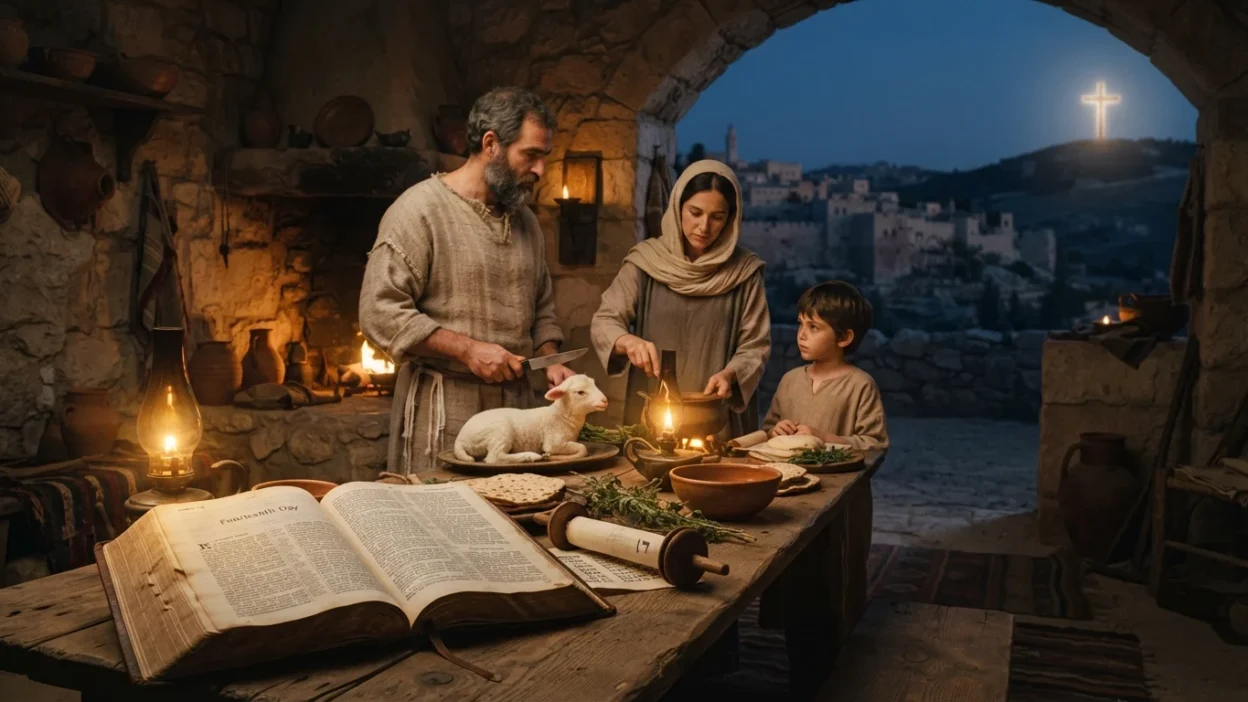
One notable Old Testament connection is the fourteenth day of the first month, when Passover was celebrated.
Exodus 12:6 instructed Israel to keep the Passover lamb until the fourteenth day of the month and then sacrifice it.
Leviticus 23:5 also identifies the fourteenth day of the first month as the time of the Lord’s Passover.
| Biblical Reference | Significance of 14 |
|---|---|
| Exodus 12:6 | Passover sacrifice |
| Leviticus 23:5 | Passover date |
| Numbers 9:3 | Passover observance |
| Numbers 28:16 | Fourteenth day and Passover |
| Matthew 1:17 | Three groups of fourteen generations |
This gives 14 a recurring connection with the Passover calendar and Matthew’s genealogy.
Number 14 and Passover
One of the clearest biblical uses of 14 is connected with Passover.
Passover was celebrated on the fourteenth day of the first month.
This event commemorated God’s deliverance of Israel from Egypt.
The Israelites placed blood from the Passover lamb on their doorposts, and God spared their households from the final plague described in Exodus 12.
Therefore, the number 14 appears within one of the Bible’s greatest stories of deliverance and redemption.
For Christians, Passover also has theological significance because the New Testament connects Jesus’ death with Passover imagery.
Paul describes Christ as “our Passover lamb” in 1 Corinthians 5:7.
This does not mean Scripture explicitly states that the number 14 itself represents Christ. Rather, the number’s association with Passover can provide meaningful biblical context.
Number 14 in Matthew’s Genealogy
Matthew 1 provides the strongest reason people study the number 14 meaning in the Bible.
Matthew organizes Jesus’ genealogy into three sections.
The first goes from Abraham to David.
The second goes from David to the Babylonian exile.
The third goes from the exile to Jesus.
Each section contains fourteen generations according to Matthew’s presentation.
This structure highlights Jesus’ place within Israel’s history.
| Section | Begins With | Ends With | Pattern |
|---|---|---|---|
| First | Abraham | David | 14 generations |
| Second | David | Exile | 14 generations |
| Third | Exile | Jesus | 14 generations |
Matthew’s arrangement emphasizes that Jesus did not appear randomly in history.
His arrival is presented as the culmination of God’s long redemptive story.
Why Is David Important to Number 14?
A popular observation is that the Hebrew numerical value of David’s name is 14.
In Hebrew, David is written with the letters dalet (4), waw (6), and dalet (4).
Their numerical values add up to:
4 + 6 + 4 = 14
Matthew’s genealogy repeatedly uses groups of fourteen, and David stands at the center of the structure.
This has led many biblical scholars and interpreters to suggest that Matthew’s arrangement may intentionally highlight Jesus as the Davidic Messiah.
However, readers should distinguish between a reasonable literary observation and a doctrine explicitly stated by Scripture.
| Hebrew Letter | Numerical Value |
|---|---|
| Dalet | 4 |
| Waw | 6 |
| Dalet | 4 |
| Total | 14 |
The connection is especially interesting because Matthew repeatedly emphasizes Jesus as the son of David.
Spiritual Meaning of Number 14
The spiritual meaning of number 14 meaning in the Bible should be approached carefully.
Rather than assigning a guaranteed definition, we can identify themes associated with its major biblical appearances.
1. Deliverance
The Passover occurred on the fourteenth day and commemorated Israel’s deliverance from Egypt.
2. Redemption
Passover becomes part of the larger biblical story that Christians understand as pointing toward Christ’s redemptive work.
3. God’s Order
Matthew’s three groups of fourteen demonstrate deliberate organization in presenting Jesus’ genealogy.
4. Davidic Promise
The number’s connection with David’s name and Matthew’s genealogy can draw attention to Jesus’ royal lineage.
5. Fulfillment
The genealogy moves through generations toward Christ, emphasizing the fulfillment of God’s historical purposes.
| Spiritual Theme | Biblical Connection |
|---|---|
| Deliverance | Passover |
| Redemption | Passover and Christ |
| Order | Matthew’s genealogy |
| Kingship | David |
| Fulfillment | Genealogy leading to Jesus |
These themes are useful for biblical reflection, but they should not be treated as a universal definition of 14.
Number 14 and the Old Testament
The Old Testament contains several references to the fourteenth day.
Passover is the most important.
Numbers 9 discusses Passover observance and again places it on the fourteenth day.
Numbers 28:16 also identifies the fourteenth day as the Lord’s Passover.
These references show that 14 had a practical calendrical role in Israel’s worship.
It was not simply a mystical number.
It marked a specific date in the religious calendar.
This is an important reminder when studying biblical numbers: numbers can have practical meanings before they have symbolic associations.
Number 14 and Jesus Christ
The connection between 14 and Jesus is particularly noticeable in Matthew.
Matthew is presenting Jesus as the promised Messiah who stands within the history of Abraham, David, Israel, and the exile.
The three sets of fourteen generations create a sense of movement toward Christ.
Abraham represents the beginning of Israel’s covenant story.
David represents the royal promise.
The exile represents judgment and national tragedy.
Jesus appears at the end of the genealogy as the one through whom the story reaches a new stage.
Therefore, 14 can be studied in connection with the ordered progression of salvation history.
Number 14 and the Concept of Deliverance
The Passover connection makes deliverance an important theme.
Israel’s deliverance from Egypt was one of the defining events of the Old Testament.
God rescued His people from slavery and brought them toward the promised land.
The fourteenth day was the appointed time for the Passover sacrifice.
For Christian readers, the Passover story becomes part of the biblical background for understanding Christ’s sacrificial death.
Again, the important distinction is that the event carries the theological meaning; the Bible does not explicitly declare, “14 means deliverance.”
This distinction keeps biblical study grounded in Scripture.
Number 14 Compared With Other Biblical Numbers
Number 14 becomes easier to understand when compared with numbers that have stronger biblical patterns.
| Number | Common Biblical Association | Strength of Pattern |
|---|---|---|
| 1 | Unity | Strong |
| 3 | Completeness/resurrection patterns | Strong |
| 7 | Completion | Very strong |
| 10 | Fullness/order | Strong |
| 12 | God’s people/governance | Strong |
| 14 | Passover and Matthew’s genealogy | Contextual |
| 40 | Testing/trial | Strong |
Unlike 7 or 12, Scripture does not provide a simple definition for 14.
Its significance is more dependent on context.
Number 14 and the Biblical Calendar
The biblical calendar gives 14 an important practical function.
Passover was observed on the fourteenth day of the first month.
The timing was part of God’s instructions to Israel.
This means the number should not be separated from the calendar and worship practices of ancient Israel.
The number 14 therefore has both:
- A literal calendrical function
- A contextual theological association
This distinction helps prevent exaggerated interpretations.
Common Misconceptions About Number 14
Misconception 1: The Bible says 14 always means deliverance
No. The Bible never provides this universal definition.
Misconception 2: Every occurrence of 14 has a secret message
Numbers can have ordinary practical functions, such as marking dates.
Misconception 3: 14 guarantees a future blessing
There is no biblical promise that repeatedly seeing 14 guarantees a particular event.
Misconception 4: The number itself has supernatural power
Biblical numbers should not be treated as magical objects.
Misconception 5: Matthew’s fourteen generations prove every genealogy must contain exactly fourteen generations
Matthew’s genealogy is deliberately structured and selective. It should not automatically be used as a model for every biblical genealogy.
Why Do People Search for Number 14 Meaning in the Bible?
People search number 14 meaning in the Bible because they may notice the number in Scripture, Bible studies, dreams, dates, or personal experiences.
Many are particularly interested in Matthew’s three groups of fourteen generations.
Others notice the fourteenth day associated with Passover.
Some people also encounter interpretations claiming that 14 has a hidden prophetic meaning.
The best approach is to begin with Scripture.
Ask:
- Where does the number occur?
- What is happening in the passage?
- Is the number literal or symbolic?
- Does Scripture itself explain its significance?
- Are later interpretations going beyond the text?
This method produces a more reliable understanding.
Number 14 in Modern Christian Interpretation
Modern Christians sometimes interpret 14 symbolically in sermons, devotionals, or Bible studies.
Common themes include:
- Deliverance
- Redemption
- God’s timing
- Davidic kingship
- Spiritual transition
- Fulfillment
These ideas can be useful for reflection when they are connected to biblical passages.
However, Christians should avoid treating personal number patterns as guaranteed divine messages.
The Bible’s primary purpose is to reveal God and His work, not to encourage people to decode every number they encounter.
How Should Christians Interpret Number 14?
A balanced approach is best.
First, identify the biblical passage.
Second, understand the historical context.
Third, determine whether the number has a practical purpose.
Fourth, examine repeated biblical patterns.
Finally, avoid making claims Scripture does not make.
For number 14, the strongest biblical connections are:
Passover + David + Matthew’s genealogy + the story leading toward Christ.
These provide a meaningful framework without requiring speculative numerology.
Final Thought
The number 14 meaning in the Bible is best understood through biblical context rather than through a fixed formula. Its strongest associations come from the fourteenth day of the month for Passover and Matthew’s carefully arranged three groups of fourteen generations leading to Jesus. The number also has an interesting connection with David because the numerical value of the Hebrew spelling of David totals fourteen.
These patterns can highlight themes of deliverance, God’s order, Davidic kingship, and the unfolding story of redemption. However, Scripture never says that 14 has one universal symbolic meaning. For Christians, the most important lesson is to study numbers in their biblical context and keep the focus on God’s message rather than on numerology. Number 14 becomes meaningful because of the biblical events and promises connected with it.
FAQs
1. What does number 14 mean in the Bible?
The Bible does not assign 14 one universal meaning. It is notably connected with Passover and Matthew’s three groups of fourteen generations.
2. Why is 14 important in Matthew?
Matthew organizes Jesus’ genealogy into three groups of fourteen generations, emphasizing Jesus’ place in Israel’s history and Davidic lineage.
3. Is David connected to the number 14?
Yes. The Hebrew letters of David’s name have numerical values of 4, 6, and 4, totaling 14. This may help explain Matthew’s structured use of fourteen.
4. What happened on the fourteenth day in the Bible?
Passover was observed on the fourteenth day of the first month of Israel’s religious calendar.
5. Does 14 symbolize deliverance?
It can be associated with deliverance because of its connection with Passover, but Scripture does not explicitly define 14 as meaning “deliverance.”
6. Is seeing 14 repeatedly a biblical sign?
The Bible does not teach that repeatedly seeing the number 14 is automatically a divine message or prophecy.
7. Should Christians study biblical numbers?
Yes, biblical numbers can be studied carefully, but interpretations should remain grounded in Scripture and avoid speculative numerology.