The adam meaning in the bible is deeply connected with humanity, creation, and the beginning of the human story. Adam is the first human being described in Genesis and is presented as the man whom God formed from the dust of the ground. His name is closely related to the Hebrew word adamah, meaning “ground” or “earth,” creating a meaningful connection between Adam and the material from which he was formed. The name therefore carries ideas of humanity, earth, and God’s creative work.
Understanding the adam meaning in the bible also requires looking beyond the name itself. Adam’s story introduces major biblical themes such as creation, responsibility, obedience, sin, death, and humanity’s need for redemption. The New Testament later connects Adam with Jesus Christ, describing Christ as the “last Adam” or “second Adam.” Because of this, Adam’s story is foundational to understanding the Bible’s message about humanity and salvation.
Quick Answer: What Does Adam Mean in the Bible?
Adam means “man,” “humanity,” or is closely associated with “earth/ground.”
The name comes from the Hebrew Adam, which is connected with adamah, meaning ground or earth.
Adam was the first man created by God according to Genesis 1–3.
Spiritually, Adam represents humanity, human responsibility, the fall into sin, and the need for redemption.
What Is the Meaning of Adam in the Bible?
The name Adam comes from Hebrew and is written as אָדָם (ʾadam).
It can refer to a human being, mankind, or a man. It is closely connected with adamah, meaning “ground” or “earth.”
Genesis 2:7 provides the important connection between Adam and the ground. God forms the man from the dust of the ground and gives him the breath of life.
This creates a powerful biblical wordplay.
| Name/Word | Meaning | Biblical Connection |
|---|---|---|
| Adam | Man/humanity | First man |
| Adamah | Ground/earth | From which Adam was formed |
| Dust | Earthly material | Human physical origin |
| Breath of life | Life from God | God gives Adam life |
| Humanity | Human race | Adam becomes representative of mankind |
Thus, the name Adam connects humanity with the earth and dependence upon God.
Origin and History of the Name Adam
Adam is one of the oldest personal names in the biblical tradition.
Its Hebrew origin is found in the opening chapters of Genesis. The name is associated with human beings and the ground from which Adam was formed.
The connection between adam and adamah is especially significant because Genesis uses language to connect the first man with the earth.
| Feature | Adam |
|---|---|
| Hebrew | אָדָם (ʾadam) |
| Language | Hebrew |
| General meaning | Man/human |
| Related word | Adamah |
| Related idea | Ground/earth |
| Biblical role | First man |
| Main passages | Genesis 1–5 |
The name later became widely used in Jewish, Christian, and Muslim traditions, although the theological details surrounding Adam differ among these religions.
Adam in the Creation Story
Adam’s story begins with creation.
Genesis 1 describes humanity being created in God’s image, male and female.
Genesis 2 provides a more detailed account of the formation of the man.
God forms Adam from the dust of the ground and breathes life into him.
This account establishes several important truths about humanity.
Human beings are created by God.
Human beings have dignity because they are made in God’s image.
Human beings are also dependent upon God for life.
The creation story therefore gives Adam a dual symbolic identity: he represents both human dignity and human dependence.
Adam and the Garden of Eden
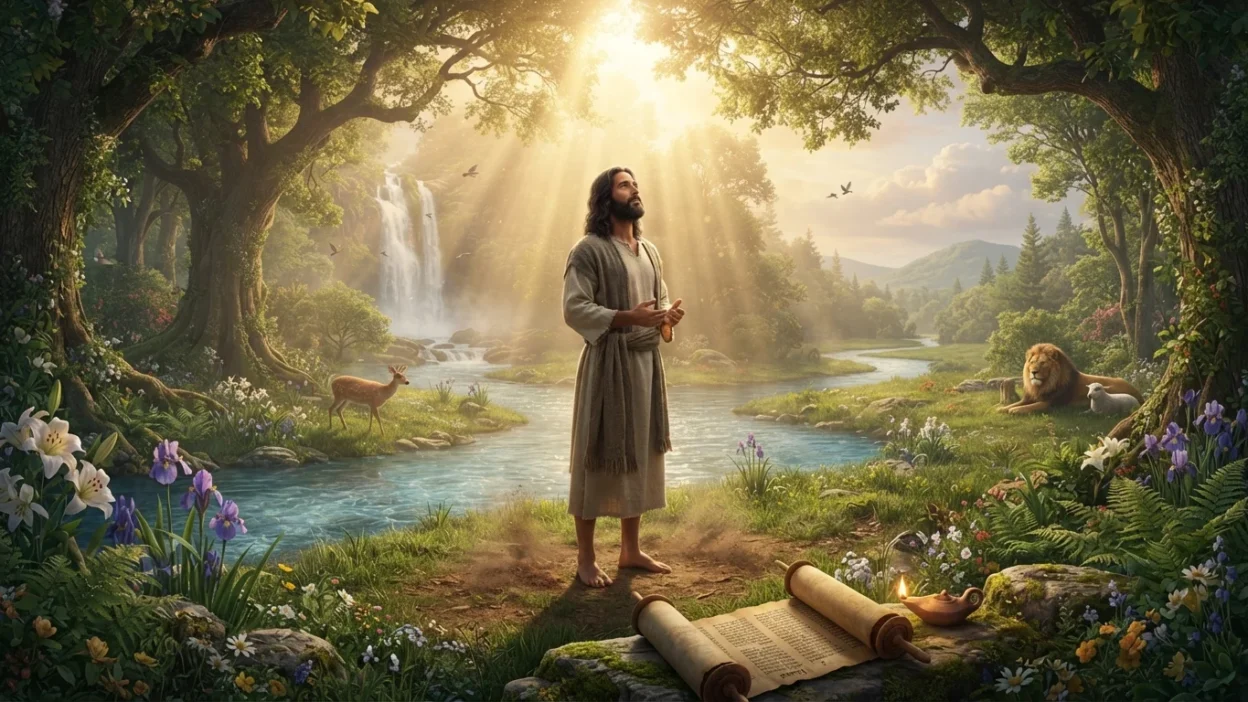
After creating Adam, God places him in the Garden of Eden.
Adam is given work to do and is instructed to cultivate and keep the garden.
This is important because work appears in Scripture before the entrance of sin.
Adam is also given a command concerning the tree of the knowledge of good and evil.
God permits Adam to eat from the trees of the garden but warns him not to eat from that particular tree.
The command introduces the biblical themes of freedom, responsibility, obedience, and trust.
Adam’s life in Eden shows humanity’s original calling to live in relationship with God and responsibly care for creation.
Adam and Eve
Adam’s story is closely connected with Eve, the first woman described in Genesis.
Genesis 2 explains that God creates Eve as a corresponding partner for Adam.
Together, Adam and Eve represent the beginning of human family life in the biblical narrative.
Their relationship also establishes the Bible’s early teaching about marriage.
Genesis 2:24 describes a man leaving his father and mother and being joined to his wife.
The relationship between Adam and Eve therefore has significance for biblical teachings about companionship, marriage, unity, and human relationships.
Adam and the Fall Into Sin
One of the most important parts of Adam’s story occurs in Genesis 3.
The serpent tempts Eve to eat from the forbidden tree.
Eve eats the fruit and gives some to Adam, who also eats.
Their disobedience introduces sin into the biblical story.
Immediately, shame and fear enter their experience.
They hide from God and recognize their nakedness.
The consequences include broken fellowship, pain, conflict, and death.
This event is commonly called the Fall.
| Before the Fall | After the Fall |
|---|---|
| Fellowship with God | Alienation and hiding |
| Innocence | Shame |
| Obedience | Disobedience |
| Peace | Conflict |
| Life in Eden | Expulsion |
| Unbroken relationship | Brokenness |
Adam’s story therefore becomes central to the biblical explanation of humanity’s fallen condition.
Spiritual Meaning of Adam
The spiritual meaning of the adam meaning in the bible includes several major themes.
1. Humanity
Adam’s name can represent mankind or humanity. His story becomes a story about the human condition.
2. Dependence on God
Adam is formed from dust and receives life from God. This symbolizes humanity’s dependence on the Creator.
3. Responsibility
Adam is given a task and a command. His story demonstrates that human beings are accountable for their choices.
4. Sin
Adam’s disobedience becomes a central biblical example of humanity’s rebellion against God.
5. Redemption
The New Testament connects Adam’s story with Christ’s saving work.
| Symbol | Spiritual Lesson |
|---|---|
| Dust | Human dependence |
| Breath | Life comes from God |
| Garden | God’s provision |
| Command | Human responsibility |
| Fall | Reality of sin |
| Christ | Hope of redemption |
Adam’s story is therefore not only about the beginning of humanity. It sets the stage for the Bible’s larger message of salvation.
Adam and the Image of God
Genesis 1:26–27 teaches that humanity was created in the image of God.
This gives Adam and all human beings extraordinary dignity.
Being created in God’s image does not mean humans physically look like God. Rather, it points to humanity’s unique created status and calling.
Human beings are capable of relationships, moral responsibility, creativity, stewardship, and meaningful communication.
The image of God also provides an important biblical foundation for the value of human life.
Adam’s story begins with dignity before it introduces the problem of sin.
Adam and Human Responsibility
Adam was not merely placed in the garden without purpose.
God gave him responsibilities.
He was commanded to work and care for the garden and to obey God’s instruction concerning the tree.
This teaches that biblical humanity is connected with responsibility.
People are not simply passive recipients of life. They are called to make choices and are accountable for those choices.
Adam’s failure demonstrates the serious consequences of rejecting God’s command.
This theme continues throughout Scripture as people are repeatedly called to choose righteousness, obedience, and faithfulness.
Adam and the Consequences of Sin
The consequences of Adam’s disobedience are described throughout Genesis 3.
The relationship between humanity and creation becomes affected.
Pain enters human experience.
Work becomes difficult.
Relationships experience conflict.
Human beings ultimately return to the dust from which Adam was formed.
Genesis 3:19 contains the important reminder that humanity returns to the ground.
This creates another word connection with the name Adam.
Adam comes from the ground, receives life from God, and eventually returns to the ground.
The picture emphasizes human mortality and dependence upon God.
Adam in the New Testament
The New Testament does not treat Adam merely as an ancient character.
Paul uses Adam to explain important truths about sin and salvation.
Romans 5 compares Adam and Christ.
Through Adam’s disobedience, sin and death enter the human story. Through Christ’s obedience, grace and life become available.
Paul develops a similar contrast in 1 Corinthians 15, describing Christ as the last Adam.
| Adam | Jesus Christ |
|---|---|
| First Adam | Last Adam |
| Disobedience | Obedience |
| Sin and death | Grace and life |
| Earthly beginning | Spiritual renewal |
| Represents fallen humanity | Represents redeemed humanity |
This comparison makes Adam essential to Christian theology.
The story begins with humanity’s fall but ultimately points toward God’s plan of redemption in Christ.
Adam and Jesus: The First and Last Adam
The connection between Adam and Jesus is one of the most important theological aspects of Adam’s story.
Adam represents humanity under sin and death.
Jesus represents a new humanity characterized by righteousness and life.
Paul’s teaching in 1 Corinthians 15:45 calls Jesus the “last Adam.”
The contrast does not mean Jesus simply repeats Adam’s story.
Instead, Christ succeeds where Adam failed.
Adam disobeyed God’s command.
Jesus remained obedient to the Father.
Adam’s disobedience is associated with death.
Christ’s obedience is associated with resurrection and life.
This gives the name Adam a much deeper place within the Christian story.
Adam vs. Other Biblical Names
Adam is unique because it is both a personal name and a Hebrew term connected with humanity.
| Name | Meaning | Biblical Significance |
|---|---|---|
| Adam | Man/humanity | First man |
| Noah | Rest/comfort | Ark and flood |
| Abraham | Father of a multitude | Father of Israel |
| Isaac | He laughs | Son of Abraham |
| Jacob | Supplanter/holder of heel | Father of Israel’s tribes |
| Moses | Drawn out | Leader of Israel |
Adam stands at the beginning of the biblical human story.
His name is therefore connected not only with one individual but also with the broader concept of humanity.
Common Misconceptions About Adam
Misconception 1: Adam simply means “dust”
Adam is associated with the ground, but the Hebrew word itself can refer to man or humanity. “Dust” describes the material from which Adam was formed.
Misconception 2: Adam was created before everything else
Genesis 1 describes the broader creation sequence before Genesis 2 provides a detailed account of humanity’s formation.
Misconception 3: Adam’s sin was only a minor mistake
The biblical narrative presents his disobedience as a major turning point in human history.
Misconception 4: Adam represents only men
The biblical Adam can refer to humanity more broadly, and the theological consequences of the Fall concern the human race.
Misconception 5: Adam has no connection to Jesus
The New Testament explicitly develops an Adam-Christ comparison.
Why Do People Search for Adam Meaning in the Bible?
People search adam meaning in the bible for many reasons.
Parents may be considering Adam as a baby name and want to understand its biblical significance.
Bible readers may want to know why Adam’s name is connected with the ground.
Others are interested in the relationship between Adam, sin, and Jesus Christ.
The name is also significant because Adam’s story appears at the beginning of Genesis and becomes foundational to major biblical teachings about creation, humanity, sin, death, and redemption.
Cultural and Modern Usage of Adam
Adam remains one of the world’s best-known biblical names.
It is used across Jewish, Christian, and Muslim communities and has become common in many languages and cultures.
The name is short, recognizable, and directly connected to the biblical story.
Modern parents may choose Adam because of its traditional character, biblical heritage, or association with humanity and creation.
Although cultural interpretations vary, its biblical identity remains one of its strongest characteristics.
What Does Adam Symbolize Spiritually?
The strongest spiritual symbolism of Adam includes humanity, dependence, responsibility, mortality, sin, and the need for redemption.
Adam reminds believers that human beings are created with dignity but are also dependent on God.
His story warns against disobedience while pointing toward God’s larger plan for restoration.
For Christians, Adam ultimately becomes part of the story that leads to Jesus Christ.
The lesson can be summarized simply:
Humanity was created by God, separated from Him through sin, and offered redemption through Christ.
Final Thought
The adam meaning in the bible reaches far beyond the definition of a personal name. Adam means “man” or “humanity” and is closely associated with the ground from which God formed him. His story introduces the Bible’s foundational themes of creation, human dignity, responsibility, obedience, sin, death, and redemption.
Adam’s failure in Eden becomes a defining moment in the biblical account of humanity, but Scripture does not end with the Fall. The New Testament presents Jesus as the “last Adam,” whose obedience brings hope where Adam’s disobedience brought death. For Christians, Adam’s story is therefore both a warning and a reminder: humanity depends completely on God, and God’s plan of redemption reaches its fulfillment in Christ.
FAQs
1. What does Adam mean in the Bible?
Adam generally means “man,” “humanity,” and is closely connected with the Hebrew word for ground or earth.
2. What is the Hebrew meaning of Adam?
The Hebrew name Adam is associated with “man” or “human” and is closely related to adamah, meaning ground or earth.
3. Why was Adam named Adam?
Genesis connects Adam’s name with the ground from which God formed him, creating a meaningful connection between the man and the earth.
4. What does Adam symbolize spiritually?
Adam can symbolize humanity, dependence on God, responsibility, sin, mortality, and the need for redemption.
5. What was Adam’s sin?
Adam disobeyed God’s command by eating from the forbidden tree in the Garden of Eden.
6. Is Adam connected to Jesus?
Yes. Paul compares Adam with Jesus and describes Christ as the “last Adam” in 1 Corinthians 15:45.
7. Is Adam a good biblical name?
Yes. Adam is a direct biblical name with a rich history and important associations with creation, humanity, and God’s redemptive plan.