
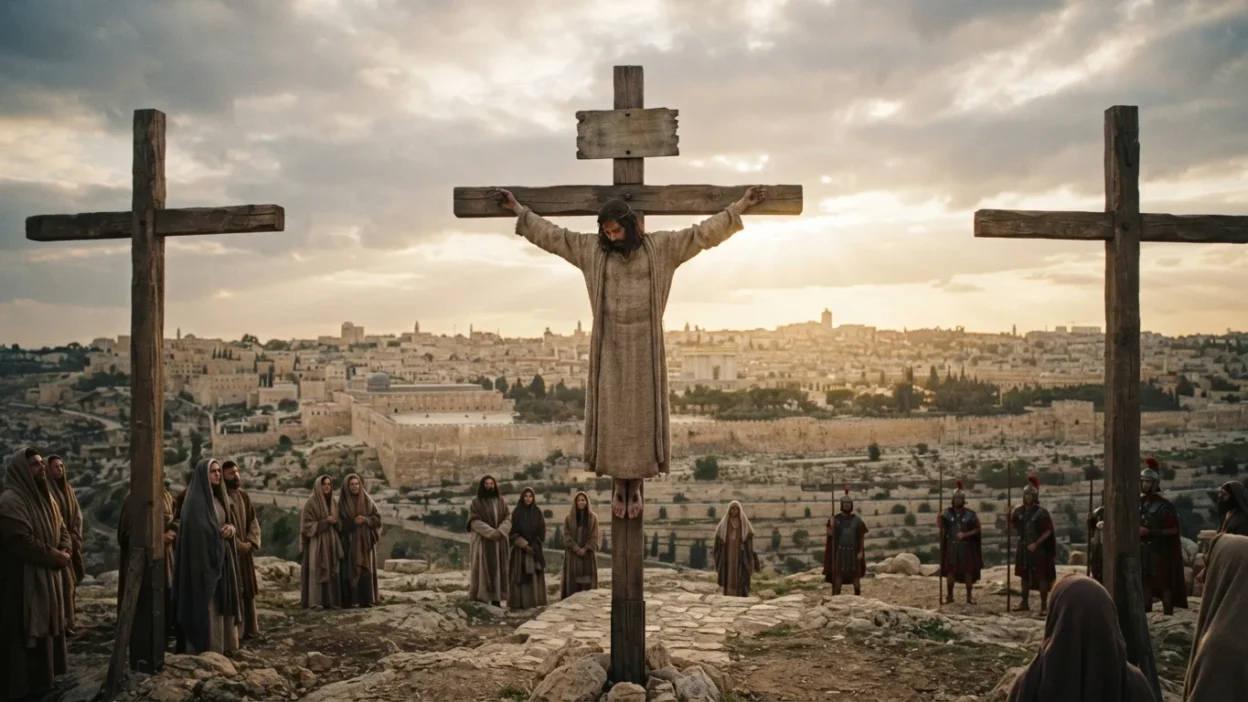
The INRI meaning in the Bible is connected to one of the most significant events in Christian history: the crucifixion of Jesus Christ. The four letters, often displayed on crosses and religious artwork, represent a Latin phrase associated with the inscription placed above Jesus during His crucifixion. Many people see INRI in churches, paintings, jewelry, and Christian symbols but may not know what the letters actually mean or why they became so widely recognized.
Understanding the INRI meaning in the Bible also helps readers explore the biblical account of Jesus’ death and the message behind the title placed above Him. The inscription identified Jesus as the “King of the Jews,” a statement that carried political, religious, and spiritual significance. Although Roman authorities intended the sign as part of the public identification of the condemned person, Christians have long reflected on its deeper meaning in relation to Jesus’ identity, kingship, sacrifice, and the fulfillment of God’s redemptive plan.
Quick Answer: What Does INRI Mean in the Bible?
INRI stands for the Latin phrase Iesus Nazarenus, Rex Iudaeorum, meaning “Jesus of Nazareth, King of the Jews.”
The inscription was placed above Jesus during His crucifixion.
The Gospel of John records that the title was written in multiple languages.
For Christians, INRI has become a symbol of Jesus’ identity, kingship, sacrifice, and salvation.
What Is the INRI Meaning in the Bible?
The INRI meaning in the Bible comes from the Latin words:
Iesus Nazarenus Rex Iudaeorum
In English, this means:
Jesus of Nazareth, King of the Jews.
The letters are an abbreviation formed from the first letters of the Latin words.
- I – Iesus
- N – Nazarenus
- R – Rex
- I – Iudaeorum
Although INRI itself is Latin, the Bible does not record the inscription using the abbreviation “INRI.” Instead, the Gospel accounts describe the title written above Jesus during the crucifixion.
| Letter | Latin Word | English Meaning |
|---|---|---|
| I | Iesus | Jesus |
| N | Nazarenus | Of Nazareth |
| R | Rex | King |
| I | Iudaeorum | Of the Jews |
The abbreviation developed from the Latin rendering of the biblical inscription.
The Biblical Origin of INRI
The INRI meaning in the Bible is rooted in the Gospel accounts of Jesus’ crucifixion.
Matthew, Mark, Luke, and John each record an inscription identifying Jesus.
John 19:19–20 provides especially detailed information about the sign.
According to John’s Gospel, Pontius Pilate wrote the title and placed it on the cross.
The inscription identified Jesus as:
Jesus of Nazareth, the King of the Jews.
John also explains that the title was written in Hebrew, Latin, and Greek, making it understandable to many people present in Jerusalem.
The use of multiple languages increased the public visibility of the message.
Why Was the Sign Placed Above Jesus?
In the Roman world, an inscription could identify the crime or charge associated with a condemned person.
The title above Jesus therefore had political significance.
The phrase “King of the Jews” could be interpreted as a challenge to Roman authority.
The chief priests objected to Pilate’s wording and wanted it changed.
They preferred language stating that Jesus merely claimed to be the King of the Jews.
However, according to John 19:22, Pilate refused to alter what he had written.
This created a striking moment in the crucifixion account.
The sign intended to identify the condemned man became, for Christians, a declaration connected to Jesus’ true identity.
The Meaning of “Jesus of Nazareth”
The first part of the inscription identified Jesus by His hometown association.
Nazareth was a small town in Galilee.
Jesus became widely known as Jesus of Nazareth.
This description distinguished Him from other people who may have shared the common name Jesus.
The phrase also connects the crucifixion account to Jesus’ earthly life and ministry.
He was not presented as an abstract religious figure.
He was a real person known by a particular name and geographical identity.
For Christians, “Jesus of Nazareth” also points toward the humanity of Christ.
The Meaning of “King of the Jews”
The title King of the Jews has several layers of meaning.
From the Roman perspective, the title could carry political implications.
A person claiming to be a king might be viewed as a threat to Caesar’s authority.
From the Jewish religious perspective, the title was connected with expectations surrounding the Messiah.
The New Testament presents Jesus as the promised Messiah, though His kingship was not expressed through military conquest or political rebellion.
Instead, Jesus taught about the kingdom of God.
His kingship was connected with truth, righteousness, sacrifice, and ultimately resurrection.
| Perspective | Meaning of “King of the Jews” |
|---|---|
| Roman | Possible political challenge |
| Jewish leaders | A controversial messianic claim |
| Biblical | Jesus’ identity and kingship |
| Christian faith | Christ as the promised King |
The INRI meaning in the Bible therefore goes beyond a simple nameplate.
It raises important questions about who Jesus truly was.
Spiritual Meaning of INRI
The spiritual meaning associated with INRI is deeply connected with Christian reflection on the cross.
1. Jesus’ Identity
The inscription publicly identified Jesus during His crucifixion.
Christians believe it also pointed toward His true identity as the Messiah.
2. Kingship Through Humility
Earthly kings often demonstrate power through wealth, armies, and authority.
Jesus’ crucifixion presents a dramatically different picture.
Christian theology teaches that Christ’s kingship is revealed through humility, sacrifice, and obedience.
3. Sacrifice and Redemption
The cross represents Jesus’ sacrificial death.
For Christians, this sacrifice is connected with forgiveness and salvation.
4. Truth
The sign was written by Roman authority, yet Christians interpret its message as carrying an unexpected truth about Jesus.
| Spiritual Symbol | Meaning |
|---|---|
| King | Christ’s authority |
| Cross | Sacrifice and redemption |
| Nazareth | Jesus’ human identity |
| Public inscription | A declaration visible to many |
| INRI | A reminder of Jesus’ crucifixion |
These symbolic interpretations developed through Christian reflection and should be understood alongside the actual Gospel context.
INRI and the Four Gospels
Each Gospel records an inscription connected with Jesus’ crucifixion.
The wording differs slightly between the accounts.
This does not necessarily mean the accounts contradict one another.
Ancient historical writing could summarize or emphasize inscriptions differently.
The central identification remains consistent: Jesus was presented as the King of the Jews.
| Gospel | Wording or Main Emphasis |
|---|---|
| Matthew 27:37 | “This is Jesus, the King of the Jews” |
| Mark 15:26 | “The King of the Jews” |
| Luke 23:38 | “This is the King of the Jews” |
| John 19:19 | “Jesus of Nazareth, the King of the Jews” |
John’s fuller wording became the basis for the familiar Latin abbreviation INRI.
Why Was INRI Written in Latin?
A common misunderstanding about the INRI meaning in the Bible is the idea that the sign above Jesus originally contained the letters “INRI.”
The biblical text does not say that.
INRI is a Latin abbreviation based on the phrase Iesus Nazarenus Rex Iudaeorum.
According to John, the inscription was written in Hebrew, Latin, and Greek.
The Latin version later became especially influential in Western Christianity.
As Latin became the major language of the Western Church, the abbreviation INRI became common on crosses, artwork, and other Christian symbols.
INRI in Christian Art and Culture
Today, INRI is often seen above Jesus on crucifixes.
It has become one of the most recognizable Christian abbreviations.
Artists have included it in paintings, sculptures, stained-glass windows, and religious jewelry.
The letters serve as a visual reminder of the crucifixion account.
However, the symbol should not be separated from its biblical meaning.
INRI points back to the historical event of Jesus’ crucifixion and the title placed above Him.
For Christians, it also carries theological meaning concerning Jesus’ kingship and sacrifice.
INRI Compared With Other Titles of Jesus
Jesus is known by many titles in the Bible.
Each title emphasizes a different aspect of His identity.
| Title | Meaning | Biblical Significance |
|---|---|---|
| Christ | Anointed One | Messiah |
| Son of God | Divine relationship | Identity and authority |
| Son of Man | Human and messianic title | Humility and mission |
| Lamb of God | Sacrifice | Redemption |
| King of the Jews | Royal and messianic identity | Crucifixion inscription |
| Lord | Authority and devotion | Christian faith |
INRI specifically focuses on Jesus as Jesus of Nazareth, King of the Jews.
Common Misconceptions About INRI
Misconception 1: INRI is an original Hebrew word
No. INRI is a Latin abbreviation.
Misconception 2: The Bible says the letters INRI were written on the cross
The Bible records the inscription’s wording but does not use the abbreviation INRI.
Misconception 3: INRI is a secret code
INRI is not a hidden or mysterious biblical code.
It is simply an abbreviation of a Latin phrase.
Misconception 4: INRI means only “Jesus died”
The letters specifically refer to the title “Jesus of Nazareth, King of the Jews.”
However, Christians connect the title with the larger meaning of the crucifixion.
Misconception 5: The title was universally accepted
The Gospel of John records that some Jewish religious leaders objected to Pilate’s wording.
Why Do People Search for INRI Meaning in the Bible?
People search INRI meaning in the Bible because they often encounter the letters on crosses, church buildings, religious paintings, or Christian jewelry.
They may wonder whether INRI is a Hebrew word, a secret message, or a special name for Jesus.
The answer is simpler.
INRI is a Latin abbreviation representing the title associated with Jesus during His crucifixion.
People also search for its spiritual meaning because the four letters are strongly connected with the cross.
Understanding the historical background helps readers appreciate both the literal meaning and the Christian symbolism.
INRI and the Message of the Cross
The INRI meaning in the Bible cannot be fully understood apart from the cross.
The inscription was placed above Jesus during one of the most important events described in the New Testament.
For Christians, the cross represents sacrifice, forgiveness, reconciliation, and hope.
The title “King of the Jews” creates a powerful contrast.
Jesus was publicly crucified in apparent weakness, yet Christian faith proclaims Him as King.
This contrast is central to Christian theology.
His kingdom is not built on the same principles as earthly kingdoms.
Jesus taught about service, truth, humility, and love.
How Should Christians Understand INRI Today?
For Christians today, INRI can serve as a reminder of several important truths.
Remember Jesus’ sacrifice. The abbreviation points directly to the crucifixion.
Reflect on Christ’s kingship. Jesus is recognized as King in Christian faith.
Understand the historical context. The title was connected with Roman authority and Jewish messianic expectations.
Avoid superstition. INRI is an abbreviation, not a magical formula.
Focus on the Gospel message. The letters are meaningful because of the biblical event they represent.
The value of the symbol comes from its connection to Jesus and the Gospel story.
Cultural and Modern Usage of INRI
INRI continues to appear in Christian culture around the world.
It is commonly placed on crucifixes, especially in Catholic and traditional Christian art.
It may also appear in paintings, statues, churches, literature, and religious jewelry.
For many people, the abbreviation immediately communicates the image of the crucifixion.
Modern audiences sometimes encounter INRI without understanding Latin.
Learning its meaning provides historical context and can deepen appreciation for Christian symbolism.
Final Thought
The INRI meaning in the Bible points to the inscription associated with Jesus’ crucifixion: Iesus Nazarenus, Rex Iudaeorum, meaning “Jesus of Nazareth, King of the Jews.” Although the Bible does not use the abbreviation INRI itself, the four letters developed from the Latin version of the title recorded in the Gospel accounts. The inscription had historical and political significance, but Christians also see profound spiritual meaning in it. It connects Jesus’ humanity as a man from Nazareth with His identity as the promised Messiah and King.
Most importantly, INRI points readers back to the cross, where Christian faith sees sacrifice, humility, redemption, and hope. Understanding its historical background helps separate biblical meaning from later misconceptions and reveals why these four letters remain powerful Christian symbols.
FAQs
1. What does INRI mean?
INRI stands for Iesus Nazarenus Rex Iudaeorum, meaning “Jesus of Nazareth, King of the Jews.”
2. Is INRI mentioned in the Bible?
The abbreviation itself is not used in the Bible. It comes from the Latin version of the inscription recorded in the Gospel accounts.
3. Who put the inscription above Jesus?
According to John 19:19, Pontius Pilate wrote the title and placed it on the cross.
4. What languages was the inscription written in?
John 19:20 states that it was written in Hebrew, Latin, and Greek.
5. Why did Pilate call Jesus the King of the Jews?
The title identified the charge or claim associated with Jesus’ crucifixion and carried political and religious significance.
6. What is the spiritual meaning of INRI?
For Christians, INRI symbolizes Jesus’ identity, kingship, sacrifice, humility, and the redemptive message of the cross.
7. Is INRI a secret biblical code?
No. INRI is simply a Latin abbreviation, not a hidden code or magical phrase.

William Noah is a spiritual writer at BibLoft, exploring hidden meanings, symbols, and divine insights. He shares thoughtful interpretations that inspire self-awareness, inner growth, and spiritual understanding.