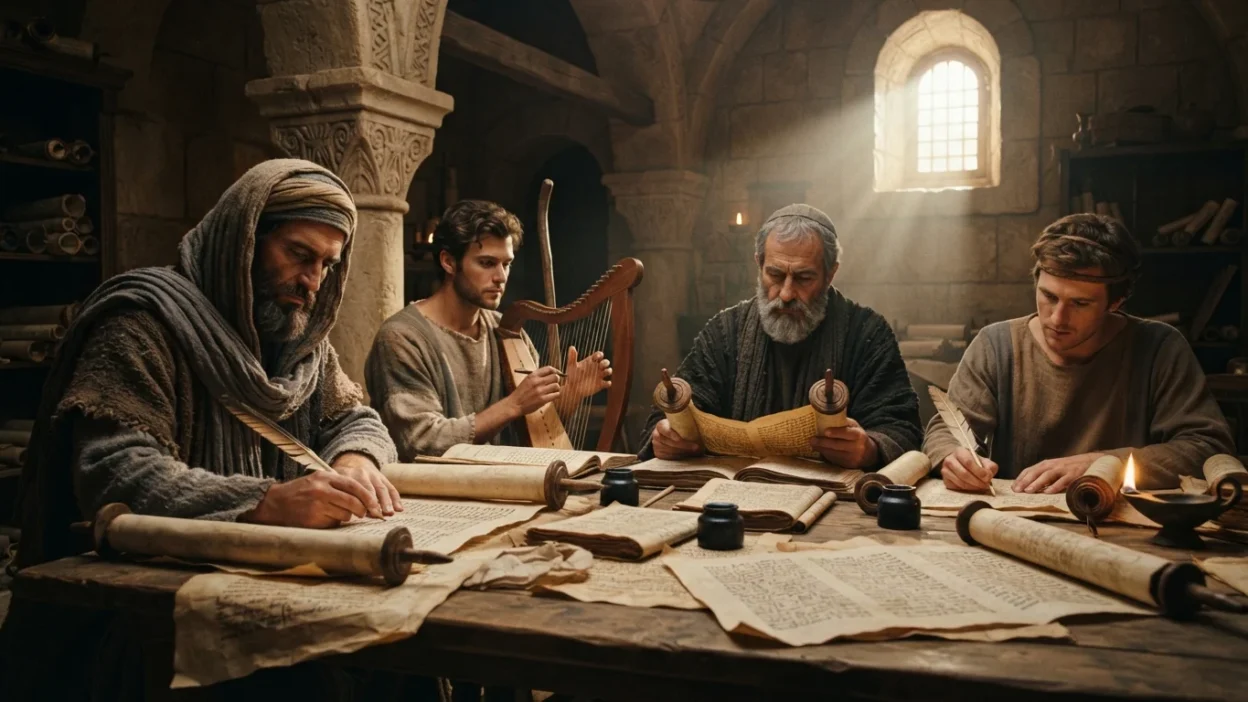
The bible authors meaning is an important topic for anyone who wants to understand where the Bible came from and who was responsible for writing its many books. The Bible is not the work of a single author. Instead, it is a collection of writings produced over many centuries by different people living in different historical settings. These writers came from varied backgrounds and wrote history, poetry, laws, prophecy, letters, and accounts of faith.
Understanding bible authors meaning also helps readers see how human experience and religious belief shaped the biblical texts. Traditional beliefs identify certain individuals as authors, while modern scholarship sometimes discusses questions of authorship, editing, and anonymous writing. Exploring these perspectives can help readers better understand the Bible as a diverse collection of ancient writings with a central role in Jewish and Christian religious traditions.
Quick Answer: What Does Bible Authors Mean?
The bible authors meaning refers to the people traditionally associated with writing the books of the Bible. The Bible has many human authors or contributors, including prophets, kings, priests, apostles, and early Christian leaders, while Jewish and Christian believers understand Scripture within their own traditions of divine inspiration.
What Does Bible Authors Mean?
The phrase “Bible authors” refers to the human writers traditionally connected with the books of Scripture.
However, authorship is not always simple.
Some biblical books clearly identify their writers.
Others are anonymous.
Some books may have been compiled, edited, or preserved by later communities.
Therefore, the bible authors meaning includes both traditional beliefs about authorship and scholarly study of how biblical texts developed.
The Bible contains many literary forms.
Its writers produced:
- Historical narratives
- Laws
- Poetry
- Proverbs
- Prophecy
- Wisdom literature
- Gospels
- Letters
- Apocalyptic visions
This diversity explains why the Bible contains different writing styles and perspectives.
Who Wrote the Bible?
According to traditional Jewish and Christian understanding, many different people contributed to the writings found in the Bible.
Traditionally associated authors include:
- Moses
- David
- Solomon
- Isaiah
- Jeremiah
- Ezekiel
- Daniel
- Matthew
- Mark
- Luke
- John
- Paul
- Peter
- James
- Jude
Not every biblical book has an agreed-upon author.
For example, some books are anonymous, while others have debated authorship.
The Bible was also written across a long period of history.
This means its books reflect different cultures, languages, and historical situations.
The Bible Was Written Over Many Centuries
The Bible did not appear all at once.
The books of the Old Testament developed across many centuries within ancient Israelite and Jewish traditions.
The New Testament writings were produced during the first centuries of Christianity.
The exact dates of individual books are often debated.
Some writings were likely based on older oral traditions.
Others were copied and edited through long processes of preservation.
The bible authors meaning therefore involves understanding both individual writers and the communities that transmitted the texts.
Major Traditional Authors of the Old Testament
Several important biblical figures are traditionally connected with Old Testament writings.
Moses
Moses is traditionally associated with the first five books of the Bible, often called the Torah or Pentateuch.
These books include Genesis, Exodus, Leviticus, Numbers, and Deuteronomy.
Modern scholarship discusses the possibility of multiple sources and long editorial development.
David
King David is traditionally associated with many Psalms.
However, not every psalm in the Book of Psalms is attributed to David.
The collection includes different authors and traditions.
Solomon
Solomon is traditionally connected with wisdom literature, especially Proverbs, Ecclesiastes, and Song of Songs.
Questions about authorship and composition remain subjects of scholarly discussion.
The Prophets
Books such as Isaiah, Jeremiah, Ezekiel, and others are traditionally associated with prophetic figures.
Some prophetic books may also reflect later followers, editors, or communities.
| Traditional Author | Books or Writings Traditionally Connected |
|---|---|
| Moses | Torah or Pentateuch |
| David | Many Psalms |
| Solomon | Wisdom traditions |
| Isaiah | Book of Isaiah |
| Jeremiah | Jeremiah and related traditions |
| Ezekiel | Book of Ezekiel |
Major Authors of the New Testament
The New Testament contains four Gospels, one historical narrative, letters, and an apocalyptic work.
Matthew, Mark, Luke, and John
Christian tradition associates the four Gospels with Matthew, Mark, Luke, and John.
Modern scholarship studies questions about the dating, sources, and composition of these writings.
The Gospels themselves are formally anonymous in their original texts, with traditional names connected to them through early Christian tradition.
Paul
Paul is traditionally associated with many New Testament letters.
Several letters are widely accepted by scholars as written by Paul, while others have debated authorship.
Paul’s letters are among the earliest surviving Christian writings.
Peter, James, Jude, and John
Several New Testament letters are traditionally connected with Peter, James, Jude, and John.
Their authorship and historical background are studied differently by various scholars and religious traditions.
Bible Authors and Their Different Backgrounds
One remarkable feature of the Bible is the diversity of people traditionally connected with its writings.
They include:
- Shepherds
- Kings
- Priests
- Prophets
- Fishermen
- Teachers
- Government officials
- Missionaries
This diversity contributes to the variety of biblical literature.
Different authors wrote from different experiences and social settings.
A king may write differently from a prophet.
A poet may communicate differently from a teacher.
A letter written to an early church has a different purpose from an ancient song or proverb.
| Type of Writer | Example Role | Common Literary Style |
|---|---|---|
| Prophet | Religious messenger | Prophecy and warning |
| King | Political leader | Poetry and wisdom |
| Apostle | Early Christian leader | Letters and teaching |
| Historian | Recorder of events | Narrative and history |
| Poet | Worship leader | Songs and prayers |
The Biblical and Religious Connection
The question of authorship is deeply connected with Jewish and Christian beliefs about Scripture.
Many believers understand the Bible as involving both divine inspiration and human authors.
The human writers lived within real historical cultures and used their own languages and literary styles.
At the same time, religious traditions often teach that Scripture has a sacred purpose beyond ordinary literature.
This understanding helps explain why believers study both the historical background and spiritual message of the Bible.
The bible authors meaning is therefore not only about identifying names.
It is also about understanding how human voices became connected with sacred writings.
The Spiritual Meaning of Bible Authors
The spiritual meaning of the bible authors meaning can be understood through themes of diversity, purpose, and inspiration.
Different writers contributed different perspectives, but their writings became part of a larger religious story.
Symbolic Spiritual Interpretation
| Symbolic Theme | Spiritual Meaning |
|---|---|
| Many authors | Diversity of human experience |
| Different writing styles | Different ways truth can be expressed |
| Ancient manuscripts | Preservation of faith |
| Prophetic voices | Calling people toward faithfulness |
| Letters | Guidance for communities |
| Poetry | Worship and personal prayer |
For many believers, the variety of authors symbolizes the idea that God can work through different people and backgrounds.
A message of faith does not require every person to have the same personality, occupation, or life story.
Why Do People Search for Bible Authors Meaning?
People search for the bible authors meaning because they want to know who wrote the Bible.
New readers often assume that one person wrote the entire book.
Others want to know whether biblical authors were eyewitnesses.
Students may also research the historical development of Scripture.
Some people are interested in questions about divine inspiration.
Others want to compare traditional religious beliefs with modern scholarship.
This topic remains popular because understanding authorship can make the Bible easier to approach as both a historical and religious collection.
Common Misconceptions About Bible Authors
Misconception 1: One Person Wrote the Entire Bible
The Bible is a collection of many books associated with different writers and traditions.
Misconception 2: Every Book Clearly Names Its Author
Some biblical books are anonymous or have debated authorship.
Misconception 3: Traditional Authorship Is Always Universally Accepted
Religious traditions and modern scholars sometimes hold different views about authorship.
Misconception 4: Different Authors Mean the Bible Has No Connection
Despite its diversity, biblical books share important religious themes and historical relationships.
Misconception 5: Bible Authors All Had the Same Background
The writers and figures traditionally associated with Scripture came from diverse social and cultural settings.
Cultural and Modern Interest in Bible Authors
Today, people study Bible authors in churches, schools, universities, and online Bible programs.
Documentaries and historical research have also increased public interest.
Modern readers can access ancient manuscripts, translations, and scholarly discussions more easily than previous generations.
Questions about authorship often appear in debates about history, theology, and biblical interpretation.
The bible authors meaning remains important because authorship can influence how readers understand the purpose and original audience of a biblical book.
How Understanding Bible Authors Helps Bible Study
Knowing something about a biblical author’s traditional identity or historical setting can improve Bible study.
It can help readers ask useful questions:
- Who was the original audience?
- What historical situation influenced the writing?
- Why was this message important?
- What literary style is being used?
- How would the original readers understand it?
For example, a personal letter should be read differently from a prophetic vision.
Understanding background helps readers avoid taking verses out of context.
Authorship is one part of a larger study that includes history, language, culture, and literary genre.
The Deeper Meaning of Bible Authors
The deeper bible authors meaning reminds readers that the Bible developed through many human voices.
Its diversity is part of its character.
There are songs of worship, stories of struggle, calls for justice, wisdom about daily life, and letters written to communities facing real problems.
These writings reflect different generations and experiences.
For believers, this diversity can also have spiritual significance.
The Bible’s message is communicated through ordinary human language and historical situations.
This connection between faith and human experience is one reason the study of biblical authors continues to be meaningful.
Final Thought
The bible authors meaning reveals that the Bible is a rich collection of writings connected with many different people, traditions, and historical communities. Traditional figures such as Moses, David, Solomon, Isaiah, Matthew, John, and Paul are important to Jewish and Christian understanding, while modern scholarship also examines anonymous writings, sources, editors, and historical development.
The diversity of biblical authors helps explain the Bible’s many literary styles, including history, poetry, prophecy, wisdom, Gospels, and letters. Spiritually, the variety of voices can symbolize how faith speaks through different people and experiences. Understanding who wrote biblical books and how they developed can help readers study Scripture with greater historical awareness and deeper appreciation.
FAQs
1. Who wrote the Bible?
The Bible is a collection of books traditionally associated with many different writers, prophets, apostles, and religious communities.
2. Did Moses write the first five books of the Bible?
Jewish and Christian tradition associates Moses with the Torah, while modern scholars discuss questions of sources and editorial development.
3. Did David write all the Psalms?
No. David is traditionally associated with many Psalms, but the Book of Psalms contains works connected with different authors and traditions.
4. Who wrote the four Gospels?
Christian tradition associates them with Matthew, Mark, Luke, and John, although modern scholarship studies their sources and authorship.
5. Did Paul write the entire New Testament?
No. Paul is traditionally associated with several New Testament letters, but many other writings were produced by different authors.
6. Why are some Bible authors unknown?
Some ancient texts were written anonymously, while others may have lost clear information about their original authors during transmission.
7. Why is knowing Bible authors important?
It helps readers understand historical context, original audiences, literary styles, and the purpose of different biblical books.