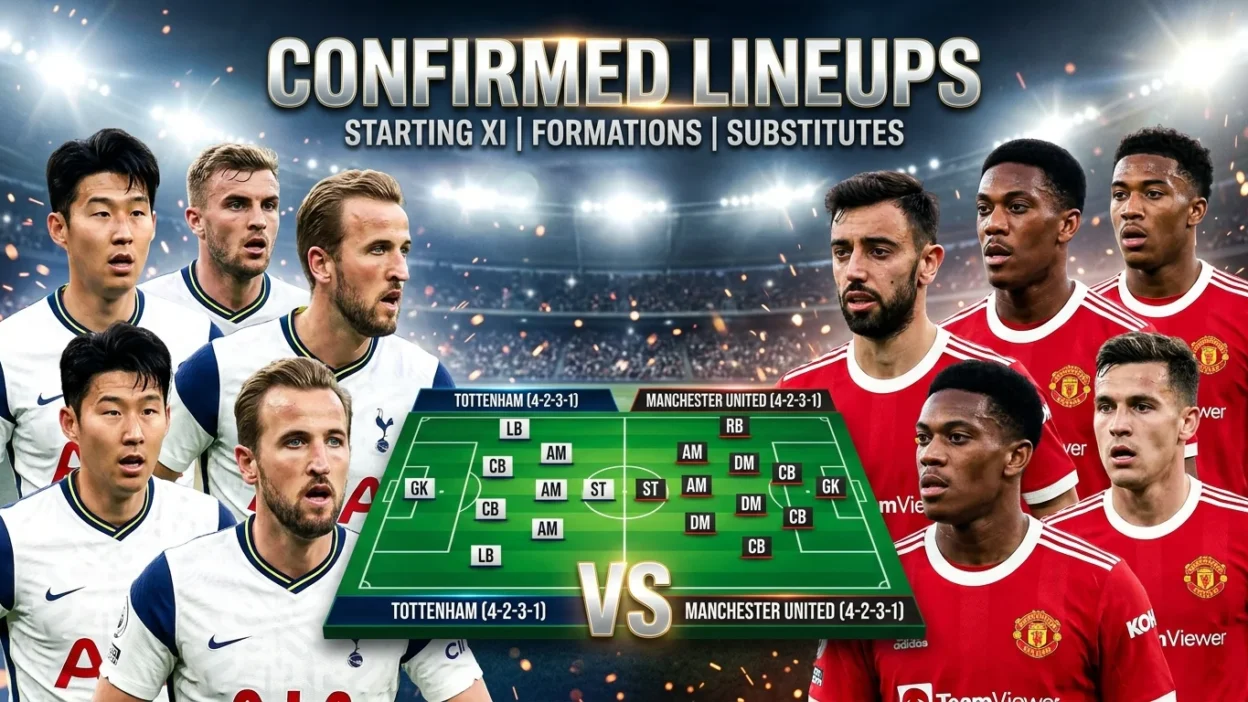
The Tottenham vs Manchester United F.C. lineups for the Premier League match on October 10, 2026, featured two different approaches to a major English football rivalry. The match took place at Old Trafford, Manchester, and finished in a 1–1 draw. Bryan Mbeumo scored for Manchester United, while Dominic Solanke equalised for Tottenham in stoppage time.
10.10.2026
+1
Both teams used a 4-2-3-1 formation, with four defenders, two central midfielders, three attacking midfielders, and one striker. Manchester United selected Senne Lammens in goal, with Bruno Fernandes supporting the attack. Tottenham started Antonín Kinský in goal and named Solanke as captain. These confirmed lineups help explain how the teams approached the game, which players started, and which options were available from the bench.
Quick Answer
The confirmed Tottenham vs Manchester United lineups on October 10, 2026, featured a 4-2-3-1 formation for both sides. United started Bryan Mbeumo and Matheus Cunha in attack, while Tottenham selected Mohammed Kudus, Savinho, and Dominic Solanke. The match ended 1–1 at Old Trafford.
10.10.2026
+1
Why Do People Confuse Confirmed and Predicted Lineups?
Football fans often see predicted starting XIs before a match and assume those are the official team selections. However, a predicted lineup is an estimate based on team news, player fitness, and tactical expectations. A confirmed lineup is published after the manager names the players for the match.
For this fixture, the starting XIs below are the confirmed selections, not predictions.
10.10.2026
+1
Tottenham Starting Lineup

Tottenham Hotspur
Formation: 4-2-3-1
Manager: Roberto De Zerbi
Tottenham selected a defensive back four with Lucas Bergvall and Sandro Tonali in midfield. Savinho, Conor Gallagher, and Mohammed Kudus supported captain Dominic Solanke up front.
10.10.2026
+1
Tottenham Confirmed Starting XI
| Position | Player |
|---|---|
| Goalkeeper | Antonín Kinský |
| Right-back | Archie Gray |
| Centre-back | Jan Paul van Hecke |
| Centre-back | Marcos Senesi |
| Left-back | Destiny Udogie |
| Central midfield | Lucas Bergvall |
| Central midfield | Sandro Tonali |
| Attacking midfield | Savinho |
| Attacking midfield | Conor Gallagher |
| Attacking midfield | Mohammed Kudus |
| Striker | Dominic Solanke (captain) |
Tottenham substitutes: Martin Dúbravka, Tosin Adarabioyo, James Maddison, Mathys Tel, Mathys Fernandes, Omar Marmoush, Rodrigo Bentancur, Ben Davies, and Micky van de Ven.
10.10.2026
Tottenham Players to Watch
- Dominic Solanke: Led the attack and scored Tottenham’s stoppage-time equaliser.
- Mohammed Kudus: Provided an attacking option between the lines and from wide areas.
- Sandro Tonali: Helped connect midfield and attack and delivered the cross for Solanke’s equaliser.
- Antonín Kinský: Started in goal and was part of the defensive structure.
Manchester United Starting Lineup

Manchester United
Formation: 4-2-3-1
Manager: Michael Carrick
United used Senne Lammens in goal, with Leny Yoro, Harry Maguire, Lisandro Martínez, and Luke Shaw in defence. Bruno Fernandes operated behind the attacking line, while Bryan Mbeumo and Matheus Cunha offered forward threat.
10.10.2026
+1
Manchester United Confirmed Starting XI
| Position | Player |
|---|---|
| Goalkeeper | Senne Lammens |
| Right-back | Leny Yoro |
| Centre-back | Harry Maguire |
| Centre-back | Lisandro Martínez |
| Left-back | Luke Shaw |
| Central midfield | Youri Tielemans |
| Central midfield | Kobbie Mainoo |
| Attacking midfield | Amad Diallo |
| Attacking midfield | Bruno Fernandes (captain) |
| Attacking midfield | Bryan Mbeumo |
| Forward | Matheus Cunha |
Manchester United substitutes: Karl Darlow, Diogo Dalot, Mason Mount, Marcus Rashford, Joshua Zirkzee, A. Nascimento dos Santos, Carlos Baleba, Ayden Heaven, and Shea Lacey.
10.10.2026
Manchester United Players to Watch
- Bryan Mbeumo: Scored United’s goal in the 73rd minute.
- Bruno Fernandes: Served as captain and played an important creative role.
- Matheus Cunha: Supported the attack and assisted Mbeumo’s goal.
- Kobbie Mainoo: Provided a central midfield option for retaining possession and moving the ball forward.
Tottenham vs Manchester United Lineups Compared
| Feature | Tottenham | Manchester United |
|---|---|---|
| Formation | 4-2-3-1 | 4-2-3-1 |
| Goalkeeper | Antonín Kinský | Senne Lammens |
| Captain | Dominic Solanke | Bruno Fernandes |
| Main striker | Dominic Solanke | Matheus Cunha |
| Key attacking player | Mohammed Kudus | Bryan Mbeumo |
| Head coach | Roberto De Zerbi | Michael Carrick |
| Final score | 1 | 1 |
10.10.2026
+1
When Should You Check Confirmed or Predicted Lineups?
Use predicted lineups before the official team sheets are released. They are useful for pre-match discussion, fantasy football planning, and understanding possible tactical choices.
Use confirmed lineups when you need to know exactly who starts, who is on the bench, and which players have been left out. Confirmed team sheets are especially important for match reports and post-match analysis.
Ten Examples of How to Read These Lineups
- Kinský starts in goal: He was Tottenham’s first-choice goalkeeper for this match.
- Lammens starts for United: He was selected as the starting goalkeeper.
- Four defenders: Each team began with a back four.
- Two central midfielders: Both teams used two players in the deeper central midfield positions.
- Three attacking midfielders: The formation placed three players behind the main forward.
- Solanke as captain: The Tottenham striker wore the captain’s armband.
- Fernandes as captain: The Manchester United midfielder led his side.
- Mbeumo starting: United included him from the beginning rather than bringing him on as a substitute.
- Van de Ven on the bench: Tottenham had another defensive option available.
- Baleba on the bench: United could introduce him during the match if the manager wanted to change the midfield.
The confirmed team sheets and match report provide the basis for these examples.
10.10.2026
+1
Common Mistakes When Reading Football Lineups
- Mixing up the home and away teams: Manchester United hosted Tottenham at Old Trafford.
- Confusing substitutes with starters: A player on the bench does not belong to the starting XI.
- Assuming a formation never changes: A 4-2-3-1 can become a different shape during a match.
- Treating a predicted XI as confirmed: Always check the official team sheet.
- Ignoring late changes: Injuries or tactical decisions can alter a lineup shortly before kick-off.
A Simple Memory Trick for the 4-2-3-1 Formation
Remember the numbers from defence to attack:
- 4 defenders
- 2 central midfielders
- 3 attacking midfielders
- 1 striker
The goalkeeper stands behind the four defenders, so the formation contains 11 starting players in total.
American vs British English: Soccer or Football?
In British English, the sport is called football. In American English, it is commonly called soccer to distinguish it from American football.
Both terms refer to the same sport in this article. The names of the teams, players, formations, and match events remain the same.
Similar Football Terms
- Starting XI: The 11 players selected to begin a match.
- Team sheet: The official list of starters and substitutes.
- Formation: The tactical arrangement of players on the pitch.
- Substitute: A player available to replace a starter during the match.
- Team news: Updates about injuries, fitness, suspensions, and selection.
- Confirmed lineup: The officially announced starting team.
- Predicted lineup: An expected team selection published before confirmation.
Final Verdict
The confirmed Tottenham vs Manchester United F.C. lineups showed both teams using a 4-2-3-1 formation in their October 10, 2026, Premier League encounter. Tottenham relied on Solanke as captain and striker, supported by Kudus, Savinho, and Gallagher. United selected Fernandes as captain, with Mbeumo and Cunha offering attacking support.
The match ended 1–1. Mbeumo gave United the lead in the second half, but Solanke’s late equaliser earned Tottenham a point. The confirmed lineups, substitutions, and match events together provide a clearer picture of how the contest unfolded.
10.10.2026
+1
Frequently Asked Questions
1. What were the Tottenham vs Manchester United starting lineups?
Tottenham started Kinský, Gray, van Hecke, Senesi, Udogie, Bergvall, Tonali, Savinho, Gallagher, Kudus, and Solanke. United started Lammens, Yoro, Maguire, Martínez, Shaw, Tielemans, Mainoo, Diallo, Fernandes, Mbeumo, and Cunha.
10.10.2026
2. What formation did Tottenham use?
Tottenham used a 4-2-3-1 formation, with four defenders, two central midfielders, three attacking midfielders, and one striker.
10 Oct 2026
3. What formation did Manchester United use?
Manchester United also started with a 4-2-3-1 formation. Bruno Fernandes operated in an attacking midfield role behind the forwards.
10 Oct 2026
4. Who captained Tottenham against Manchester United?
Dominic Solanke was Tottenham’s captain for this match.
10.10.2026
5. Who captained Manchester United?
Bruno Fernandes captained Manchester United.
10.10.2026
6. What was the final score?
The match finished 1–1 at Old Trafford on October 10, 2026. Bryan Mbeumo scored for United, and Dominic Solanke equalised for Tottenham.
The Guardian
7. Where can I find official team news?
You can check the clubs’ official websites and the Premier League match centre for confirmed starting XIs, substitutes, injury updates, and match reports.
Remember This
Tottenham and Manchester United both used a 4-2-3-1 formation on October 10, 2026. Solanke and Fernandes were their respective captains, and the match finished 1–1. Always distinguish confirmed team sheets from predicted lineups.
Conclusion
The Tottenham vs Manchester United F.C. lineups reveal how both managers organised their teams for a competitive Premier League match. Tottenham selected an attacking group around Solanke, while United relied on Fernandes, Mbeumo, and Cunha to create scoring opportunities. Their shared formation made the midfield battle and individual attacking contributions especially important.
For readers, students, and football fans, understanding the starting XI is a useful way to follow tactics and player roles. Check the confirmed lineup before kick-off, compare the substitutes, and then use the final match report to understand how the original team selection influenced the result.