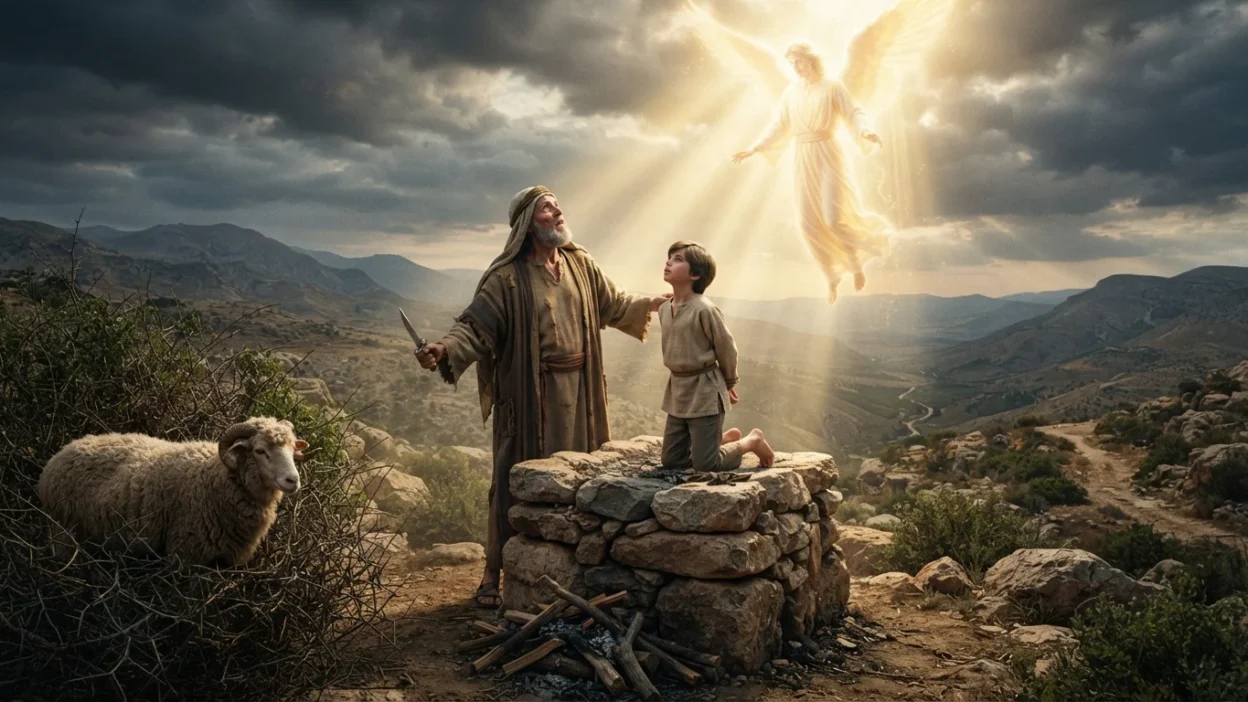
The sacrifice of Isaac meaning in the Bible is one of the most difficult and significant stories in the Old Testament. Found in Genesis 22, the account describes Abraham being tested when God instructed him to offer his son Isaac. The story raises deep questions about faith, obedience, trust, sacrifice, and the nature of God’s promises. It is also important because Isaac was the promised son through whom Abraham’s covenant family would continue.
Understanding the sacrifice of Isaac meaning in the Bible requires looking beyond the shocking surface of the story. Abraham’s willingness to obey demonstrates extraordinary trust, while God’s intervention provides a ram instead of Isaac. The event ultimately emphasizes faith, divine provision, and the certainty of God’s promise. For Christians, the account also carries important theological connections to later biblical ideas about sacrifice and redemption.
Quick Answer: What Does the Sacrifice of Isaac Mean in the Bible?
The sacrifice of Isaac is primarily a story about Abraham’s faith and obedience when God tested him. God stops Abraham before Isaac is killed and provides a ram instead. The account emphasizes trust, divine provision, covenant promise, and wholehearted devotion to God.
What Is the Meaning of the Sacrifice of Isaac?
The sacrifice of Isaac meaning in the Bible centers on Abraham’s test of faith.
Isaac was not an ordinary son in the biblical narrative. He was the child through whom God had promised to continue Abraham’s family line.
Therefore, God’s command created an apparently impossible situation. Abraham was being asked to trust God even when the command seemed to conflict with the promise he had received.
Abraham proceeded in obedience, but God stopped him before Isaac was sacrificed.
A ram was provided as a substitute.
| Element | Meaning |
|---|---|
| Abraham | Faith and obedience |
| Isaac | Promised son |
| Mountain | Place of testing and worship |
| Altar | Complete devotion |
| Ram | Divine provision and substitution |
| God’s intervention | Mercy and faithfulness |
| Promise | Continuity of the covenant |
Where Is the Story Found?
The account appears in Genesis 22 and is traditionally known as the binding of Isaac, or the Akedah in Jewish tradition.
The chapter begins with God testing Abraham.
Abraham takes Isaac to the appointed location, prepares an altar, and follows the instructions he has received.
At the crucial moment, God intervenes.
Abraham sees a ram caught nearby and offers it instead of his son.
The story ends with renewed emphasis on God’s promise to Abraham.
This structure is important because the story is not ultimately about Isaac’s death. Isaac survives. The climax is God’s provision and Abraham’s demonstrated faith.
Origin and Historical Background
The story belongs to the patriarchal narratives of Genesis.
Abraham lived in the ancient Near Eastern world, where sacrificial practices existed among surrounding cultures. This historical background helps explain why the concept of sacrifice would have been familiar to ancient audiences.
However, the biblical story presents a distinctive outcome.
God does not allow Abraham to complete the sacrifice of Isaac.
Instead, a ram is provided.
The narrative therefore distinguishes itself through divine intervention and emphasizes that God’s purpose is not the death of Isaac.
| Category | Information |
|---|---|
| Biblical book | Genesis |
| Chapter | Genesis 22 |
| Main character | Abraham |
| Son | Isaac |
| Setting | A mountain in the land of Moriah |
| Main event | Abraham is tested |
| Substitute | A ram |
| Major themes | Faith, obedience, provision, promise |
The Religious Connection of Isaac’s Sacrifice
The story has a major place in Jewish and Christian interpretation.
In Judaism, the binding of Isaac is known as the Akedah and is an important part of Jewish theological and liturgical tradition.
In Christianity, Genesis 22 is frequently understood as a story that points toward later biblical themes involving sacrifice, substitution, faith, and redemption.
The story is also connected to Abraham’s covenant relationship with God.
Isaac’s survival is especially important because the covenant promise depends upon the continuation of Abraham’s family through Isaac.
Spiritual Meaning of the Sacrifice of Isaac
The spiritual meaning of the sacrifice of Isaac meaning in the Bible is strongly connected with trust.
Abraham faced a situation in which he could not see how God’s promise would continue if Isaac died.
Yet he continued forward in faith.
This demonstrates a central spiritual principle: faith trusts God even when circumstances appear impossible to understand.
1. Faith Under Pressure
Abraham’s faith was tested at an extraordinary level.
The story challenges readers to consider whether their trust in God depends entirely on circumstances being understandable.
2. Complete Obedience
Abraham’s actions demonstrate his willingness to obey God’s command.
The story presents obedience as costly rather than convenient.
3. Trust in God’s Promise
Isaac represented God’s promise.
Abraham had to trust that God remained faithful even when the situation appeared to threaten that promise.
4. Divine Provision
The ram becomes the central symbol of God’s provision.
Abraham did not ultimately provide Isaac as a sacrifice. God provided another offering.
5. Worship and Devotion
The journey to the mountain is described as an act connected with worship.
This connects faith with surrender and devotion.
What Does Isaac Symbolize?
Isaac can symbolize promise, hope, and the future God has established.
He was born after years of waiting and represented the continuation of Abraham’s covenant family.
His presence on the altar therefore makes the test particularly difficult.
Isaac’s survival also becomes an important part of the story’s message.
| Symbol | Spiritual Idea |
|---|---|
| Isaac | Promise and hope |
| Abraham | Faith and obedience |
| Altar | Surrender |
| Ram | Provision and substitution |
| Mountain | Testing and worship |
| Fire | Sacrificial devotion |
These symbols should be understood alongside the historical narrative rather than replacing it.
Why Did God Test Abraham?
The text describes the event as a test.
This does not mean that God lacked knowledge of Abraham’s character and needed information.
Rather, the test reveals faith through action.
Abraham’s response demonstrates that his relationship with God was not merely theoretical.
The story also becomes a testimony for future generations.
It shows that faith can involve difficult decisions, uncertainty, and surrender.
At the same time, the story should not be interpreted as permission for people to harm others in the name of religious obedience.
Genesis 22 is a unique biblical event in which God Himself stops the sacrifice and provides the substitute.
The Meaning of the Ram as a Substitute
The ram is one of the most important details in the story.
When Abraham is stopped from sacrificing Isaac, he discovers a ram caught by its horns and offers it instead.
This demonstrates divine provision.
The ram also introduces the biblical theme of substitution, in which one life is offered in place of another.
This theme becomes important in later biblical discussions of sacrifice and atonement.
For Christian readers, the substitute can also point toward the broader theological theme of redemption.
Sacrifice of Isaac and Jesus
The sacrifice of Isaac meaning in the Bible is often connected by Christian interpreters with the story of Jesus.
There are several similarities worth considering carefully.
Both stories involve a beloved son.
Both are connected with sacrifice.
Both involve a mountain setting in biblical tradition.
Both contribute to larger themes of obedience, faith, and God’s provision.
However, Isaac and Jesus are not identical figures.
Isaac is spared.
Jesus, according to the New Testament, actually dies and is raised again.
Therefore, Christians generally view Isaac’s story as a significant pattern or foreshadowing rather than a direct repetition of the later Gospel story.
| Genesis 22 | Christian Fulfillment Theme |
|---|---|
| Isaac is the promised son | Jesus is central to God’s redemptive promise |
| Abraham offers his son | God gives His Son |
| Isaac is spared | Jesus willingly undergoes death |
| Ram is provided | Christ is understood as the ultimate sacrifice |
| Mountain setting | Biblical sacrifice imagery continues |
Common Misconceptions About Isaac’s Sacrifice
One major misconception is that Abraham actually killed Isaac.
He did not.
The story clearly reaches its turning point when God stops Abraham.
Another misconception is that the story teaches parents to obey any voice that tells them to harm their children.
That is not a responsible interpretation.
Genesis 22 is presented as a unique divine test within the biblical covenant story, and the sacrifice is stopped before Isaac is killed.
Another misconception is that the story has no connection with mercy.
In fact, God’s intervention and provision are central to its conclusion.
Cultural and Modern Understanding
The story of Abraham and Isaac has influenced Jewish, Christian, and Islamic traditions, although the details and interpretations differ among the three religions.
In Jewish tradition, the Akedah remains a significant theological theme.
Christian art and literature have also frequently depicted Abraham, Isaac, the altar, and the ram.
In modern discussions, the story is sometimes used to explore difficult questions about faith, morality, obedience, and divine authority.
Because of its challenging subject matter, it should be approached thoughtfully and within its biblical context.
Why Do People Search for the Sacrifice of Isaac Meaning?
People search for the sacrifice of Isaac meaning in the Bible because the story is emotionally and spiritually challenging.
Many readers wonder why God would ask Abraham to sacrifice his promised son.
Others want to understand the significance of the ram.
Christian readers may also want to know how Genesis 22 relates to Jesus and the concept of substitution.
Bible students frequently study the passage because it connects several major themes: covenant, faith, obedience, sacrifice, testing, and divine provision.
Lessons for Christians Today
The story offers several lessons that can be applied carefully to modern faith.
Trust When You Cannot See the Outcome
Abraham did not know exactly how the situation would end.
Surrender What You Value
The story challenges readers to consider whether anything has become more important than their relationship with God.
Remember God’s Faithfulness
Isaac was connected with a promise that seemed impossible.
Look for God’s Provision
The ram demonstrates that God’s provision can appear at the moment it is most needed.
Do Not Confuse Faith With Recklessness
Biblical faith is not an excuse for harmful or immoral actions.
The unique nature of Genesis 22 matters when applying its lessons today.
Final Thought
The sacrifice of Isaac meaning in the Bible is ultimately a story about faith, testing, obedience, and divine provision. Abraham was asked to surrender what mattered most to him, yet God intervened before Isaac was sacrificed and provided a ram instead. The story therefore does not end in tragedy but in God’s faithfulness and provision. Isaac’s survival is essential to understanding the account because he remained the promised son through whom Abraham’s covenant family continued. For Christians, the story also carries deeper connections with later themes of substitution and redemption. For all readers, Genesis 22 raises profound questions about trust and surrender while reminding us that biblical faith must always be understood within the larger story of God’s character and purposes.
FAQs
1. What is the sacrifice of Isaac?
It is the biblical account in Genesis 22 where God tests Abraham by commanding him to offer Isaac, but God stops him before Isaac is killed.
2. Did Abraham sacrifice Isaac?
No. Abraham did not kill Isaac. God intervened and provided a ram as a substitute.
3. Why did God test Abraham?
The biblical account presents the event as a test of Abraham’s faith and obedience, demonstrating his trust in God.
4. What does Isaac symbolize?
Isaac represents God’s promise, hope, covenant continuation, and the fulfillment of something that had seemed impossible.
5. What does the ram symbolize?
The ram represents God’s provision and the biblical concept of substitution.
6. Is Isaac a picture of Jesus?
Christian interpreters often see parallels between Isaac and Jesus, particularly regarding sonship, sacrifice, and promise. However, Isaac is spared while Jesus’ death and resurrection form the central event of the Christian Gospel.
7. What is the main lesson of Genesis 22?
The story teaches about faith, obedience, surrender, God’s provision, and trust in divine promises even when circumstances are difficult to understand.

William Noah is a spiritual writer at BibLoft, exploring hidden meanings, symbols, and divine insights. He shares thoughtful interpretations that inspire self-awareness, inner growth, and spiritual understanding.