
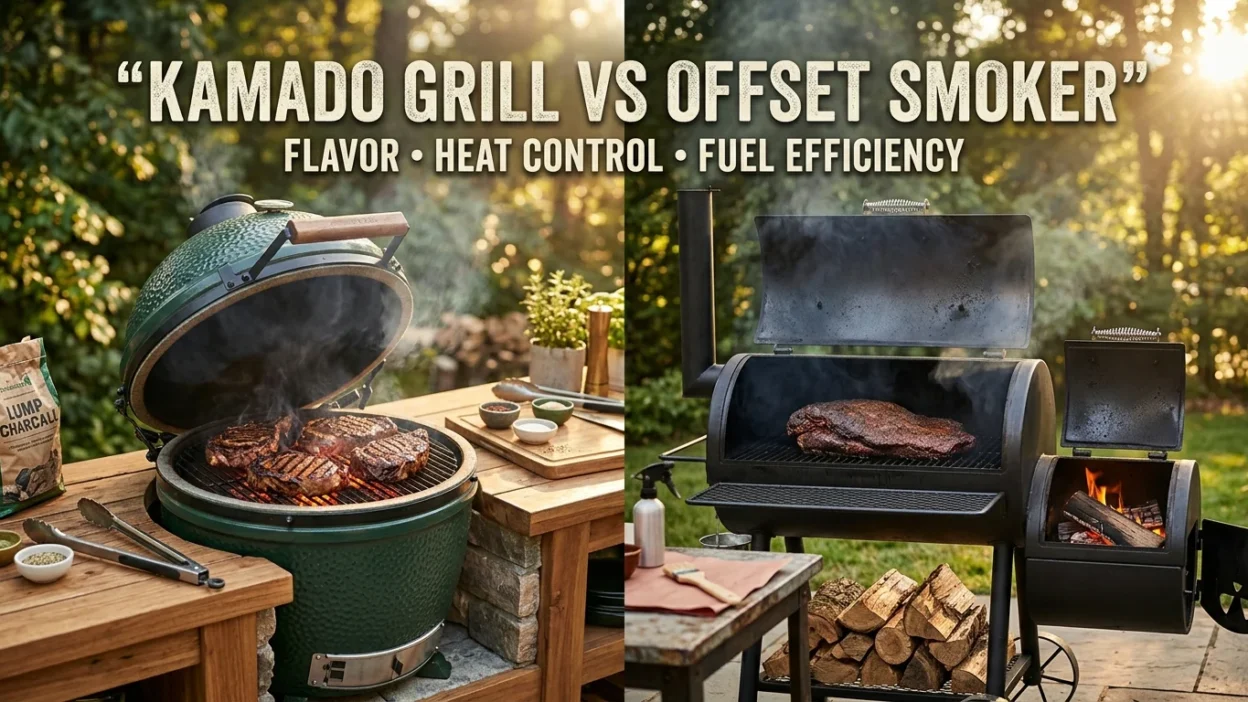
Choosing between a kamado grill vs offset smoker can make a big difference in your outdoor cooking experience. Both can produce delicious barbecue, tender ribs, smoked chicken, and flavorful brisket, but they work in different ways. A kamado grill uses an insulated, egg-shaped design to retain heat and control airflow, while an offset smoker uses a separate firebox to move wood-fired heat and smoke through a cooking chamber.
The right choice depends on what you cook most often, how much food you prepare, and how involved you want to be during a long barbecue session. Some cooks prefer the kamado’s versatility and fuel efficiency, while others enjoy the traditional smoky flavor and larger cooking space of an offset smoker. Understanding their main differences will help you choose a cooker that fits your budget, outdoor space, and cooking style.
Quick Answer: Kamado Grill vs Offset Smoker
A kamado grill is best for versatility, temperature stability, fuel efficiency, and high-heat grilling. An offset smoker is best for traditional wood-smoked flavor, larger cooking capacity, and classic low-and-slow barbecue.
Choose a kamado if you want one cooker for grilling, smoking, roasting, baking, and searing. Choose an offset smoker if you prioritize wood-fired flavor and enjoy managing a live fire.
What Is a Kamado Grill?
A kamado grill is a rounded, egg-shaped outdoor cooker traditionally made from thick ceramic or another heat-retaining material. Its insulated body traps heat, while adjustable vents regulate airflow and help maintain the cooking temperature.
Most kamado grills use lump charcoal as their primary fuel. You can add small pieces of smoking wood to create additional smoke flavor. With the right setup, a kamado can handle low-temperature smoking as well as high-temperature grilling.
Main Benefits of a Kamado Grill
- Excellent heat retention and temperature stability.
- Lower charcoal consumption during long cooking sessions.
- Suitable for grilling, smoking, roasting, and baking.
- Capable of reaching high temperatures for searing steaks and cooking pizza.
- Compact design that works well in many backyard spaces.
Potential Drawbacks
Kamado grills can be heavy, especially ceramic models, and moving them requires care. Their cooking area is often smaller than that of a large offset smoker. Ceramic also takes time to cool after becoming too hot, so temperature adjustments require patience.
What Is an Offset Smoker?
An offset smoker has a horizontal cooking chamber connected to a separate firebox on the side. The fire burns in the firebox, and heat and smoke travel through the cooking chamber before exiting through a chimney.
Traditional offset smokers commonly use seasoned hardwood splits, sometimes with charcoal to establish the initial fire. This arrangement makes them popular for classic American barbecue, particularly brisket, pork shoulder, and racks of ribs.
Main Benefits of an Offset Smoker
- Strong, distinctive wood-smoke flavor when operated correctly.
- Large cooking capacity on many models.
- Suitable for cooking several large cuts of meat at once.
- Provides hands-on control over the fire and smoke.
- Ideal for cooks who enjoy traditional barbecue techniques.
Potential Drawbacks
An offset smoker generally consumes more fuel than a well-insulated kamado. You may need to add wood regularly, monitor the fire, and adjust airflow throughout a long cook. Temperature can also vary across the cooking chamber, particularly in inexpensive or poorly insulated models.
Kamado Grill vs Offset Smoker: Comparison Table
| Feature | Kamado Grill | Offset Smoker |
|---|---|---|
| Main design | Insulated, rounded cooker | Horizontal chamber with separate firebox |
| Common fuel | Lump charcoal | Hardwood splits, often with charcoal |
| Smoke flavor | Usually cleaner and milder | Often stronger and more pronounced |
| Temperature stability | Excellent after proper setup | Depends on fire management and construction |
| Fuel efficiency | Generally high | Generally lower |
| Cooking capacity | Small to medium | Medium to large |
| High-heat searing | Excellent | Limited in the main chamber |
| Versatility | Very high | Primarily designed for smoking |
| Learning curve | Moderate | Often steep |
| Fire management | Less frequent adjustment | Regular attention required |
| Space requirements | Usually more compact | Usually longer and bulkier |
| Best use | Everyday cooking and varied barbecue | Traditional smoking and large cooks |
These are general differences. Performance varies according to the model, construction quality, cooking setup, weather, and the cook’s experience.
1. Smoke Flavor: Which Produces Better BBQ?
Smoke flavor is one of the most important differences between these cookers.
An offset smoker can produce a deep, pronounced wood-smoke character because it burns hardwood in a separate firebox. When the fire is clean and well managed, it can create excellent bark on brisket and pork shoulder.
A kamado can also produce excellent smoked food. It usually burns charcoal with a few pieces of smoking wood, creating a cleaner, often milder smoke profile. Its enclosed design also retains heat and moisture effectively.
Winner for traditional wood-smoke flavor: Offset smoker.
However, stronger smoke is not automatically better. If you prefer a balanced flavor that does not overpower chicken, fish, vegetables, or delicate foods, a kamado may suit your taste better.
2. Temperature Control and Heat Retention
Kamado grills are known for their ability to hold a stable temperature. Their insulated walls and adjustable vents restrict airflow and reduce heat loss. Once the fire reaches the desired temperature, a properly managed kamado can maintain it for hours with relatively little intervention.
Offset smokers rely more heavily on fire size, airflow, fuel quality, and chimney draft. Skilled cooks can maintain excellent temperatures, but the process requires more attention, especially during long smoking sessions.
The kamado’s insulation is helpful in cold or windy conditions. An offset’s performance depends significantly on its steel thickness, construction, seals, and exposure to weather.
Winner for temperature stability: Kamado grill.
3. Fuel Efficiency and Running Costs
Kamado grills generally use less fuel because their insulated bodies retain heat and their vents restrict oxygen. During a long smoking session, a kamado may operate on a single charcoal load, depending on the model, temperature, and weather.
Traditional offset smokers require a more active fire. Cooks often add hardwood splits throughout the session to maintain the desired temperature and smoke quality.
| Cost Factor | Kamado Grill | Offset Smoker |
|---|---|---|
| Primary fuel | Lump charcoal | Hardwood, sometimes charcoal |
| Fuel consumption | Usually lower | Usually higher |
| Fuel replenishment | Less frequent | More frequent |
| Long-cook convenience | Generally higher | Requires more attention |
Actual running costs depend on local fuel prices and cooking habits, but a kamado is usually the more economical option for frequent low-and-slow cooking.
4. Cooking Capacity: Which Holds More Food?
An offset smoker is often the better choice when you regularly prepare food for large gatherings. Its long cooking chamber can accommodate multiple racks of ribs, large briskets, or several pork shoulders, depending on its dimensions.
A kamado grill generally has a smaller cooking surface. Some models offer additional cooking levels or expandable racks, but space remains a consideration when preparing food for a crowd.
For everyday family meals, a kamado’s capacity may be more than enough. For parties, catering, or multiple large cuts, a generously sized offset can be more practical.
Winner for large-volume cooking: Offset smoker.
5. Versatility: Grilling, Smoking, Roasting, and Baking
Kamado grills are designed to do much more than smoke meat. With the correct accessories and cooking arrangement, you can grill burgers, sear steaks, roast poultry, bake bread, and cook pizza.
Offset smokers are primarily designed for smoking at relatively low temperatures. Some models include a grill grate over the firebox, but this does not provide the same all-purpose cooking setup as a kamado.
If you want one outdoor cooker for a wide range of meals, the kamado has a clear advantage.
Winner for versatility: Kamado grill.
6. Ease of Use and Learning Curve
A kamado is generally easier to manage once you learn how its vents affect airflow. It still takes practice to establish the correct temperature, especially because ceramic retains heat and cools slowly after an overshoot.
An offset smoker demands more hands-on attention. You must learn how to build a clean-burning fire, choose suitable wood, manage airflow, and respond to temperature changes. The fire may need attention every 30–60 minutes or so, although the interval varies by smoker, fuel, and conditions.
For beginners who want to smoke meat without constantly tending a fire, a kamado is often the easier starting point. For barbecue enthusiasts who enjoy learning fire management, an offset can be especially rewarding.
7. Which Is Better for Brisket and Ribs?
Both cookers can make excellent brisket and ribs when used correctly.
An offset smoker is especially appealing for traditional Texas-style brisket because its wood-fired heat and smoke can develop a pronounced bark and distinctive flavor. Its larger cooking chamber also helps when preparing several cuts.
A kamado can produce tender brisket and juicy ribs with steady heat and efficient fuel use. However, its smaller cooking space may limit the size or number of cuts you can prepare.
Choose an offset for a traditional wood-fired experience and bigger smoking sessions. Choose a kamado for consistent low-and-slow cooking with less fuel and less frequent fire management.
8. Cleaning and Maintenance
Both cookers need regular cleaning, but their maintenance routines differ.
A kamado requires ash removal, occasional cleaning of cooking grates, and inspection of its gasket and vents. Ceramic bodies must be handled carefully to avoid cracks from impact or sudden temperature changes.
An offset smoker needs ash and grease removal, along with regular checks for rust, damaged paint, worn seals, and chimney buildup. Steel smokers exposed to rain and humidity may require additional protection.
Neither cooker is maintenance-free. Proper cleaning and storage help preserve performance and extend the life of your equipment.
9. Price and Overall Value
The purchase price varies widely. Basic steel offset smokers may be relatively affordable, while heavy-duty, thick-steel models can cost considerably more. Quality kamado grills can also be expensive, especially large ceramic models and units with premium accessories.
Consider more than the initial price. Fuel use, accessories, cooking capacity, maintenance, and how frequently you will use the cooker all affect long-term value.
A kamado may provide better value if you want a single cooker for many cooking styles. An offset may provide better value if you specifically want traditional wood-fired barbecue and enough space for large quantities of food.
10. Pros and Cons at a Glance
| Cooker | Pros | Cons |
|---|---|---|
| Kamado grill | Fuel-efficient, stable temperature, versatile, compact footprint | Heavy, limited cooking area, slow to cool after overheating |
| Offset smoker | Strong wood-smoke flavor, large capacity, traditional barbecue experience | Higher fuel use, regular fire tending, larger footprint |
Which One Should You Choose?
Choose a kamado grill if you:
- Want one cooker for grilling, smoking, roasting, and baking.
- Prefer steady temperatures and lower fuel consumption.
- Cook mostly for family and small groups.
- Want to sear steaks or cook pizza at high temperatures.
- Prefer less hands-on fire management.
Choose an offset smoker if you:
- Prioritize classic wood-fired barbecue flavor.
- Frequently smoke briskets, ribs, and large cuts of meat.
- Need a larger cooking surface.
- Enjoy tending a live fire and learning traditional smoking techniques.
- Have sufficient outdoor space for a larger cooker.
Neither option is universally better. Your ideal cooker is the one that matches the meals you prepare and the amount of time you want to spend cooking.
FAQs
Is a kamado grill better than an offset smoker?
A kamado is generally better for versatility, fuel efficiency, and temperature stability. An offset is usually better for traditional wood-smoke flavor and large smoking sessions. The right choice depends on your priorities.
Can a kamado grill smoke brisket?
Yes. A kamado can maintain low temperatures for long periods and produce tender brisket. Adding suitable smoking wood can enhance the flavor, although the smoke profile may differ from that of a traditional offset smoker.
Does an offset smoker use more fuel than a kamado?
Usually, yes. Traditional offsets burn hardwood splits or a combination of charcoal and wood, while insulated kamados retain heat and use charcoal efficiently. Actual consumption depends on the cooker and cooking conditions.
Which cooker is easier for beginners?
A kamado is often easier for beginners because it holds temperature well once properly adjusted. An offset requires more practice with fire building, wood selection, and airflow management.
Can you grill steaks on an offset smoker?
Some offset smokers have a grill grate over the firebox or another direct-heat area, but the main cooking chamber is designed primarily for smoking. A kamado is generally much better for high-temperature steak searing.
Which is better for cooking for a crowd?
A large offset smoker is usually better for preparing several briskets, pork shoulders, or racks of ribs at once. A kamado may be sufficient for smaller gatherings, depending on its cooking surface and rack configuration.
Can you own both a kamado and an offset smoker?
Yes. They complement each other well. A kamado can handle everyday grilling and efficient smoking, while an offset can be reserved for larger cooks and traditional wood-fired barbecue.
Conclusion
The kamado grill vs offset smoker comparison comes down to versatility versus specialization. A kamado grill is an excellent all-purpose cooker that retains heat, uses fuel efficiently, and handles everything from high-heat searing to low-and-slow smoking. An offset smoker is designed for traditional wood-fired barbecue, offering a distinctive smoke profile and greater capacity on many models.
If you want convenience, temperature stability, and flexibility for everyday meals, a kamado is likely the better fit. If you enjoy managing a live fire, smoking large cuts, and developing classic barbecue flavor, an offset smoker may be the more satisfying choice. Consider your cooking habits, available space, budget, and preferred flavors before deciding.