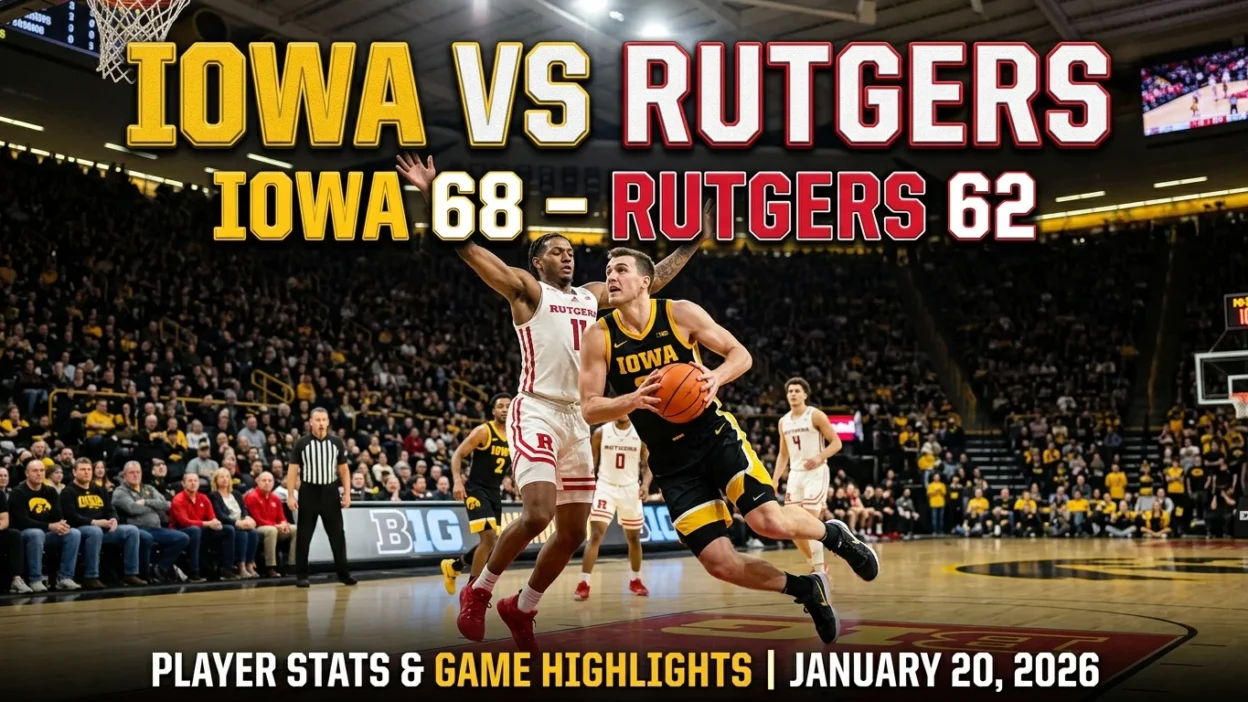
The Iowa vs Rutgers matchup delivered an exciting Big Ten men’s college basketball contest on January 20, 2026. The Iowa Hawkeyes defeated the Rutgers Scarlet Knights 68–62 at Carver-Hawkeye Arena in Iowa City. Iowa used a strong first-half finish and timely scoring late in the game to secure the six-point victory.
The game featured several impressive individual performances, including 20 points from Iowa’s Bennett Stirtz and 17 points from Rutgers’ Darren Buchanan Jr. Rutgers briefly took the lead in the second half, but Iowa responded and maintained enough control to finish ahead. For fans searching for Iowa vs Rutgers results, player statistics, team comparisons, and game highlights, this article explains the final score, leading performers, quarter-by-quarter action, and the main reasons Iowa won.
Quick Answer: Who Won Iowa vs Rutgers?
The Iowa Hawkeyes defeated the Rutgers Scarlet Knights 68–62 on January 20, 2026, in a Big Ten men’s basketball game. Bennett Stirtz led Iowa with 20 points and five assists, while Darren Buchanan Jr. led Rutgers with 17 points. Iowa’s strong first-half finish and late-game execution helped secure the victory.
Iowa vs Rutgers Match Overview
The matchup took place at Carver-Hawkeye Arena in Iowa City, Iowa. Both teams competed closely during several stretches, but Iowa created an important advantage before halftime.
Rutgers responded after the break with a strong scoring run that briefly put the Scarlet Knights ahead. Iowa then regained control, made key plays in the final minutes, and converted late free throws to protect its lead.
| Match Detail | Information |
|---|---|
| Match | Iowa Hawkeyes vs Rutgers Scarlet Knights |
| Sport | Men’s college basketball |
| Competition | Big Ten Conference |
| Date | January 20, 2026 |
| Venue | Carver-Hawkeye Arena |
| Iowa Score | 68 |
| Rutgers Score | 62 |
| Winning Team | Iowa Hawkeyes |
| Winning Margin | 6 points |
Iowa vs Rutgers Final Score by Half
Iowa finished the first half with a seven-point advantage. Rutgers improved after halftime, but the Hawkeyes scored enough points in the closing minutes to maintain their lead.
| Period | Iowa Hawkeyes | Rutgers Scarlet Knights |
|---|---|---|
| First Half | 31 | 24 |
| Second Half | 37 | 38 |
| Final Score | 68 | 62 |
Rutgers outscored Iowa by one point in the second half, but that was not enough to overcome the first-half deficit. Iowa’s seven-point halftime lead ultimately proved decisive.
Iowa Player Stats
Iowa received valuable contributions from its leading scorer and several supporting players. Bennett Stirtz led the offense, while Tate Sage delivered an efficient scoring performance.
| Player | Points | Rebounds | Assists |
|---|---|---|---|
| Bennett Stirtz | 20 | 4 | 5 |
| Tate Sage | 17 | 1 | 2 |
| Tavion Banks | 12 | 2 | 0 |
| Isaia Howard | 6 | 8 | 1 |
| Cam Manyawu | 4 | 2 | 1 |
| Cooper Koch | 3 | 1 | 2 |
| Kael Combs | 5 | 0 | 0 |
Selected player statistics from the game.
Bennett Stirtz Leads Iowa
Bennett Stirtz was Iowa’s leading scorer, finishing with 20 points, four rebounds, and five assists. He played an important role in keeping the Hawkeyes competitive when Rutgers threatened to take control.
Stirtz made eight of his 21 field-goal attempts and converted four free throws. His scoring and playmaking helped Iowa create opportunities during important stretches of the game.
Tate Sage Provides Efficient Scoring
Tate Sage contributed 17 points and two assists. He made five of seven field-goal attempts, including four of six three-point attempts.
His outside shooting gave Iowa an important offensive boost. Sage’s ability to score efficiently helped the Hawkeyes maintain pressure on the Rutgers defense.
Tavion Banks Adds 12 Points
Tavion Banks finished with 12 points and two rebounds. He made five of nine field-goal attempts, providing another reliable scoring option.
Banks’ contribution was valuable because Iowa did not have to depend entirely on Stirtz. Multiple scoring threats helped the Hawkeyes respond when Rutgers made its second-half run.
Isaia Howard Helps on the Boards
Isaia Howard recorded six points and eight rebounds. His rebounding helped Iowa compete for possession and limit Rutgers’ opportunities to extend its second-half advantage.
Rutgers Player Stats
Rutgers had several productive individual performances, especially from Darren Buchanan Jr. and Tariq Francis. However, turnovers and missed opportunities made it difficult for the Scarlet Knights to complete a comeback.
| Player | Points | Rebounds | Assists |
|---|---|---|---|
| Darren Buchanan Jr. | 17 | 3 | 0 |
| Tariq Francis | 15 | 3 | 1 |
| Kaden Powers | 8 | 1 | 3 |
| Emmanuel Ogbole | 8 | 10 | 1 |
| Angelino Mark | 7 | 2 | 3 |
| Dylan Grant | 6 | 3 | 0 |
| Christopher Nwuli | 1 | 2 | 0 |
Selected player statistics from the game.
Darren Buchanan Jr. Leads Rutgers
Darren Buchanan Jr. led Rutgers with 17 points. He made five of eight field-goal attempts and converted six of seven free throws.
His scoring kept Rutgers within reach, particularly during the stretches when the Scarlet Knights were trying to close the gap. However, the team needed more consistent offensive production to overcome Iowa’s advantage.
Tariq Francis Adds 15 Points
Tariq Francis scored 15 points and collected three rebounds. He made four field goals and converted five free throws.
Francis provided another important scoring option for Rutgers. His performance helped the Scarlet Knights remain competitive, but Iowa’s late-game execution prevented Rutgers from completing the comeback.
Emmanuel Ogbole Records 10 Rebounds
Emmanuel Ogbole finished with eight points and a game-high 10 rebounds. His work near the basket helped Rutgers compete on the boards.
Ogbole also recorded two blocks, contributing defensively. His performance demonstrated that rebounding and rim protection remained important even though Rutgers finished on the losing side.
Iowa vs Rutgers Team Statistics Comparison
The team statistics reveal several differences between the Hawkeyes and Scarlet Knights. Iowa shot more efficiently from the field and committed fewer turnovers.
| Statistic | Iowa | Rutgers |
|---|---|---|
| Final Points | 68 | 62 |
| Field Goals Made | 24 | 19 |
| Field-Goal Attempts | 51 | 44 |
| Field-Goal Percentage | 47.1% | 43.2% |
| Three-Pointers Made | 7 | 5 |
| Three-Point Attempts | 19 | 18 |
| Free Throws Made | 13 | 19 |
| Total Rebounds | 19 | 29 |
| Assists | 12 | 9 |
| Steals | 9 | 6 |
| Blocks | 4 | 5 |
| Turnovers | 12 | 16 |
Rutgers had a substantial rebounding advantage, collecting 29 rebounds compared with Iowa’s 19. The Scarlet Knights also made more free throws.
However, Iowa made five more field goals and recorded fewer turnovers. Those advantages helped the Hawkeyes overcome Rutgers’ success on the boards and at the free-throw line.
Iowa vs Rutgers Game Timeline
First Half: Iowa Builds Momentum
Rutgers started quickly, taking an early 5–0 lead. Iowa responded with a seven-point run and improved its defensive pressure.
The Hawkeyes held Rutgers scoreless for more than four minutes during one stretch. Iowa then closed the half with a 13–3 run, moving ahead 31–24.
That late scoring burst gave Iowa an important advantage heading into halftime.
Second Half: Rutgers Takes the Lead
Rutgers opened the second half with a 9–0 run, turning a seven-point deficit into a 33–31 lead.
Kaden Powers contributed a three-pointer, while Buchanan Jr. helped the Scarlet Knights generate points from the free-throw line. Emmanuel Ogbole also scored inside as Rutgers briefly shifted the momentum.
Iowa responded by finding better scoring opportunities and keeping the game close. Neither team established a comfortable advantage during much of the second half.
Final Minutes: Iowa Secures the Victory
The game remained competitive as the clock moved toward the final minutes. Iowa made important plays when it needed them most, with Stirtz helping the Hawkeyes regain control.
Late free throws helped Iowa protect its advantage. Rutgers continued to compete, but the Scarlet Knights could not find enough scoring to close the remaining gap.
Iowa finished with a 68–62 victory, earning an important Big Ten win.
Why Did Iowa Beat Rutgers?
Several factors contributed to Iowa’s victory.
1. Better field-goal efficiency: Iowa made 47.1% of its field-goal attempts, compared with Rutgers’ 43.2%.
2. Fewer turnovers: Iowa committed 12 turnovers, while Rutgers committed 16. The difference gave the Hawkeyes more opportunities to maintain possession and build scoring chances.
3. Bennett Stirtz’s performance: Stirtz led Iowa with 20 points and five assists, providing both scoring and playmaking.
4. Tate Sage’s shooting: Sage scored 17 points and made four three-pointers, giving Iowa an efficient outside scoring threat.
5. Strong first-half finish: Iowa’s 13–3 run before halftime created a lead that proved important in the final result.
What Went Wrong for Rutgers?
Rutgers produced a strong second-half response and finished with more total rebounds than Iowa. Nevertheless, several issues prevented the Scarlet Knights from winning.
The team committed 16 turnovers, four more than Iowa. Those mistakes reduced the number of possessions available for scoring and made it harder to sustain momentum.
Rutgers also made five three-pointers compared with Iowa’s seven. Although the Scarlet Knights scored more points at the free-throw line, their lower field-goal efficiency and turnover total contributed to the defeat.
Buchanan Jr. and Francis delivered strong individual scoring performances, but Rutgers needed more consistent contributions across the lineup.
What Does the Result Mean for Iowa and Rutgers?
The victory improved Iowa’s record to 14–5 overall and 4–4 in Big Ten play at the time of the game. It also gave the Hawkeyes their second consecutive win.
Rutgers fell to 9–10 overall and 2–6 in conference play after the defeat. The game highlighted both the Scarlet Knights’ ability to respond after halftime and the importance of protecting possession in close contests.
For Iowa, the result demonstrated the value of efficient shooting and timely scoring. For Rutgers, the performance showed that rebounding and individual scoring alone may not be enough when turnovers become a problem.
FAQs
1. Who won the Iowa vs Rutgers basketball game?
The Iowa Hawkeyes defeated the Rutgers Scarlet Knights 68–62 on January 20, 2026.
2. How many points did Bennett Stirtz score?
Bennett Stirtz scored 20 points and recorded five assists for Iowa.
3. Who was Rutgers’ leading scorer?
Darren Buchanan Jr. led Rutgers with 17 points.
4. How many points did Tate Sage score?
Tate Sage scored 17 points, including four three-pointers.
5. Which team had more rebounds?
Rutgers collected 29 rebounds, while Iowa recorded 19.
6. Why did Iowa win the game?
Iowa shot more efficiently from the field, committed fewer turnovers, and benefited from a strong first-half finish.
7. What was the halftime score?
Iowa led Rutgers 31–24 at halftime.
Conclusion
The Iowa vs Rutgers basketball game on January 20, 2026, ended with a 68–62 victory for the Iowa Hawkeyes. Bennett Stirtz led Iowa with 20 points and five assists, while Tate Sage added 17 points and Tavion Banks contributed 12. For Rutgers, Darren Buchanan Jr. scored 17 points, and Tariq Francis added 15 points. Despite Rutgers’ advantage in rebounding, Iowa’s better field-goal efficiency and fewer turnovers helped secure the win.
The game remained competitive, especially after Rutgers started the second half with a strong scoring run and briefly took the lead. However, Iowa responded with important plays and effective late-game execution. Overall, the matchup showed how shooting accuracy, ball control, and teamwork can determine the outcome of a close college basketball game.

William Noah is a spiritual writer at BibLoft, exploring hidden meanings, symbols, and divine insights. He shares thoughtful interpretations that inspire self-awareness, inner growth, and spiritual understanding.