
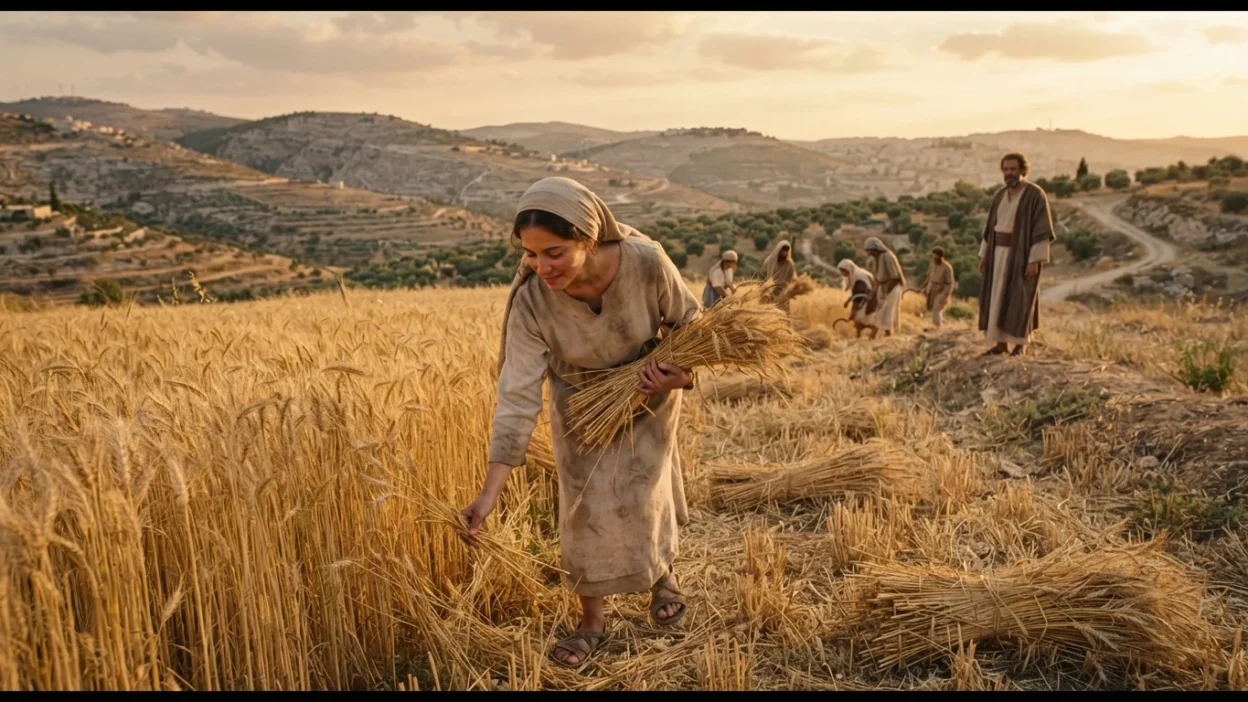
The glean meaning in the Bible is closely connected with the ancient practice of gathering leftover grain or produce after a harvest. In biblical times, gleaning was more than an agricultural activity. It was connected to God’s instructions about caring for the poor, widows, foreigners, and others in need. The practice created an opportunity for vulnerable people to gather food while preserving dignity through meaningful work.
Understanding the glean meaning in the Bible also helps readers appreciate the powerful story of Ruth. When Ruth went into the fields to gather leftover grain, her actions became part of a larger story involving provision, kindness, loyalty, and redemption. The biblical idea of gleaning continues to offer spiritual lessons about generosity, humility, hard work, and God’s ability to provide through ordinary circumstances.
Quick Answer: What Does Glean Mean in the Bible?
The glean meaning in the Bible is to gather leftover grain or crops from a field after the main harvest. Biblical laws instructed landowners not to collect everything, allowing poor and vulnerable people to gather what remained. Gleaning is especially important in the story of Ruth, where it becomes connected with God’s provision and redemption.
What Does Glean Mean in the Bible?
To glean means to collect what is left behind after the main harvest.
In an agricultural setting, workers harvested the main crop first. Small amounts of grain could remain in the field, including stalks that were missed or dropped.
These remaining crops could then be gathered by people in need.
The glean meaning in the Bible therefore includes both a practical action and a social purpose.
Gleaning was connected with biblical laws designed to protect vulnerable members of society.
| Term | Meaning |
|---|---|
| Glean | Gather leftover crops |
| Harvest | Collect the main crop |
| Field | Agricultural land where crops grow |
| Reaping | Cutting and gathering mature crops |
| Provision | Supplying what is needed |
The Origin and History of Gleaning
Gleaning was a common agricultural practice in ancient societies.
Harvesting fields by hand meant that workers could not collect every stalk or piece of produce.
Biblical law also specifically instructed landowners to leave portions of their harvest available for others.
These instructions are found in passages such as Leviticus 19:9–10 and Deuteronomy 24:19–22.
The purpose was to provide support for the poor, the foreigner, the orphan, and the widow.
This historical background shows that gleaning was not simply accidental.
It became part of a system that combined agricultural work with social responsibility.
Gleaning in Old Testament Law
The Old Testament contains clear instructions concerning harvest practices.
Landowners were told not to reap completely to the edges of their fields or repeatedly return for everything that had been missed.
Some of the remaining produce was to be left for people in need.
This principle connected worship and ethics.
A person’s relationship with God was expected to influence how they treated others.
The glean meaning in the Bible therefore reflects compassion expressed through practical action.
| Biblical Principle | Purpose |
|---|---|
| Leave field edges | Provide food for those in need |
| Do not collect everything | Create opportunities for gleaning |
| Remember the vulnerable | Encourage compassion |
| Share the harvest | Recognize God’s provision |
| Work with dignity | Allow people to gather food |
These laws show that biblical generosity was often structured into everyday life.
The Story of Ruth and Gleaning
The best-known example of gleaning appears in the Book of Ruth.
Ruth and her mother-in-law, Naomi, faced a difficult situation after losing family members.
As widows, they were vulnerable and needed food and support.
Ruth went to a field to glean grain during the harvest.
The field belonged to Boaz, a relative of Naomi’s late husband.
Boaz noticed Ruth and treated her with kindness.
He instructed his workers to allow her to glean safely and generously.
This event became an important turning point in the story.
Ruth’s simple act of gathering grain eventually led to her marriage to Boaz and her place within the family line of King David.
For Christians, Ruth’s story is also connected to the broader biblical story that leads to Jesus.
Why Was Gleaning Important to Ruth?
Gleaning allowed Ruth to take action during a difficult time.
Rather than waiting passively, she worked in the fields to provide food for herself and Naomi.
Her example is often associated with diligence, humility, and loyalty.
At the same time, Ruth depended on the generosity of others and ultimately on God’s provision.
The glean meaning in the Bible becomes especially meaningful in her story because it shows how ordinary work can become part of a larger purpose.
Ruth did not enter the field knowing how her future would unfold.
Yet her faithfulness in an everyday task became part of a remarkable story of redemption.
The Spiritual Meaning of Gleaning in the Bible
The spiritual meaning of gleaning can be understood through several important themes.
God’s Provision
Gleaning reminds readers that God can provide through ordinary means.
Ruth found food in a field, but the story also shows divine care working through human kindness and everyday events.
Humility
A gleaner gathered what remained after others had harvested.
This can symbolize humility and a willingness to receive help when needed.
Diligence
Ruth worked actively in the field.
Her example shows that faith and responsible effort can work together.
Generosity
Landowners were instructed to leave part of their harvest for others.
This teaches that blessings should not always be kept for personal benefit.
Redemption
In Ruth’s story, gleaning eventually connects her with Boaz and the larger theme of restoration.
| Spiritual Symbol | Possible Lesson |
|---|---|
| Leftover grain | Provision for those in need |
| The harvest field | Opportunity and God’s care |
| Ruth’s work | Diligence and faithfulness |
| Boaz’s kindness | Generosity and protection |
| The final outcome | Redemption and restoration |
The spiritual lessons connected with the glean meaning in the Bible should be understood as reflections on biblical themes rather than secret symbolism.
Gleaning and God’s Provision
One of the strongest lessons connected with gleaning is that provision can come through unexpected circumstances.
Ruth simply went out to gather grain.
She did not know that the field she entered belonged to Boaz.
The story demonstrates how ordinary decisions can become important moments.
This does not mean every coincidence should automatically be viewed as a direct sign.
Instead, the biblical story encourages believers to recognize that God’s care can operate through work, relationships, generosity, and everyday opportunities.
The harvest field became a place where Ruth received both food and hope.
Gleaning and Caring for the Poor
Biblical gleaning laws reveal an important social principle.
People with resources were expected to consider the needs of others.
The landowner did not have complete freedom to use every possible part of the harvest only for personal gain.
Some of the produce was intentionally left available for vulnerable people.
This principle teaches that generosity can be practical and organized.
Compassion is not only an emotional feeling.
It can influence business practices, personal decisions, and the way communities care for people facing hardship.
Glean vs. Harvest: What Is the Difference?
Gleaning and harvesting are related but different activities.
| Gleaning | Harvesting |
|---|---|
| Gathering what remains | Collecting the main crop |
| Often done after reapers | Usually done by primary workers |
| Connected with provision for the vulnerable | Connected with agricultural production |
| Smaller amount of produce | Main collection of crops |
| Important in Ruth’s story | Common throughout biblical agriculture |
Understanding this difference makes the glean meaning in the Bible much clearer.
A gleaner was not necessarily performing the main harvest.
Instead, the person collected what remained available.
Common Misconceptions About Gleaning
Misconception 1: Gleaning means stealing crops
Biblical gleaning was connected with laws that allowed vulnerable people to gather what was intentionally left behind.
Misconception 2: Gleaning was only charity
It provided assistance, but it also allowed people to work for their food.
Misconception 3: Gleaning only appears in Ruth
The practice is also connected with Old Testament laws concerning harvests and care for vulnerable people.
Misconception 4: Every field owner was required to give away the entire harvest
The laws instructed landowners to leave specific portions and missed produce rather than collecting everything.
Misconception 5: Gleaning has no relevance today
Although modern agriculture differs greatly, its principles can still inspire generosity and concern for people in need.
Why Do People Search for Glean Meaning in the Bible?
Many readers encounter the word “glean” while reading the Book of Ruth.
Because the term is not commonly used in everyday modern English, its meaning may be unclear.
People also search glean meaning in the Bible because they want to understand Ruth’s actions and the biblical laws concerning harvests.
Others are interested in the spiritual lessons behind the practice.
Studying gleaning provides insight into ancient farming, biblical social responsibility, and God’s provision through ordinary circumstances.
Cultural and Modern Usage of the Word Glean
Today, the word “glean” has both literal and figurative meanings.
In agriculture and food recovery, gleaning can still describe collecting usable produce that would otherwise be left behind.
Figuratively, people may say they “gleaned information,” meaning they collected useful details from different sources.
This modern usage preserves the central idea of gathering something valuable from what remains or from scattered pieces.
The biblical background gives the word an additional connection to compassion, provision, and responsible use of resources.
What Can Christians Learn From Gleaning?
The glean meaning in the Bible offers several practical lessons.
First, generosity should be intentional.
Biblical landowners were instructed to leave opportunities for others rather than focusing only on maximum personal gain.
Second, people facing hardship can still demonstrate courage and diligence.
Ruth worked faithfully while receiving help.
Third, ordinary actions can become part of a larger story.
Ruth’s journey into a field may have seemed simple, yet it became a turning point in her life.
Finally, communities can reflect God’s care by creating practical ways to support vulnerable people.
Gleaning as a Symbol of Faith and Hope
Gleaning can also serve as a meaningful illustration of faith and hope.
A gleaner entered a field without controlling the entire harvest.
The person depended on what was available.
This can remind believers of human dependence on God’s provision.
At the same time, Ruth’s story shows active faith.
She did not simply wait for food to appear.
She went to work.
This combination of trust and effort is one of the most practical lessons connected with gleaning.
Hope does not always mean knowing the final outcome.
Sometimes it means taking the next faithful step.
Final Thought
The glean meaning in the Bible begins with a simple agricultural practice: gathering leftover grain after the main harvest. Yet Scripture gives this practice a deeper significance through laws that protected vulnerable people and through the powerful story of Ruth. Gleaning demonstrates how generosity, dignity, work, and compassion can exist together. Ruth’s journey into Boaz’s field reminds readers that ordinary actions may become part of a much larger story.
The practice also teaches that provision often comes through practical means, human kindness, and opportunities to work. Today, the biblical lessons of gleaning can inspire believers to share their resources, support people in need, work faithfully, and trust that God can bring hope and purpose from everyday circumstances.
FAQs
1. What does glean mean in the Bible?
To glean means to gather leftover grain or crops after the main harvest.
2. Why did Ruth glean in the fields?
Ruth gleaned to provide food for herself and Naomi after they faced difficult circumstances.
3. Was gleaning allowed in biblical law?
Yes. Old Testament laws instructed landowners to leave portions of their harvest for the poor, foreigners, widows, and others in need.
4. What is the spiritual meaning of gleaning?
Gleaning can represent God’s provision, humility, diligence, generosity, hope, and redemption.
5. What is the difference between gleaning and harvesting?
Harvesting collects the main crop, while gleaning gathers what remains after the primary harvest.
6. Who was Boaz in the story of Ruth?
Boaz was the owner of the field where Ruth gleaned and later became her husband and kinsman-redeemer.
7. What can Christians learn from biblical gleaning?
Christians can learn about generosity, compassion, responsible work, human dignity, and trusting God through ordinary circumstances.