
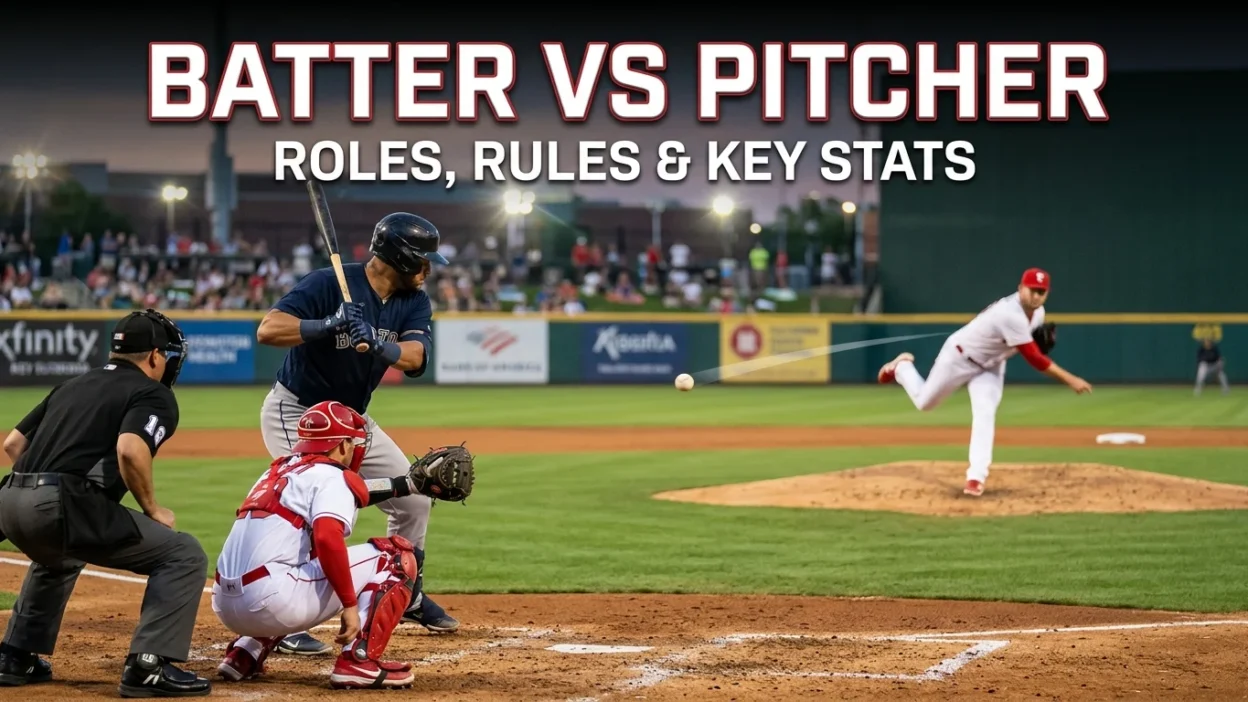
The difference between a batter vs pitcher in baseball comes down to their roles in the game. A batter is the offensive player who tries to hit the ball and help their team score runs, while a pitcher is the defensive player who throws the ball toward home plate and tries to get the batter out. These two players face each other during every pitch, making their matchup one of the most important parts of baseball.
Understanding batter vs pitcher matchups can help beginners follow a baseball game, understand player statistics, and learn how teams develop their strategies. The phrase also appears in fantasy baseball, sports analysis, and betting discussions, where people compare a hitter’s past performance against a particular pitcher. Although these statistics can provide useful information, they do not guarantee what will happen in a future game.
Quick Answer: Batter vs Pitcher
A batter attempts to hit the baseball and reach base or score runs, while a pitcher throws the ball to prevent the batter from succeeding. The batter belongs to the offensive team during the plate appearance, and the pitcher represents the defensive team. Their matchup depends on skill, pitch selection, timing, strategy, and game conditions.
Why People Confuse Batter and Pitcher
People sometimes confuse these terms because both players are involved in the same action. The pitcher throws the ball, and the batter tries to hit it. However, they have opposite goals.
The batter wants to make solid contact, reach base, advance runners, or hit a home run. The pitcher wants to limit those outcomes by throwing effective pitches and recording outs.
Another reason for confusion is the phrase batter vs pitcher stats, often shortened to BvP. In this context, the phrase describes a particular hitter’s historical performance against a particular pitcher, rather than simply explaining their positions.
First Word: Batter
A batter is the offensive player standing in the batter’s box, attempting to hit a pitch delivered by the opposing pitcher. The batter uses a bat to make contact with the ball and help the team score.
What Does a Batter Do?
A batter can try to hit a single, double, triple, or home run. The player can also reach base by drawing a walk or being hit by a pitch.
Batters must recognize different pitches, judge their location, and decide whether to swing. A successful batter combines timing, hand-eye coordination, patience, and an understanding of the opposing pitcher’s strategy.
Common Batter Statistics
- Batting average (AVG): Measures hits divided by official at-bats.
- Home runs (HR): Counts balls hit over the outfield fence in fair territory without first touching the ground, under standard home-run rules.
- Runs batted in (RBI): Measures runs credited to a batter’s plate appearance, subject to scoring rules.
- On-base percentage (OBP): Measures how frequently a player reaches base through qualifying outcomes.
- Slugging percentage (SLG): Measures total bases earned per official at-bat.
These statistics help explain how a batter contributes offensively.
Second Word: Pitcher
A pitcher is the defensive player who throws the baseball from the pitcher’s mound toward home plate. The pitcher tries to prevent the batter from reaching base and helps the defensive team record outs.
What Does a Pitcher Do?
Pitchers use different pitches to challenge hitters. A fastball emphasizes velocity, while a curveball or slider uses movement to make contact more difficult. A changeup can disrupt a batter’s timing by arriving more slowly than a fastball.
Pitchers also work with catchers to select pitches, target locations, and respond to the game situation.
Common Pitcher Statistics
- Earned run average (ERA): The average number of earned runs allowed per nine innings pitched.
- Strikeouts (K): Counts batters retired by strike three.
- Walks and hits per inning pitched (WHIP): Measures walks and hits allowed per inning, with specific scoring conventions.
- Wins and losses: Records credited to a pitcher under baseball’s scoring rules.
- Innings pitched (IP): Measures how much of the game a pitcher has pitched.
These statistics help evaluate pitching performance, although no single number explains everything about a pitcher.
Batter vs Pitcher: Comparison Table
| Feature | Batter | Pitcher |
|---|---|---|
| Main role | Offense | Defense |
| Primary goal | Hit the ball and reach base | Prevent hits and record outs |
| Main equipment | Bat and batting helmet | Baseball and glove |
| Position during the matchup | Batter’s box | Pitcher’s mound |
| Important statistics | AVG, HR, OBP, SLG | ERA, strikeouts, WHIP |
| Main skills | Timing, contact, plate discipline | Velocity, movement, command |
| Successful outcome | Hit, walk, or productive plate appearance | Strikeout, weak contact, or another out |
When to Use Each Term
Use batter when discussing the player attempting to hit the ball.
Example: The batter hit a double into the gap between the outfielders.
Use pitcher when discussing the player delivering pitches.
Example: The pitcher struck out two batters in the inning.
Use batter vs pitcher when describing their direct matchup or comparing a hitter’s historical record against a particular pitcher.
Example: The analyst examined the batter vs pitcher statistics before evaluating the upcoming matchup.
Use BvP stats when discussing the historical numbers between one specific hitter and one specific pitcher. These numbers should be interpreted carefully because a small sample of plate appearances can be misleading.
10 Examples of Batter vs Pitcher in Baseball
- The batter hit a single against the opposing pitcher.
- The pitcher struck out the batter with a breaking ball.
- A patient batter drew a walk after receiving four balls.
- The pitcher changed his pitch selection after giving up a home run.
- The batter watched a low pitch pass without swinging.
- The pitcher recorded three strikeouts in one inning.
- A left-handed batter faced a right-handed pitcher.
- The coach studied the batter’s past results against the starting pitcher.
- The batter hit a sacrifice fly that allowed a teammate to score.
- The pitcher induced a ground ball and helped the defense record an out.
These examples show that the matchup involves more than hitting power or throwing speed. Decisions, pitch location, discipline, and the game situation all matter.
What Are Batter vs Pitcher Stats?
Batter vs pitcher statistics describe how a particular hitter has performed against a particular pitcher in previous meetings. They may include plate appearances, at-bats, hits, home runs, walks, strikeouts, batting average, and other measures.
For example, suppose a hitter has faced a pitcher 10 times and recorded three hits. The hitter’s batting average in those official at-bats cannot be calculated from plate appearances alone, because walks and other outcomes may not count as at-bats.
A key limitation is sample size. Three hits in five at-bats may look impressive, but five at-bats are not enough to confidently predict future success. Analysts should also consider the hitter’s overall ability, the pitcher’s current form, pitch types, handedness, and the context of previous meetings.
BvP statistics are useful as one piece of information, not as a guaranteed prediction.
Common Mistakes
Mistake 1: Thinking the Batter Always Swings
A batter does not have to swing at every pitch. The player can wait for a favorable pitch, draw a walk, or protect against a pitch near the strike zone.
Mistake 2: Thinking the Pitcher Only Throws Fastballs
Pitchers use different pitch types, speeds, and locations to keep hitters off balance.
Mistake 3: Treating Batting Average as the Complete Story
Batting average measures hits per at-bat, but it does not fully capture walks, power, or other offensive contributions. Other statistics can provide additional context.
Mistake 4: Assuming BvP Stats Guarantee a Result
Past performance against one pitcher does not guarantee a hitter will succeed in the next game. Baseball outcomes are influenced by many changing factors.
Memory Trick: Batter vs Pitcher
Remember this simple rule:
- Batter = Bat: The player uses a bat to hit the ball.
- Pitcher = Pitch: The player throws pitches toward home plate.
The batter tries to create offense, while the pitcher tries to stop it. Remembering these two actions makes the difference easy to understand.
American vs British English
The terms batter and pitcher are standard in American English baseball terminology. In cricket, a similar offensive role is commonly called a batter, while the player delivering the ball is called a bowler.
| Baseball Term | Similar Cricket Term |
|---|---|
| Batter | Batter |
| Pitcher | Bowler |
| Pitch | Delivery or ball |
| Home run | No exact equivalent; a six is a comparable scoring outcome in some situations |
| Strikeout | No exact equivalent; a dismissal by bowled or caught may occur in different circumstances |
Baseball and cricket share some vocabulary, but their rules and player roles are different. A baseball pitcher and a cricket bowler should not be treated as identical positions.
Similar Words: Hitter, Pitcher, Bowler, and Catcher
Hitter: Another common word for a batter, especially when discussing offensive performance.
Pitcher: The player who delivers the baseball toward home plate.
Bowler: The player who delivers the ball in cricket.
Catcher: The defensive player who receives pitches behind home plate and works with the pitcher on strategy.
BvP: An abbreviation for batter versus pitcher, commonly used when analyzing a hitter’s previous results against a particular pitcher.
Knowing these related terms makes baseball reports and statistical discussions easier to understand.
Final Verdict: Batter vs Pitcher
The difference between batter vs pitcher is simple: the batter tries to hit the ball and help the team score, while the pitcher tries to prevent that success by delivering effective pitches and recording outs. Both roles require skill, preparation, and strategic thinking.
When reading batter vs pitcher statistics, remember that historical performance can provide context but cannot predict every result. The best analysis combines matchup history with current performance, relevant statistics, and the circumstances of the game.
FAQs
1. What is the main difference between a batter and a pitcher?
A batter attempts to hit the ball and reach base, while a pitcher throws the ball and tries to get the batter out.
2. What does BvP mean in baseball?
BvP means batter versus pitcher. It usually refers to the historical statistics between a specific hitter and a specific pitcher.
3. Is the batter on offense or defense?
The batter is on offense during the plate appearance.
4. Is the pitcher on offense or defense?
The pitcher is on defense while pitching against the opposing team’s batter.
5. Which statistics are important for a batter?
Batting average, on-base percentage, slugging percentage, home runs, and strikeouts are among the useful measures of a batter’s performance.
6. Which statistics are important for a pitcher?
Earned run average, strikeouts, WHIP, innings pitched, and walks allowed help describe a pitcher’s performance.
7. Are batter vs pitcher stats reliable?
They can provide useful historical information, but their reliability depends on sample size and context. Small samples should not be treated as strong evidence of future results.
Remember This
A batter hits, and a pitcher throws. The batter tries to reach base and score runs, while the pitcher tries to record outs and limit scoring. Batter vs pitcher statistics compare a hitter’s previous performance against a particular pitcher, but past results do not guarantee future outcomes.
Conclusion
Understanding batter vs pitcher is essential for anyone learning baseball or reading baseball statistics. The batter leads the offensive effort by trying to hit the ball, while the pitcher leads the immediate defensive challenge by choosing pitches and attempting to retire the hitter. Their confrontation shapes the pace and strategy of every plate appearance.
For fans and analysts, BvP statistics offer another way to explore a matchup. However, they are most helpful when combined with broader performance data and an understanding of the game’s context. Learning the roles, statistics, and limitations makes baseball easier to follow and player comparisons more meaningful.

William Noah is a spiritual writer at BibLoft, exploring hidden meanings, symbols, and divine insights. He shares thoughtful interpretations that inspire self-awareness, inner growth, and spiritual understanding.