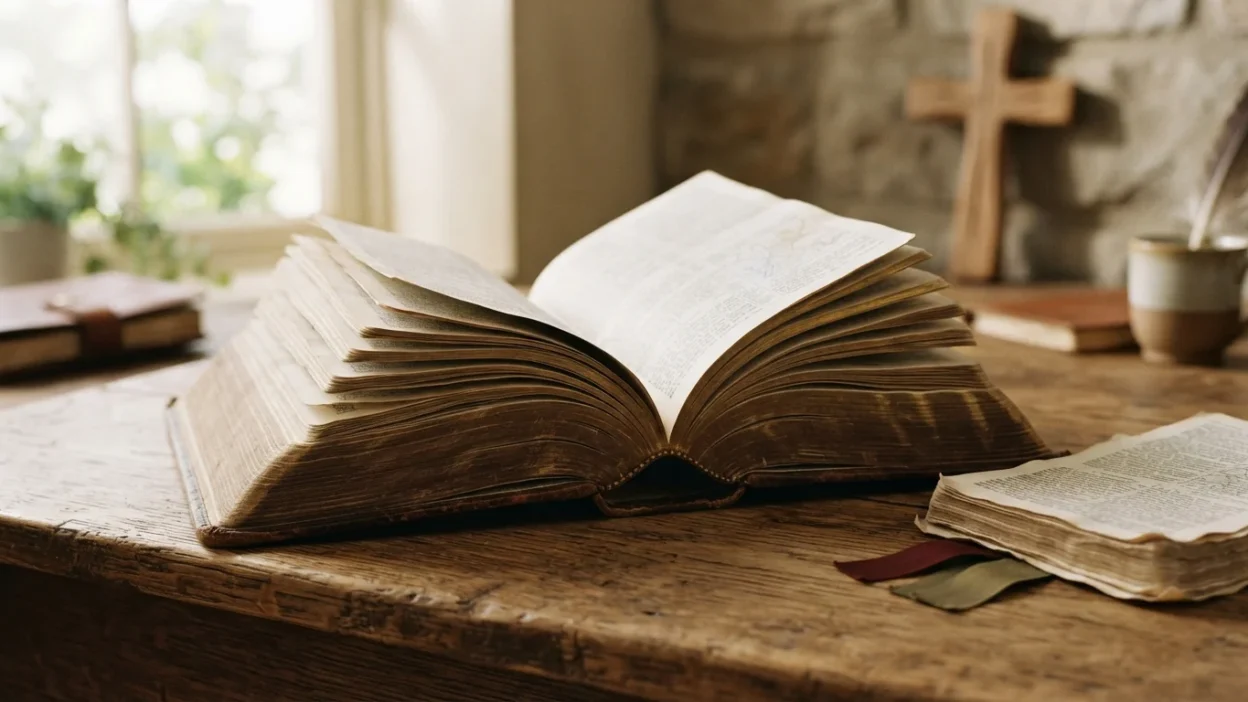
The question how many pages are in the Bible sounds simple, but there is no single page count that applies to every Bible. The number of pages can change depending on the translation, font size, page dimensions, study notes, illustrations, cross-references, and whether the Bible contains additional books. A compact Bible may have far fewer pages than a large study Bible even though both contain the same core biblical text.
Understanding how many pages are in the Bible can be helpful for anyone who is beginning to read Scripture, choosing a Bible for personal study, or wondering how long it might take to read the entire Bible. The Bible is a collection of many books written across different historical periods, and its physical length varies considerably from one edition to another. The number of pages therefore tells us more about the format of a particular Bible than about the actual size of Scripture itself.
Quick Answer
Most standard printed Bibles contain roughly 1,000 to 1,500 pages, but the exact number varies significantly by edition and format.
A compact Bible may have fewer pages, while a large-print or study Bible can contain well over 2,000 pages.
The Bible’s page count depends on translation, font size, paper size, notes, references, maps, and additional material.
How Many Pages Are in the Bible?
There is no universal page count for the Bible.
A standard personal Bible may contain around 1,000–1,500 pages. However, this is only a general estimate. Some compact editions may contain fewer than 1,000 pages, while large study Bibles can exceed 2,000 pages.
The actual biblical text also varies depending on the Christian tradition. Protestant Bibles generally contain 66 books, while Catholic Bibles include additional Old Testament books, and Orthodox traditions can contain even more.
Therefore, asking how many pages are in the Bible requires considering which edition and tradition is being discussed.
Why Does the Bible Have Different Page Counts?
Several factors influence the physical length of a Bible.
The most important factors include:
- Bible translation
- Font size
- Page dimensions
- Line spacing
- Paper thickness
- Study notes
- Cross-references
- Introductions
- Maps
- Charts
- Illustrations
- Book introductions
- Additional biblical books
For example, a Bible printed in very small type can fit substantially more words onto each page than a large-print Bible.
A study Bible can also be much longer because its pages contain extensive explanations and references in addition to the biblical text.
Bible Page Count by Common Format
The following table gives general estimates rather than exact counts.
| Bible Format | Approximate Page Range | Main Feature |
|---|---|---|
| Compact Bible | 700–1,100 | Small size and condensed printing |
| Standard Bible | 1,000–1,500 | General personal reading |
| Large-print Bible | 1,200–1,800+ | Easier-to-read text |
| Study Bible | 1,800–3,000+ | Notes, references, maps, and commentary |
| Children’s Bible | Varies greatly | Simplified text and illustrations |
| Journaling Bible | Varies greatly | Extra writing space |
These numbers are approximate because individual editions can differ substantially.
How Many Books Are in the Bible?
Another important factor is the number of books included.
Most Protestant Bibles contain 66 books: 39 in the Old Testament and 27 in the New Testament.
Catholic Bibles generally contain 73 books because they include additional books commonly called the Deuterocanonical books.
Some Orthodox Christian traditions recognize additional books beyond the Catholic canon.
This means that the physical Bible can differ depending on the Christian tradition in which it is published.
| Christian Tradition | Common Number of Books |
|---|---|
| Protestant | 66 |
| Catholic | 73 |
| Orthodox | Varies by tradition |
The difference in book count is one reason that asking how many pages are in the Bible without specifying a particular edition can produce different answers.
How Long Is the Bible Compared With Other Books?
The Bible is considerably longer than most individual modern books.
However, it is important to remember that the Bible is not one continuous book written by one author. It is a collection of many books containing history, poetry, prophecy, wisdom literature, letters, and other forms of writing.
This makes the Bible more like a library than a single conventional volume.
Its physical length can therefore seem intimidating to new readers. Yet readers do not have to approach it as though they must finish everything at once.
Reading a few chapters each day can make the entire Bible much more manageable.
Does Every Bible Have the Same Number of Pages?
No.
Even two Bibles using the same translation can have different page counts.
For example, one edition might use a small font and thin paper, while another might use large text, wider margins, thicker paper, and additional study material.
A Bible with extensive footnotes may also be hundreds of pages longer than a basic edition containing mostly the biblical text.
This is why page count should not be used as a measurement of the Bible’s spiritual or literary importance.
How Many Pages Are in the Bible Compared With Chapters?
The Bible contains 1,189 chapters in the standard Protestant 66-book arrangement.
There are 929 chapters in the Old Testament and 260 chapters in the New Testament.
However, chapters were added later as a way to make the biblical text easier to locate and reference. They were not part of the original manuscripts in their modern numbered form.
The number of pages and the number of chapters therefore measure different things.
One page might contain multiple short chapters, while a single long chapter can extend across several pages.
How Many Words Are in the Bible?
Word counts also vary by translation.
Different translations use different vocabulary, sentence structures, and approaches to translating the original Hebrew, Aramaic, and Greek texts.
A Bible’s word count can also change based on whether headings, footnotes, introductions, and other materials are included.
For this reason, there is no single word count that applies equally to every Bible.
This is another example of why physical Bible measurements depend on the edition being examined.
Spiritual Meaning of the Bible’s Length
The spiritual significance of the Bible is not determined by how many pages it contains.
A Bible with 800 pages is not spiritually less important than one with 2,000 pages. The physical size of a Bible does not determine the value of its message.
The Bible’s length can, however, symbolically remind readers that spiritual growth is a journey.
There are stories of faith, failure, forgiveness, obedience, suffering, hope, redemption, and restoration throughout Scripture. Reading the Bible slowly allows readers to reflect on these themes rather than simply trying to reach the final page.
The important question is not only how many pages someone can read but how deeply they engage with the message.
Why Do People Search How Many Pages Are in the Bible?
People search how many pages are in the Bible for many practical reasons.
Someone purchasing a Bible may want to know its approximate size before choosing an edition. A new Christian may wonder how difficult it will be to read the entire Bible. Students may also need to estimate the amount of reading involved in a Bible study plan.
Others may simply be curious about the physical size of Scripture.
Page count can be particularly useful when comparing compact Bibles, study Bibles, large-print editions, and digital versions.
How Long Does It Take to Read the Bible?
The time required to read the Bible depends on reading speed and daily commitment.
Someone reading around 15–20 minutes each day can make steady progress. A more intensive reading plan may involve 30 minutes or more per day.
Some people complete the Bible in one year, while others take several years because they prefer slow study and reflection.
A useful approach is to create a realistic reading schedule rather than focusing on speed.
For example:
| Daily Reading Habit | General Approach |
|---|---|
| 10 minutes | Slow, long-term reading |
| 15–20 minutes | Steady daily reading |
| 30 minutes | Faster reading plan |
| 45–60 minutes | Intensive study or reading |
| Longer sessions | Useful for focused study |
The goal does not have to be finishing quickly. Understanding and applying Scripture can be more important than reaching the final page as fast as possible.
Common Misconceptions About Bible Page Count
One misconception is that every Bible contains the same number of pages. As explained above, this is not true.
Another misconception is that a Bible with more pages necessarily contains more Scripture. A large study Bible may have thousands of pages because much of the additional material consists of notes, explanations, maps, charts, and references.
Some people also assume that digital Bibles have a fixed page count. Digital Bible applications often use scrolling rather than fixed pages, so their physical page count does not apply.
The Bible’s content should therefore be considered separately from its physical presentation.
Bible Page Count Comparison
Here is a simplified comparison showing why editions can differ:
| Bible Type | Approximate Size | Why It Differs |
|---|---|---|
| Compact Bible | Smaller | Condensed typography |
| Standard Bible | Medium | Balanced readability |
| Large-print Bible | Larger | Bigger font |
| Study Bible | Very large | Notes and study resources |
| Children’s Bible | Variable | Illustrations and simplified presentation |
| Digital Bible | No fixed pages | Screen-based format |
This comparison makes it easier to understand why there is no single answer to how many pages are in the Bible.
Does Bible Page Count Matter for Choosing a Bible?
Page count can matter, but it should not be the only factor.
If portability is important, a compact Bible may be convenient. If readability is the priority, a large-print Bible may be better.
Someone who wants detailed study resources may prefer a study Bible even though it is significantly larger.
When choosing a Bible, consider:
- Translation
- Readability
- Font size
- Physical size
- Binding quality
- Study notes
- Cross-references
- Maps
- Portability
- Personal reading goals
The best Bible is often the one that you can comfortably read and use consistently.
Final Thought
The answer to how many pages are in the Bible depends on the particular Bible edition. Most standard printed Bibles fall somewhere around 1,000 to 1,500 pages, while compact, large-print, and study editions can vary significantly. The number of books, translation, font size, paper, notes, maps, and additional resources all influence the final page count.
More importantly, the Bible should not be judged by its physical size. It is a collection of sacred writings that has shaped Christian faith, worship, history, literature, and culture for centuries. Whether your Bible has fewer than 1,000 pages or more than 2,000, the value of reading Scripture comes from engaging with its message. Instead of worrying about finishing quickly, choose a manageable reading plan and make consistent time for reflection and spiritual growth.
FAQs
How many pages are in the Bible?
Most standard printed Bibles contain approximately 1,000–1,500 pages, but the exact number varies by edition.
Does every Bible have the same number of pages?
No. Font size, translation, page dimensions, study notes, maps, and additional books can all change the page count.
How many books are in the Bible?
Most Protestant Bibles contain 66 books, while Catholic and Orthodox Bibles can contain additional books.
How many chapters are in the Bible?
The standard Protestant Bible contains 1,189 chapters: 929 in the Old Testament and 260 in the New Testament.
Can the Bible be read in one year?
Yes. Many reading plans divide the Bible into daily portions that allow readers to complete it in approximately one year.
Is a study Bible longer than a regular Bible?
Usually, yes. Study Bibles often contain extensive notes, explanations, cross-references, maps, charts, and introductions.
Does a Bible with more pages contain more Scripture?
Not necessarily. Extra pages may come from larger fonts, thicker paper, study notes, commentary, maps, or other supplementary material.

William Noah is a spiritual writer at BibLoft, exploring hidden meanings, symbols, and divine insights. He shares thoughtful interpretations that inspire self-awareness, inner growth, and spiritual understanding.