
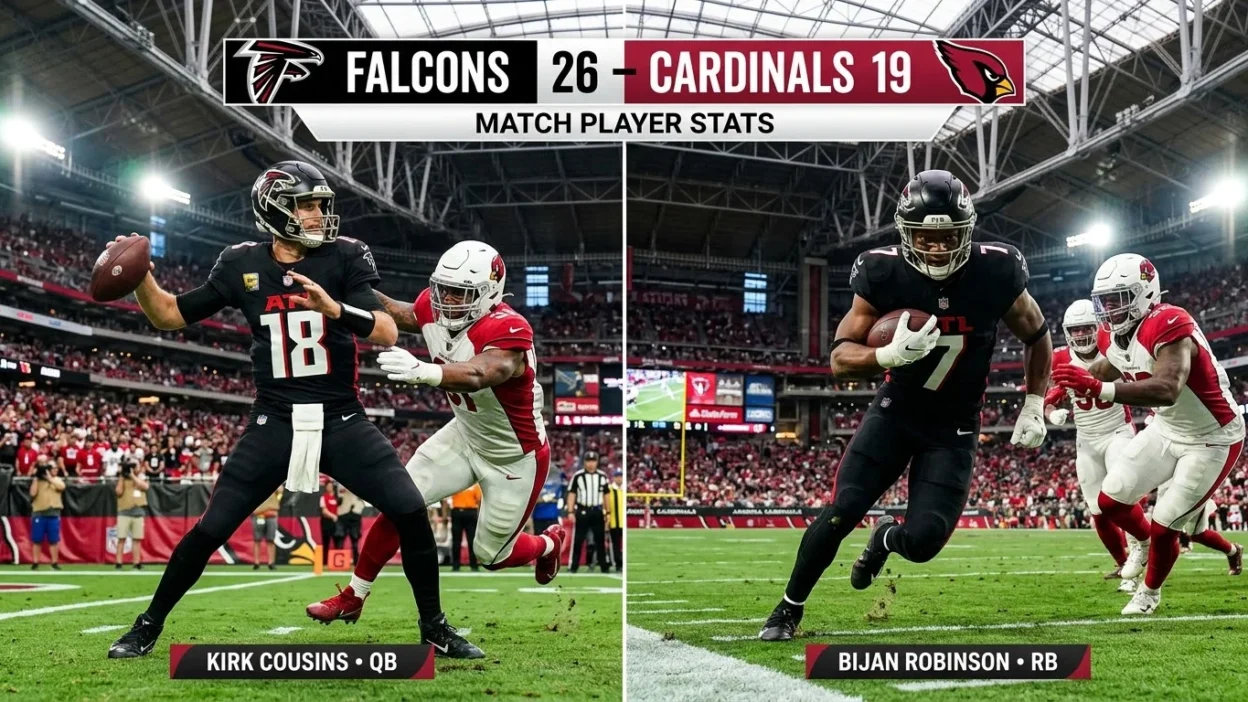
The Atlanta Falcons vs Arizona Cardinals match player stats from December 21, 2025, show how Atlanta secured a 26–19 victory over Arizona in Week 16 of the NFL regular season. The Falcons finished with 342 total yards, while the Cardinals recorded 320. Atlanta’s offense delivered important touchdowns through the air and on the ground, helping the team hold off Arizona’s late scoring attempt.
Kirk Cousins led the Falcons with 197 passing yards and two passing touchdowns, while Bijan Robinson contributed 168 yards from scrimmage and a touchdown. Kyle Pitts also caught a touchdown pass. For Arizona, quarterback Jacoby Brissett threw for 203 yards and one touchdown, while Michael Wilson caught a 32-yard touchdown pass. The Cardinals produced several strong offensive plays but could not overcome Atlanta’s scoring advantage. These player statistics explain the game’s leading performers, team differences, and decisive moments.
Quick Answer
The Atlanta Falcons defeated the Arizona Cardinals 26–19 on December 21, 2025, at State Farm Stadium. Kirk Cousins threw two touchdown passes and added a rushing touchdown. Bijan Robinson produced 168 total yards and one touchdown, while Kyle Pitts caught a touchdown pass. Jacoby Brissett threw for 203 yards and one touchdown for Arizona.
Why People Compare Falcons vs Cardinals Player Stats
Fans compare NFL player statistics to understand which athletes influenced the result and how each team performed. The final score shows who won, while passing, rushing, receiving, and defensive numbers explain how the game unfolded.
Atlanta’s balanced offense helped it control possession and score 26 points. Arizona gained yards through its passing game but struggled to turn enough drives into touchdowns. The Falcons also held the ball for more than 35 minutes, limiting Arizona’s opportunities.
First Team: Atlanta Falcons Player Stats
Atlanta finished with 26 points and 342 total yards. The Falcons used a combination of passing plays, rushing attempts, and short touchdown drives to secure the win.
Falcons Passing Stats
| Player | Completions/Attempts | Passing Yards | TD | INT |
|---|---|---|---|---|
| Kirk Cousins | 21/35 | 197 | 2 | 1 |
Cousins completed 21 passes from 35 attempts. He threw two touchdown passes and also scored on a one-yard rushing play in the fourth quarter.
Falcons Rushing Stats
| Player | Carries | Rushing Yards | Longest Run | Rushing TD |
|---|---|---|---|---|
| Tyler Allgeier | 16 | 79 | 12 | 0 |
| Bijan Robinson | 16 | 76 | 29 | 0 |
| Kirk Cousins | 5 | -3 | 2 | 1 |
Robinson added receiving production to his rushing total, giving him 168 yards from scrimmage. Allgeier also provided a useful ground-game contribution with 79 rushing yards.
Falcons Receiving Stats
| Player | Receptions | Receiving Yards | Longest Catch | Receiving TD |
|---|---|---|---|---|
| Bijan Robinson | 7 | 92 | 41 | 1 |
| Kyle Pitts | 7 | 57 | 12 | 1 |
| Drake London | 3 | 27 | 12 | 0 |
| Darnell Mooney | 2 | 24 | 17 | 0 |
| Charlie Woerner | 1 | 3 | 3 | 0 |
| Tyler Allgeier | 1 | -6 | -6 | 0 |
Atlanta’s Top Performers
Bijan Robinson: Robinson was Atlanta’s most productive all-around offensive player. He rushed for 76 yards, caught seven passes for 92 yards, and scored a receiving touchdown. His 168 total yards made him a major factor in the victory.
Kirk Cousins: Cousins threw for 197 yards and two touchdowns, connecting with Robinson and Pitts for scores. He also ran for a one-yard touchdown, giving him three total touchdowns.
Kyle Pitts: Pitts caught seven passes for 57 yards and a touchdown. His score helped Atlanta stay close during the first half and contributed to the team’s offensive balance.
Tyler Allgeier: Allgeier rushed 16 times for 79 yards. His work helped Atlanta maintain a productive ground attack and control the pace of the game.
Second Team: Arizona Cardinals Player Stats
Arizona scored 19 points and recorded 320 total yards. The Cardinals moved the ball through the air and found the end zone with two passing touchdowns, but they could not complete the comeback.
Cardinals Passing Stats
| Player | Completions/Attempts | Passing Yards | TD | INT |
|---|---|---|---|---|
| Jacoby Brissett | 16/31 | 203 | 1 | 1 |
Brissett completed 16 of 31 attempts for 203 yards. He threw one touchdown pass and one interception.
Cardinals Rushing Stats
| Player | Carries | Rushing Yards | Longest Run | Rushing TD |
|---|---|---|---|---|
| Michael Carter | 11 | 65 | 22 | 0 |
| Corey Kiner | 6 | 32 | 9 | 0 |
| Emari Demercado | 5 | 30 | 12 | 0 |
| Jacoby Brissett | 1 | 5 | 5 | 0 |
Michael Carter led Arizona’s rushing attack with 65 yards on 11 carries. The Cardinals averaged 5.7 yards per rushing attempt as a team, but their ground production did not lead to a rushing touchdown.
Cardinals Receiving Stats
| Player | Receptions | Receiving Yards | Longest Catch | Receiving TD |
|---|---|---|---|---|
| Elijah Higgins | 7 | 91 | 25 | 0 |
| Michael Wilson | 2 | 52 | 32 | 1 |
| Trey McBride | 4 | 27 | 10 | 0 |
| Xavier Weaver | 2 | 19 | 13 | 0 |
| Marvin Harrison Jr. | 1 | 14 | 14 | 0 |
Arizona’s Top Performers
Jacoby Brissett: Brissett threw for 203 yards and one touchdown. Although he moved the ball through the air, Arizona needed more scoring drives to overcome Atlanta’s lead.
Elijah Higgins: Higgins led the Cardinals in receiving yards with 91 on seven catches. He provided an important target in Arizona’s passing game.
Michael Wilson: Wilson caught two passes for 52 yards, including a 32-yard touchdown reception. His score gave Arizona an early advantage.
Michael Carter: Carter rushed for 65 yards and led the Cardinals’ running backs. His performance helped Arizona maintain a respectable rushing average.
Falcons vs Cardinals Match Stats Comparison
| Team Statistic | Atlanta Falcons | Arizona Cardinals |
|---|---|---|
| Final score | 26 | 19 |
| Total yards | 342 | 320 |
| Passing yards | 197 | 203 |
| Rushing yards | 152 | 132 |
| Total plays | 73 | 56 |
| Time of possession | 35:34 | 24:26 |
| Turnovers | 2 | 1 |
| Penalties | 4 | 5 |
| Penalty yards | 20 | 14 |
Atlanta had 22 more total yards than Arizona and held the ball for more than 11 additional minutes. The Cardinals recorded slightly more passing yards, but Atlanta’s balanced offense and longer possession time helped it maintain the lead.
When to Focus on Passing, Rushing, or Receiving Stats
Passing statistics show how effectively a quarterback distributes the ball. Completions, attempts, passing yards, touchdowns, and interceptions help explain his performance.
Rushing statistics measure ground production. Carries, rushing yards, and yards per attempt reveal how well a team advances the ball without passing.
Receiving statistics show which players caught passes and created yards. Receptions, receiving yards, and touchdowns help identify the most productive targets.
In this matchup, Robinson’s combined rushing and receiving contribution stands out, while Cousins’ passing touchdowns and rushing score show how Atlanta used multiple ways to reach the end zone.
How the Falcons vs Cardinals Game Was Decided
Arizona started strongly, with Michael Wilson catching a 32-yard touchdown pass from Brissett. The Cardinals also added field goals, but Atlanta answered with touchdowns of its own.
Cousins connected with Robinson for a 13-yard touchdown and later found Pitts for a five-yard score. Atlanta and Arizona traded points during the first half, leaving the game close at halftime.
The Falcons added a field goal in the third quarter. In the fourth, Cousins scored on a one-yard run, extending Atlanta’s lead to 26–16. Arizona added a late field goal, but it was not enough to change the result.
Atlanta’s ability to produce touchdowns through passing and rushing proved decisive.
Common Mistakes When Reading NFL Player Stats
- Confusing passing yards with total yards: Passing yards measure a quarterback’s passing production, while total offensive yards include both passing and rushing.
- Mixing up receptions and receiving yards: Receptions count catches; receiving yards measure the distance gained on those catches.
- Ignoring interceptions: A quarterback can gain passing yards but still hurt his team with turnovers.
- Looking only at rushing touchdowns: A running back can have a major impact through receiving, too.
- Assuming more passing yards means a win: Arizona recorded more passing yards than Atlanta but still lost the game.
Memory Trick for NFL Box Scores
Remember CMP–YDS–TD–INT when reading quarterback statistics:
- CMP: Completed passes.
- YDS: Yards gained.
- TD: Touchdowns.
- INT: Interceptions thrown.
For running backs, focus on ATT–YDS–TD: carries, rushing yards, and rushing touchdowns. For receivers, use REC–YDS–TD: receptions, receiving yards, and receiving touchdowns.
American vs British English in Football
The Falcons and Cardinals play American football, which uses different terminology from association football, commonly called soccer in the United States.
| American football term | Meaning |
|---|---|
| Quarterback | Player who leads the passing offense |
| Touchdown | A scoring play worth six points before any extra point |
| Rushing | Advancing the ball by running |
| Receiving | Catching a forward pass |
| Interception | A defensive player catches a pass intended for the offense |
| Field goal | A kick through the goalposts worth three points |
In American English, the word football usually refers to the NFL-style sport. In British English, football usually refers to soccer.
Similar NFL Statistics Worth Following
Fans who want a fuller picture of a player’s performance can also track:
- Completion percentage: The percentage of passes completed.
- Yards per attempt: Passing yards divided by pass attempts.
- Yards per carry: Rushing yards divided by rushing attempts.
- Yards after catch: Receiving yards gained after a completed catch.
- Sacks: Times a quarterback is tackled behind the line of scrimmage while attempting to pass.
- Turnover margin: The difference between turnovers gained and turnovers lost.
These statistics help explain a player’s efficiency and the ways a team creates or prevents scoring opportunities.
Final Verdict
The Atlanta Falcons defeated the Arizona Cardinals 26–19 on December 21, 2025. Kirk Cousins threw two touchdown passes and scored a rushing touchdown, while Bijan Robinson contributed 168 yards from scrimmage and a receiving score. Kyle Pitts also caught a touchdown pass. For Arizona, Jacoby Brissett passed for 203 yards, and Michael Wilson recorded a 32-yard touchdown reception. Atlanta’s longer possession time and balanced offensive production helped it protect the lead despite Arizona’s late points.
FAQs
1. Who won the Falcons vs Cardinals game on December 21, 2025?
The Atlanta Falcons defeated the Arizona Cardinals 26–19.
2. How many passing yards did Kirk Cousins record?
Cousins threw for 197 yards, with two passing touchdowns and one interception.
3. How many total yards did Bijan Robinson produce?
Robinson recorded 168 total yards, including 76 rushing yards and 92 receiving yards.
4. How many passing yards did Jacoby Brissett have?
Brissett threw for 203 yards, one touchdown, and one interception.
5. Who led the Cardinals in receiving yards?
Elijah Higgins led Arizona with 91 receiving yards on seven catches.
6. How many total yards did each team record?
Atlanta recorded 342 total yards, while Arizona finished with 320.
7. Why did the Falcons win?
Atlanta combined passing and rushing touchdowns, produced more total yards, and controlled possession for longer than Arizona.
Remember This
The Falcons beat the Cardinals 26–19 on December 21, 2025. Kirk Cousins accounted for three touchdowns, Bijan Robinson produced 168 total yards, and Kyle Pitts caught a touchdown. Arizona’s Jacoby Brissett threw for 203 yards, but the Cardinals could not complete the comeback.
Conclusion
The Falcons vs Cardinals match player stats show that Atlanta’s balanced offense was the key to its 26–19 victory. Cousins contributed through the air and on the ground, while Robinson made a major impact as both a runner and receiver.
Arizona had productive performances from Brissett, Higgins, and Wilson, but the team could not turn enough possessions into touchdowns. The final score reflected Atlanta’s ability to combine offensive production with effective game management.